Spoiler note: this essay discusses the hearing-aid torture, McClure's death, and the airport finale in The Big Combo.
Joseph H. Lewis's The Big Combo is usually praised as a textbook film noir, which is true but incomplete.[1][2][3] The phrase can make the movie sound like a well-preserved cabinet of familiar ingredients: a gangster kingpin, an obsessed cop, a compromised woman, John Alton shadows, and a final showdown in fog. What keeps the film alive is something more exact. Lewis turns power into a sensory regime. People in this movie do not merely threaten one another with guns or legal authority. They seize the eye, invade the ear, stage themselves in light, and use humiliation as a way of fixing rank. That is why the movie feels so extreme even when the plot wanders. Its real subject is command.
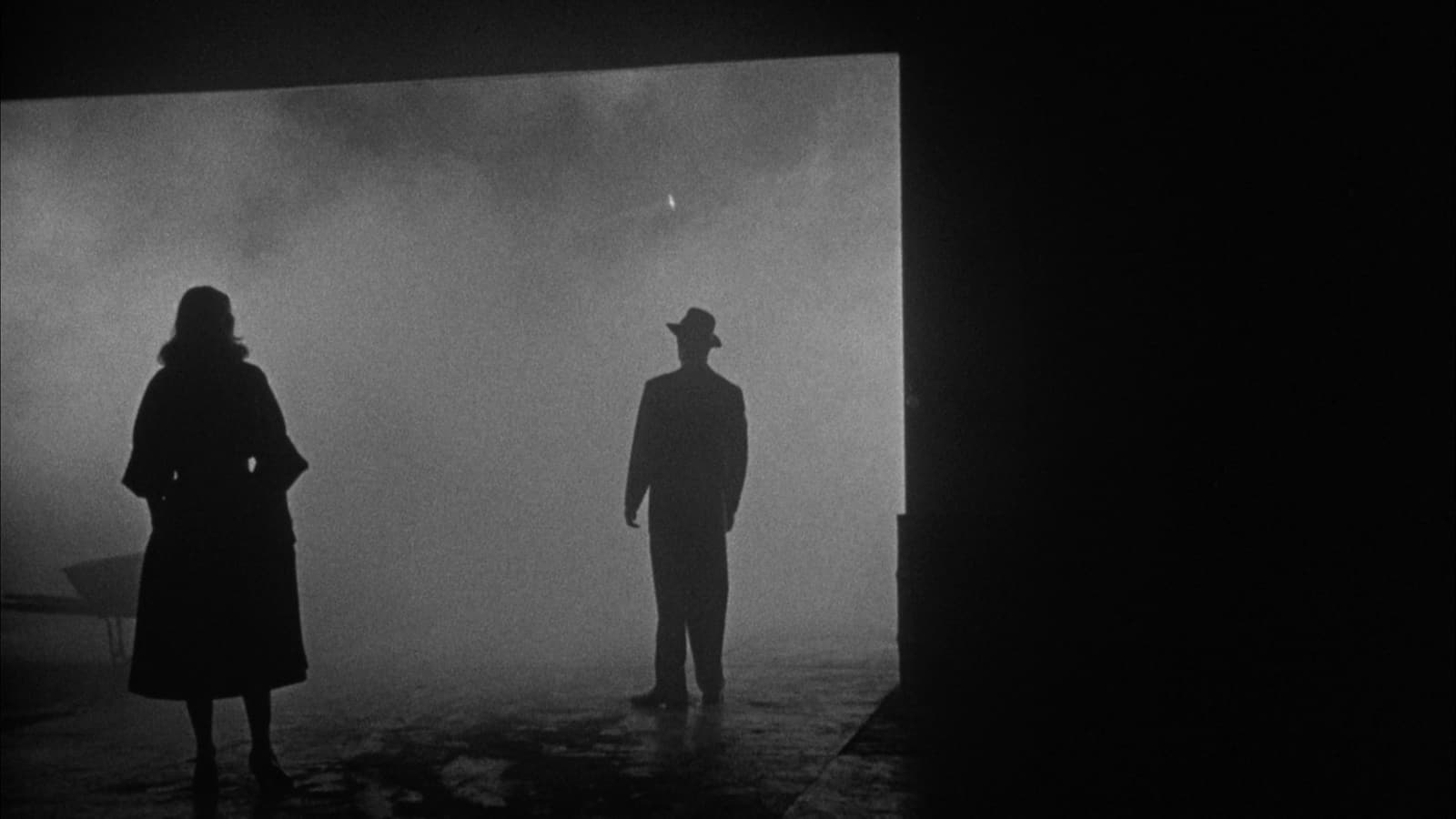
Image context: the lead image uses the trailer silhouette from Wikimedia Commons rather than a poster. That choice matters for this article because the film's most memorable visual logic is not graphic design or star portraiture. It is the way bodies become black cutouts in glare, smoke, and fog until desire itself starts to look like a lighting setup.[6]
Mr. Brown treats power as an erotic performance
Richard Conte's Mr. Brown is frightening because he never behaves like a businessman who happens to commit crimes.[1][3][4] He behaves like a man who experiences hierarchy as seduction. Senses of Cinema gets to the heart of this when it describes the film as a world of sexual obsession in which money, violence, and authority keep crossing into one another.[3] Brown states his creed with absurd clarity, "First is first and second is nobody," and the line matters because it defines the whole movie's emotional climate.[3] He does not simply want to win. He wants everyone around him to occupy an inferior position and to feel it.
That is why Leonard Diamond's pursuit never reads as clean heroism.[1][3][5] Diamond is a police lieutenant, yet his relation to Brown is already intimate with the same structure of fixation.[1][5] MoMA's note describes the story as a detective's obsession with bringing down a gangster, and "obsession" is the right word because the chase quickly exceeds procedure.[5] Diamond watches Brown's mistress Susan Lowell with a fervor that is investigative on the surface and competitive underneath. Brown wants possession; Diamond wants exposure; both men are locked into a contest about who gets to define Susan's reality and who gets to name the terms of submission.
The supporting relationships reinforce that field of command.[3][5] MoMA explicitly notes the homosexual subtext in the Fante-Mingo pairing, while Senses of Cinema treats the film's entire architecture as one in which desire is inseparable from domination.[3][5] Lewis does not present sexuality as a side current next to the crime plot. He lets it saturate the plot's basic movements. Orders, interrogations, stalking, and protection all carry a charge that keeps slipping toward possession.
John Alton's lighting makes hierarchy visible before the dialogue does
The movie's black-and-white look is often admired in a general way, but its precision is worth naming.[2][3][4] TCM calls attention to Alton's chiaroscuro effects as a way of expressing the characters' psychological states, and that description is exact because the lighting never behaves like neutral atmosphere.[2] It assigns status. It isolates. It flattens people into targets or silhouettes. The opening pursuit of Susan by Fante and Mingo already has, as TCM notes, an exaggerated, almost hallucinatory theatricality.[2] Before the story has properly settled, Lewis has already told us that this world will be staged as pressure.
AFI's catalog synopsis quietly points to one of the film's best recurring motifs when it notes Brown brooding over the name Alicia and writing it on fogged windows.[4] That detail matters because The Big Combo keeps treating visibility as unstable matter. Names cloud glass. Faces emerge from darkness late. Bodies half-disappear into smoke. The gangster's empire is supposed to be an organized system, yet Lewis films it as if its authority depended on unstable surfaces that can blur, reflect, or thicken without warning.
This is why the movie's famous airport climax feels prepared from the first reel.[2][3] The final fog does not arrive as an isolated flourish. It is the grand terminal form of a logic already present in the interiors. Alton has been training the viewer to read contrast as rank, obscurity as danger, and whiteness not as clarity but as a field in which outlines can be erased.
The hearing aid scenes turn noir into a struggle over who controls sound
The film's boldest technical move may be its treatment of hearing.[1][2][4] AFI's synopsis and TCM's database both preserve the notorious torture scene in which Diamond is overpowered, a hearing aid is forced into his ear, and a blaring radio is used as a weapon.[1][4] That scene is brutal partly because it literalizes what the whole movie has been doing symbolically. Power here enters through the ear. Authority is not only a matter of who speaks. It is a matter of who can make another person receive sound at an unbearable volume.
TCM's essay sharpens the point by noting that Lewis's use of sound is innovative throughout, whether through oppressive music or through the strategic withdrawal of sound altogether.[2] The example it singles out is McClure's death: once his hearing aid is removed, the viewer experiences the gunfire in silence from his deaf perspective.[2] This is one of the great technical shocks in 1950s noir. The film does not merely show violence. It changes the sensory contract under which violence is perceived. Suddenly the usual expressive noise of a shoot-out disappears, and death becomes a mute visual event inside a man-made void.
That silence is more revealing than a loud climax would have been.[2][3] Brown's world is full of claims, commands, and swaggering speech. Yet when one of his own men dies, Lewis strips the scene to helpless image. The result exposes how fragile the gangster's control really is. All the rhetoric of mastery gives way to one body unable to hear the force destroying it. In a film this concerned with humiliation, silence becomes the ultimate degradation.
The airport fog strips noir down to pure pressure
Senses of Cinema identifies the final confrontation as a fog-bound airplane hangar showdown whose outcome turns on Susan Lowell.[3] That formulation matters because the ending is often remembered mainly for its image: men with guns reduced to silhouettes in white vapor. The image is extraordinary, but its force comes from what the movie has done to earn it. By the time Diamond and Brown arrive there, the story has emptied police procedure and gangster glamour into something more skeletal. What remains is outline, movement, and the question of whose command still carries force when faces can barely be seen.
The airport sequence is therefore morally interesting in a very hard way.[2][3][5] Fog usually suggests confusion, but here it also produces abstraction. Brown and Diamond start to resemble each other more than they would like. One is the law, one is organized crime, yet both have spent the film pursuing the same woman through the same grammar of fixation. When the frame turns them into dark cutouts, Lewis is not saying the two men are identical in every respect. He is saying that the struggle has burned away most of the comforting detail each institution uses to justify itself.
That is why The Big Combo lasts.[1][2][3][5] It is not merely a stylish crime picture with one legendary fog shot at the end. It is a movie that steadily translates lust, rank, and coercion into concrete film form: black-and-white pressure, deafened bodies, invasive music, and silhouettes that look more elemental than human. The hearing aid, the silent death, and the airport fog all belong to one design. Lewis takes noir's usual contest of cops and gangsters and turns it into a study of how command feels when it reaches the senses before it reaches the mind.
Sources
- Turner Classic Movies, "The Big Combo (1955)" TCMDB film page with synopsis, credits, release data, and production notes.
- Jeff Stafford, "The Big Combo," Turner Classic Movies.
- Fran Mason, "First is First and Second is Nobody: Hoodlums and Heroines in Joseph H. Lewis' The Big Combo," Senses of Cinema.
- AFI Catalog, "The Big Combo (1955)".
- MoMA, "The Big Combo. 1955. Directed by Joseph H. Lewis."
- Wikimedia Commons, "File:BigComboTrailer.jpg".