Douglas Sirk is still too often introduced as the king of glossy 1950s melodrama, which is accurate and also evasive.[1][2] The gloss is there: lacquered stair rails, polished windows, autumn leaves that look almost overripe, dresses that seem lit from inside, rooms so tastefully arranged they begin to feel accusatory. But the real Sirk achievement is what he does with that beauty. He turns decor into social pressure. His films do not treat color, mirrors, upholstery, or weather as ornament added after the fact. They make those surfaces carry the argument.[1][2][6]
That is why Sirk keeps returning whenever critics and filmmakers want to explain how melodrama can think. BFI's overview of his work places him at the center of a run of films that look luxurious while cutting hard into conformity, loneliness, class hierarchy, and the policing of desire.[1] Criterion's retrospective note moves across the same terrain from another angle: the career stretches from German work to Hollywood weepers, yet the through-line is already visible in the way emotional excess becomes a method for exposing social arrangements that claim to be orderly.[6] What makes Sirk enduring is not that he elevated "women's pictures" by adding seriousness from outside. He showed that the genre already contained brutal knowledge about how people are watched, sorted, and trapped.[1][2][6]
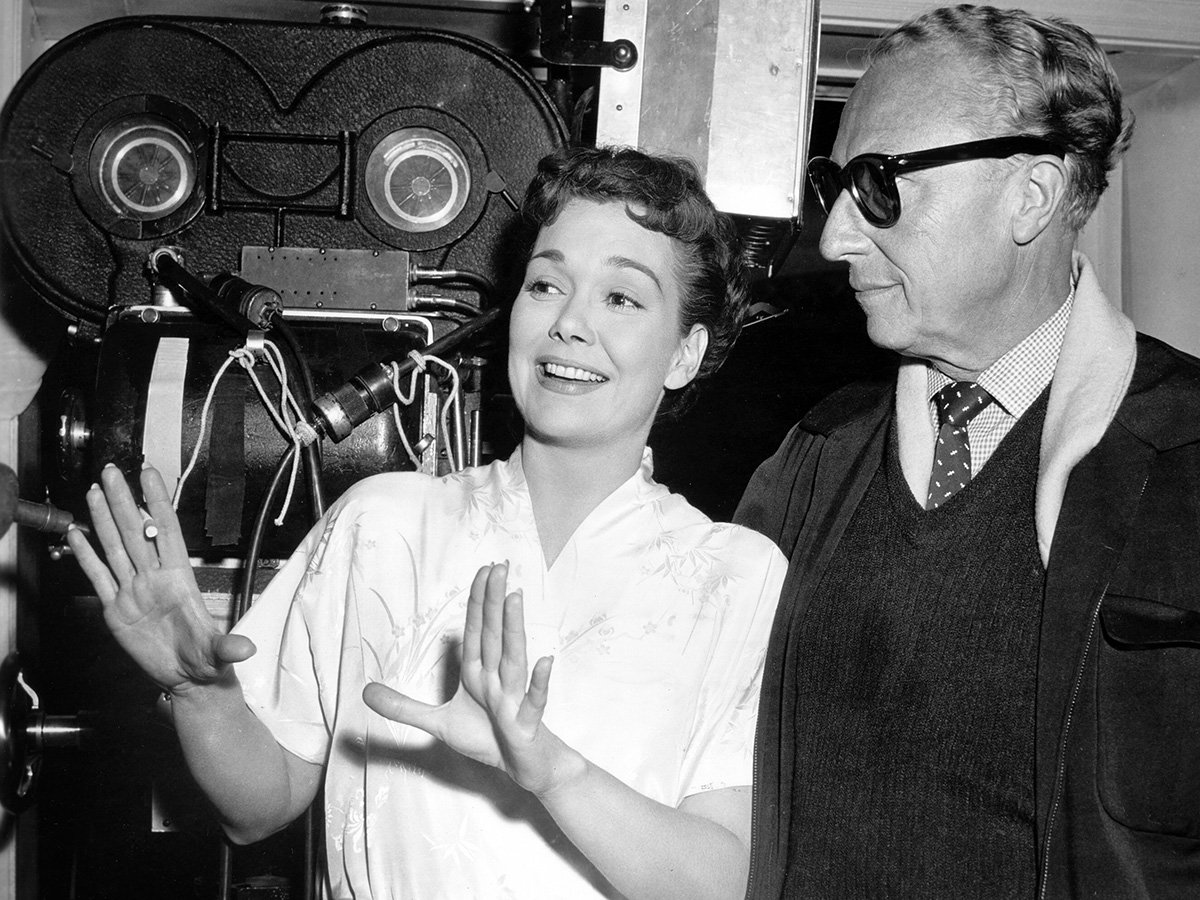
Image context: the lead image is a real 1955 production photo of Jane Wyman with Sirk on the set of All That Heaven Allows. It belongs here because a director profile needs more than a generic portrait. This photograph places Sirk inside the kind of space his cinema made unforgettable: a room disciplined by furniture, framing, and social expectation, with emotional weather already gathering in the arrangement of bodies.[7]
An emigre director who made melodrama into diagnosis
Tom Ryan's Senses of Cinema essay is useful because it keeps Sirk's reputation tied to irony rather than mere lushness.[2] Before Hollywood turned him into the major stylist of late studio melodrama, he had already moved through German theater and film, carrying with him a sharp sense that public order and private feeling rarely line up cleanly.[2] That tension matters because Sirk does not film emotion as something pure that society later interrupts. Society is already inside the emotion. Class, reputation, family discipline, money, and moral display are there from the first shot.
This is why his best films feel so exact about the violence of respectable environments.[1][2] Sirk's rooms are rarely chaotic. They are too composed. The danger comes from how well they function as machines for embarrassment and self-surveillance. A window reflects a face back at itself. A staircase turns descent into spectacle. A country club, a suburban living room, or an oil family's mansion provides comfort and humiliation in the same gesture. Sirk's visual intelligence lies in making these spaces gorgeous enough that the viewer first wants to live in them and then slowly understands the bill.[1][2]
In All That Heaven Allows, decor becomes discipline
Criterion's film page calls All That Heaven Allows a profoundly felt film about class and conformity in small-town America, and that description gets close to Sirk's method because conformity in this movie is never abstract.[3] Cary Scott's romance with her younger gardener Ron Kirby is opposed through drawing rooms, dinner tables, windows, gossip circuits, and the quiet menace of "good taste."[3] The whole town seems to look at her through domestic objects. Her children do not merely disagree with her choices; they present modern comfort itself as a substitute for adult life.
Sirk makes that coercion visible by refusing to separate emotional pain from interior design.[1][3] The famous television set is not just a satirical prop. It is the endpoint of a whole social logic: if desire threatens the town's idea of propriety, then the widow can be given a machine, a managed routine, and a picture of acceptable solitude. Mirrors and windowpanes matter for the same reason. They keep returning Cary to herself as an image already judged, already framed by others before she has spoken.[3] Beauty in Sirk is never neutral. It is the polished surface through which a community disciplines the people inside it.
This is where Sirk's melodrama differs from simple camp appreciation.[2][3] He understands spectacle, but he also makes spectacle analytic. The autumn colors and glowing interiors in All That Heaven Allows do not soften the cruelty. They make the cruelty legible by embedding it in supposedly civilized surroundings. Respectability looks warm, then starts to suffocate.
In Written on the Wind, color and excess stop feeling luxurious and start feeling rotten
MoMA's note on Written on the Wind calls it among Sirk's most Sirkian films, full of pent-up emotion, unsentimental passion, and smoldering looks.[4] That description helps because the movie is not simply "about" a rich Texas oil family in decline. It is about a whole moral world losing composure while insisting on its own glamour.[4] Robert Stack's Kyle Hadley, Dorothy Malone's Marylee, Lauren Bacall's Lucy, and Rock Hudson's Mitch move through a universe of money, planes, glass, alcohol, and oversized interiors that look abundant at first glance and diseased a second later.[4]
Sirk's genius here is to turn excess into structure.[2][4] The bright colors do not announce vitality; they announce imbalance. The mansion's scale does not signify security; it broadcasts emotional vacancy. Marylee's famous movements through the house do not simply register hysteria in a sensational key. They show a person acting out inside an environment already built to reward appetite and punish steadiness. Sirk films wealth as a form of bad weather. It gathers around the characters and strips them of proportion.
That is why Written on the Wind matters so much to Sirk's profile.[4][6] It proves that his melodramas were never just tasteful critiques of suburban hypocrisy. He could also push toward vulgarity, fever, and near-operatic collapse without losing control. The point was never moderation. The point was to show that surfaces prized by American success culture could become engines of psychic disarray.
In Imitation of Life, the mirror widens from gender and class to race and performance
BFI's page on Imitation of Life describes the film as a mirror held up to the hypocrisies of 1950s America through two mothers and two daughters across class and racial divides.[5] That summary matters because it marks the scale of Sirk's last major Hollywood masterpiece. The film does not stay inside a single romantic taboo or one family arrangement. It expands the melodramatic frame outward until performance itself becomes the subject: maternal performance, social performance, stardom, passing, service, and the terrible labor of making oneself visible under unequal terms.[5]
Sirk's visual system becomes even harsher in this setting.[2][5] Lana Turner's theatrical whiteness and public ambition belong to one kind of spectacle. Juanita Moore's Annie moves through another register altogether, one built from devotion, work, grief, and emotional knowledge the society around her keeps exploiting.[5] Sarah Jane's attempt to pass is not presented as a twist inserted into an otherwise comfortable story. It is the film's clearest revelation that visibility itself is unequally priced. To be seen correctly, to be loved, to be legible, to be safe: these are not distributed evenly, and Sirk builds the movie so every domestic scene keeps colliding with that fact.[5]
This is where the charge that Sirk is "too beautiful" becomes especially weak.[2][5] The beauty is the trap. Imitation of Life understands that American culture can aestheticize suffering and still refuse justice. Sirk does not stand outside that contradiction and lecture on it. He stages it until the polished image begins to indict the culture that produced it.
Why Sirk's afterlife keeps growing
BFI's introduction to Sirk and Criterion's retrospective note both point toward the same reason later directors kept returning to him: he made melodrama structurally intelligent without draining it of feeling.[1][6] Rainer Werner Fassbinder, Todd Haynes, and many others did not borrow from Sirk because his films were merely pretty or quotable. They borrowed from him because he found a way to make mise-en-scene reveal how a society organizes shame, desire, race, class, and aspiration before any character can explain those forces in words.[1][6]
That is why Sirk still feels contemporary in 2026.[1][2][6] He knew that domination often arrives through pleasant things: furniture, etiquette, gifts, family concern, a company office, a television, a mansion staircase, a performance of care. His movies remain devastating because they never confuse civility with kindness or comfort with freedom. They look at beautiful rooms and ask what kind of obedience those rooms are demanding.
Seen from that angle, Sirk's cinema is not a guilty pleasure and not an exercise in retro taste. It is a master class in how style becomes argument. Mirrors split the self. Color thickens the air. Social weather enters the frame before anyone names it. By the time a Sirk character finally speaks the truth of a situation, the room has usually said it already.[1][2][3][5]
Sources
- BFI, "Where to begin with Douglas Sirk."
- Tom Ryan, "Sirk, Douglas," Senses of Cinema.
- The Criterion Collection, "All That Heaven Allows (1955)" - film page.
- MoMA, "Written on the Wind. 1956. Directed by Douglas Sirk."
- BFI, "Imitation of Life (1959)" - film page.
- The Criterion Collection, "Home for the Holidays with Douglas Sirk."
- Wikimedia Commons, "File:All That Heaven Allows 1955 set photo (Wyman & Sirk).jpg."