
The original Citizen Kane trailer is strange in exactly the right way.[1] It does not behave like a dutiful plot preview, and it does not rush to sell the film by laying out the mystery of Rosebud, the rise and fall of a newspaper empire, or the usual dramatic beats of a prestige release.[1][2][3] Instead it opens in darkness, drops a beam of light onto a hanging microphone, and starts sounding less like ordinary Hollywood promotion than like an act of staged self-introduction.[1] Before the trailer tells us who Charles Foster Kane is, it tells us that an apparatus is about to speak.
That choice matters because Citizen Kane arrived as a special kind of debut. BFI still frames the film as the enduring first feature by Orson Welles that dominated Sight and Sound's greatest-films poll for decades, while Britannica's account of Welles at RKO stresses that the film drew heavily on Mercury Theatre collaborators rather than standard studio-star packaging.[2][4] The trailer understands that background and turns it into form. It does not pretend this is just one more story rolled down the assembly line. It sells a troupe, a voice, a production machine, and only then a title.
That is what makes the preview worth watching on its own. In just under four minutes, it turns publicity into a miniature lesson in how the film works.[1][2][3][4] Instead of offering one stable portrait of Kane, it gives us equipment, rehearsal-like space, performer introductions, disembodied voices, and a title that arrives only after a long delay.[1] The movie itself is built from testimony, reputation, and partial access; the trailer copies that logic by withholding direct mastery over its subject. It advertises the film by making incompleteness feel glamorous.
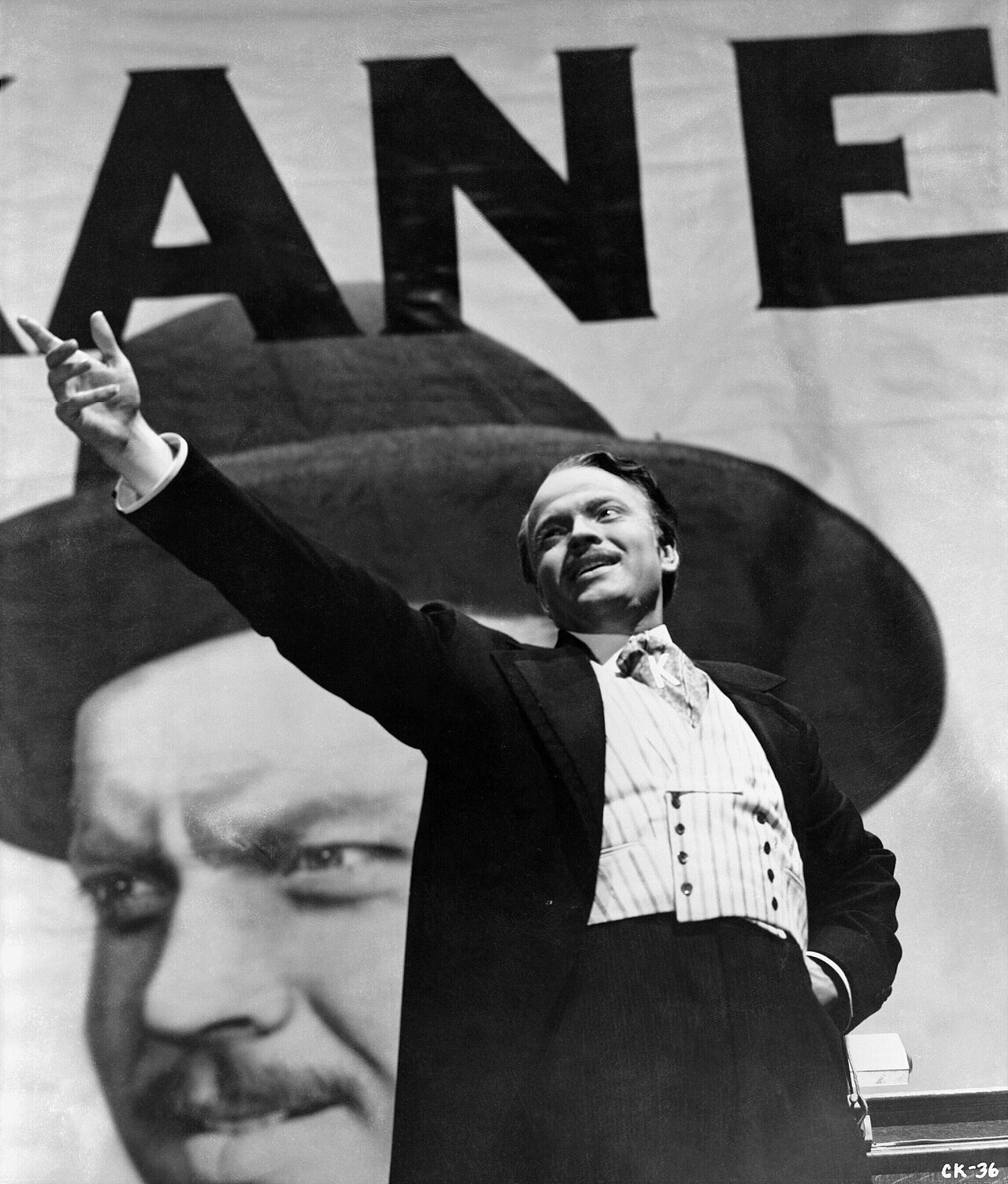
Image context: the lead image uses a black-and-white publicity still from Wikimedia Commons showing Orson Welles in front of a giant KANE campaign poster. It fits the article because the trailer repeatedly treats Kane as something produced for mass circulation rather than simply revealed as a person.[5]
At 0:00, the microphone makes the trailer feel like a performance booth before it feels like a movie ad
The opening image is almost absurdly simple: black screen, harsh spotlight, suspended microphone.[1] Yet that simplicity carries the whole argument. The trailer does not start with Kane's mansion, his newspaper, or a face turned toward the camera. It starts with hardware. The microphone hangs there like a piece of public infrastructure, a reminder that Welles arrived in film with radio authority already attached to his name.[1][4] Even without saying so explicitly, the trailer frames Citizen Kane as a production that wants the audience to hear the machinery of announcement.
That is a sharper move than ordinary mystery advertising. Most trailers begin by translating a film into accessible story terms. This one begins by emphasizing transmission itself.[1] The beam of light and the hanging mic make the frame feel half theatrical and half industrial, as if the audience has wandered onto a soundstage a second before the house voice begins. For a film that would become famous for turning biography into layers of mediated memory, the choice feels exact.[2][3] Kane will not be offered to us as a natural, self-present man. He will arrive through platforms, voices, witnesses, and systems that claim to explain him.
Around 0:40, the trailer sells a repertory company instead of a clean synopsis
Once the preview begins moving through performers, sets, and backstage corridors, it becomes clear that the real sales pitch is not simply "here is a great man with a scandalous life."[1] The trailer keeps parading faces, names, and fragments of atmosphere rather than settling into linear explanation. Britannica's account of Welles at RKO is useful here because it notes how heavily the production depended on Mercury actors, including Joseph Cotten, Agnes Moorehead, Ray Collins, and Everett Sloane.[4] The trailer turns that ensemble fact into an event. Rather than isolate one conventional romantic pair or one villain, it presents a collective entering the frame under Welles's organizing gravity.
This is why the backstage quality of the imagery matters. Lights, cables, studio walls, and transitional spaces keep intruding into the ad's visual texture.[1] The result is not polished invisibility. The result is a half-deliberate display of filmmaking as labor and coordination. That fits Citizen Kane unusually well. The film is often remembered for singular genius, but the trailer keeps nudging the viewer toward a troupe model, a sense that the movie's authority comes from a whole machine of voices and performances assembled around one central act of direction.[1][4]
Around 1:30, the trailer withholds Kane himself and turns ignorance into the hook
The smartest thing the preview does is refuse easy possession of its title character.[1] Kane is everywhere in language and implication, yet the trailer does not simply plant him in front of us and say: here is the man, here is the plot, now buy a ticket. It keeps substituting approaches for access. We get declarations, walk-ons, hints of social scale, suggestive fragments of rooms and power, and the steady sense that an introduction is being prepared but not completed.[1][2][3]
That withholding mirrors the movie's deeper design. The Library of Congress essay on the film emphasizes the way Kane's life is reconstructed through multiple sources and memories rather than through a single secure point of view, and even the Library's item page summary describes a reporter assigned to discover the meaning of a dead man's last word by piecing together testimony after the fact.[3][6] The trailer is doing a lighter, more playful version of that same thing. It advertises the film by refusing to collapse the man into one marketable essence. Publicity becomes a puzzle engine.
This is also where the film's Hearst-shadowed public reputation becomes useful without dominating the piece.[4] You can feel the trailer deciding that biography alone is too flat a way to sell the movie. Kane is a publisher, a celebrity, a political image, a scandal object, a recluse, a myth. The ad chooses not to simplify those identities into a single slogan. Instead it lets them accumulate as rumor and pressure. The effect is to make the viewer feel that the title names not a person already known, but a public monument whose interior remains inaccessible.
In the last stretch, the phone-call gallery turns publicity into a network of witnesses
The late run of close-ups, especially the faces speaking into telephones or emerging from dark space, is where the trailer suddenly feels closest to the finished film's architecture.[1] One person after another appears to deliver a line, react, announce, or pass on a fragment. Nobody seems to own the full picture. The movie will become famous for its deep-focus compositions and fractured biography, but the trailer gets at the same instability through another route: it makes information social before it makes it explanatory.[1][2][3]
That is why the title card lands so well when it finally arrives. By the time Citizen Kane appears on screen, the film has already been built in the viewer's mind as a field of signals rather than a settled narrative.[1] BFI's capsule description calls the movie an enduring classic about newspaper magnate Charles Foster Kane, which is true and useful, but the trailer understands that the movie's deeper fascination lies in how a magnate becomes a circulation system.[2] He exists through microphones, campaign images, telephone voices, employees, ex-friends, and institutional memory. The ad's final delay makes the title feel less like a label than like the name of a weather system that has been gathering all along.
That is why this trailer remains so good. It does not merely market a famous film; it copies the film's method in miniature.[1][2][3][4] It introduces Kane by dispersing him into technology, ensemble, and rumor. It introduces Welles not as a solitary genius working in a vacuum, but as the impresario of a whole speaking machine. And it proves that the best publicity sometimes does less by telling than by arranging the conditions under which curiosity becomes unavoidable.
Sources
- Warner Bros. Rewind, "Citizen Kane - Original Theatrical Trailer," YouTube video.
- BFI, "Citizen Kane (1941)."
- Library of Congress National Film Preservation Board, "Citizen Kane" essay PDF.
- Encyclopaedia Britannica, "Orson Welles: At RKO, Citizen Kane and The Magnificent Ambersons."
- Wikimedia Commons, "File: Citizen-Kane-Orson-Welles.jpg."
- Library of Congress, "Citizen Kane" item record.