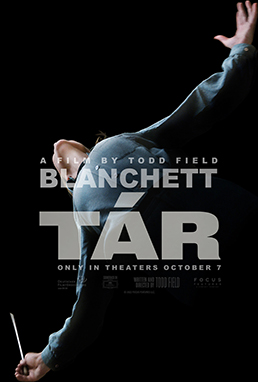
Todd Field’s TÁR (2022) is often discussed as a “cancel-culture movie” or a late-career star vehicle for Cate Blanchett. That framing is understandable, because the film’s social fallout is explicit and Blanchett’s performance is monumental.[1][2][3] But the movie’s deeper mechanism is narrower and more useful: it studies how authority is performed before it is exercised. Lydia Tár does not simply hold power because she sits atop institutions. She holds power because she can stage herself as someone who appears to control time, interpretation, and legitimacy—first in a room, then in a city, then in a global prestige network.[1][4]
That is why the film keeps returning to speech events, rehearsal space, and procedural rituals. TÁR is not organized as a mystery that asks whether Lydia is brilliant or corrupt. It is organized as a systems drama about how reputational authority is assembled and how quickly that assembly can reverse once framing control leaves the subject’s hands. When that reversal comes, Field does not switch genres into courtroom spectacle. He keeps the same grammar of performance and simply flips who gets to edit whom.
Spoiler note: this essay discusses major plot developments in TÁR, including the Juilliard sequence, the digital backlash arc, and the ending.
Authority arrives first as language, then as rhythm
The opening New Yorker interview sequence is not expositional filler. It is the film’s operating manual.[1][4] Lydia speaks in long, calibrated turns about mentorship, score interpretation, and “time” as the conductor’s medium. Her rhetoric does two things at once: it advertises expertise, and it positions everyone else in the room as temporally behind her. The point is not simply that she is articulate. The point is that she can define the frame in which judgment happens.
Field then repeats this pattern in different registers: donor conversations, assistant management, rehearsal commands, and casual social encounters. In each setting, Lydia’s edge comes from sequencing. She moves first, names terms, and decides the tempo in which others must respond. Authority here is not brute force. It is pacing power.[1][3]
That pacing structure also explains why the film’s 158-minute runtime matters formally rather than as trivia.[1][2] The duration gives Field room to let institutional routines breathe: travel, scheduling, personnel reshuffles, fellowship politics, audition choreography, and media obligations. The audience does not just “learn” Lydia’s status; it feels the labor of maintaining that status hour by hour.
The Juilliard scene is a stress test of legitimacy language
The Juilliard masterclass sequence has been treated as the film’s most debate-ready scene, yet its function inside the movie is precise.[1][5] Lydia argues for separating artistic interpretation from artists’ personal conduct while the student insists identity and politics are inseparable from canon choice. The scene is not written to deliver a stable winner. It is written to show what happens when authority built on elite fluency enters a room where legitimacy claims are no longer centralized.
Lydia initially dominates by converting disagreement into pedagogy. She reframes the student’s refusal as a failure of musical seriousness and tries to pull the room back under craft hierarchy. For a moment, that works. But the scene plants the film’s core risk: the same exchange can later be remixed and redistributed outside her control, where platform logic rewards conflict compression over institutional nuance.[1]
In other words, TÁR does not argue that digital culture suddenly destroys stable institutions. It argues something harder: institutions now coexist with rival framing infrastructures, and rhetorical mastery in one arena can become reputational liability in another.
The film’s world is built from gatekeeping logistics, not abstract “fame”
One reason TÁR feels unusually concrete is that it keeps showing the operational layer beneath prestige: assistant funnels, fellowship pipelines, audition design, replacement politics, and board relationships.[1][2][4] These are not side details. They are the machinery through which taste becomes career outcomes.
Lydia’s power is therefore less about celebrity in the tabloid sense and more about control over gatekeeping interfaces. Who gets heard, who gets delayed, who gets soft-pushed out, who is visible in rehearsal, who becomes “future leadership”: the film makes these decisions feel procedural, almost clerical, and precisely for that reason unsettling. Harm in TÁR is frequently administered through workflow.
This is where Blanchett’s performance is most exact. She plays Lydia as someone who cannot tolerate idle systems. Every space becomes schedulable. Every person becomes a variable. The character’s charisma is inseparable from managerial appetite, and the movie refuses to sentimentalize the difference.
Sound design tracks control failure before the plot announces it
As Lydia’s authority contract begins to crack, Field and his collaborators push instability through sound before fully articulating it through dialogue.[1][6] Environmental noises, offscreen disturbances, and acoustic intrusions produce a pattern: the woman who once mastered orchestral time now fails to govern her own sensory field.
This design choice prevents the film from becoming a purely social-media morality play. The collapse is not only external punishment. It is also internal desynchronization. Lydia can still command rooms for stretches, yet her perceptual confidence is already leaking. By the time public consequences arrive in full force, the audience has been listening to control decay for much longer.
That connection between power and acoustics is central to the theme essay mode. TÁR is a conductor film that treats hearing as political structure. To conduct means selecting what counts as signal and what can be reduced to noise. The tragedy is that Lydia’s private and public systems eventually invert that hierarchy around her.
The ending rejects redemption arcs and chooses transfer logic
The final movement is often read as humiliation, but the film’s ending is more diagnostic than punitive.[1] Lydia does not vanish. She is rerouted into a different cultural market where her technical competence still has value, just under a changed prestige hierarchy. That transfer is brutal, yet analytically sharp.
Field avoids a moral epilogue in which the character either confesses and heals or fully self-destructs. Instead he shows reputational reallocation. The message is not that talent was fake. The message is that talent never operated alone; it always rode on institutions, and institutions are contingent architectures. Once the top-tier ecosystem closes, another ecosystem can absorb the same skill under different symbolic terms.
This is why the film remains difficult to flatten into pro- or anti-cancellation rhetoric. TÁR is interested in structure, not slogan. It asks how authority is staged, how gatekeeping gets disguised as neutral excellence, and how media environments can rapidly reorder who gets to define seriousness.
Why the film still feels current
The movie premiered at Venice in September 2022 and moved through global release into an awards season where it took six Oscar nominations, including Best Picture, Best Director, and Best Actress.[1][2][7] Cate Blanchett also won major lead-actress recognition at the Golden Globes and BAFTA.[8][9] Those milestones matter because they place TÁR inside the very prestige circuits it anatomizes.
That reflexive position is part of its durability. The film never claims to stand outside elite culture while criticizing it. It works from inside, using the textures of institutional life—funding bodies, rehearsal etiquette, interview rituals, nomination systems—to show how quickly legitimacy can mutate when framing power shifts.
So the most accurate way to describe TÁR is not “a movie about downfall.” It is a movie about authority as choreography. Rise and fall are outcomes. The engine is performance grammar: who sets tempo, who names standards, who edits context, who controls sequence, and who survives when that sequence is no longer theirs to conduct.
90-second rewatch drill
If you revisit the film with this argument in mind, test three things in order:
- Watch for sequencing control: track who sets the rhythm of each institutional interaction (interview, rehearsal, audition, admin conversation).
- Track gatekeeping as workflow: note where career outcomes are decided through procedural choices rather than open declarations.
- Listen for desynchronization: in later sections, observe how sound intrusions foreshadow Lydia’s loss of framing control before formal consequences fully land.
Sources
- Wikipedia — TÁR (film): production, release timeline, runtime, cast, plot, and awards overview
- Focus Features — official film page for TÁR (runtime, release, credits)
- Variety review — “Tár Review: Cate Blanchett in Todd Field’s Masterful Conductor Drama”
- La Biennale di Venezia — Tár competition listing (Venice 2022)
- The New Yorker Festival event page — Adam Gopnik in conversation with Cate Blanchett and Todd Field on TÁR
- The Hollywood Reporter — Todd Field interview and craft discussion around TÁR
- The Academy — 95th Oscars nominees and winners
- Golden Globes — TÁR nominations and win record
- BAFTA — EE BAFTA Film Awards 2023 nominations and winners
- Wikipedia file page — poster source used in this article
Editor’s Pick Review
This piece wins today because it stays inside the film’s actual mechanics instead of drifting into opinion shorthand. It tracks how authority is built through timing, institutional sequencing, and framing control, then shows how the same system can invert once media context shifts. The argument is source-anchored, scene-specific, and structurally coherent from lead to ending.
It also meets the stricter image gate: the visual is a direct, topic-grounded official poster tied to the exact film under discussion, with no analytical or decorative graphic substitution. Combined with a high-signal Chinese translation that preserves rhythm and terminology clarity, this is the strongest 24-hour quality profile in the current candidate pool.