The joke is also the method
Juzo Itami's Tampopo is usually introduced by its irresistible label: a 1985 "ramen western." The phrase sounds like a one-line joke, and the film enjoys the joke fully. Goro and Gun arrive like drifters, hats and truck cab standing in for horse and saddle, then devote their wandering expertise to a failing noodle shop rather than a frontier town. Janus Films' restoration page leans into that premise, calling the helpers "ramen ronin" and framing the quest around a widow's search for the perfect recipe.[1]
But the genre joke is only the entry point. The deeper comedy is that Tampopo treats appetite as a public craft. Eating is not private indulgence, not simply biological need, and not only class display. It is a learned social practice, full of rules, humiliations, discoveries, false authorities, physical discipline, and moments of joy that belong to more people than polite culture wants to admit. The western parody matters because it gives an everyday bowl of ramen the scale usually reserved for duels, rescue missions, and heroic apprenticeship.
The basic frame is compact: Tampopo is a 114-minute color Japanese film from 1985, directed and written by Itami, with Nobuko Miyamoto, Tsutomu Yamazaki, Ken Watanabe, Koji Yakusho, and Rikiya Yasuoka in the cast.[1][2] That cast arrangement already tells us something. The movie's center is not a solitary genius chef. It is a shop owner, a drifter-teacher, a young assistant, a group of eccentric specialists, and a crowd of customers whose bodies judge the result. Skill here is collective and visible.
Ramen as training, not mystique
The most useful thing about Tampopo is that it refuses food mystique while still loving food intensely. The film knows that a perfect bowl can feel transcendent, but it keeps dragging transcendence back to procedure: broth, timing, customer flow, bodily attention, and the awkward fact that a restaurant has to work as a room before it can work as a dream. Nippon Connection's program note gets the plot mechanics right: two truckers meet a struggling noodle-shop owner and join her quest to create the perfect ramen.[2]
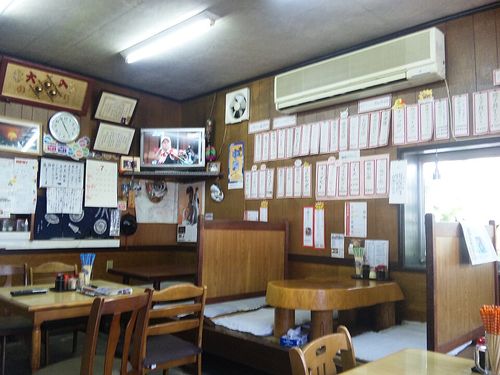
That detail matters because the movie's appetite is not lazy appetite. Tampopo does not become better by believing in herself in some vague inspirational way. She improves because she submits to practice. She watches other shops, carries heavy pots, studies customers, absorbs correction, and learns that deliciousness is partly choreography. The image of the counter captures that contract: the pot, bowls, posted prices, steam, bodies leaning forward, Tampopo watching from the working side of the rail. The shop is not just where the story happens. It is the film's laboratory.
This is why Itami's comedy still feels fresh. Many food movies either romanticize craft until labor disappears, or reduce food to a luxury signal. Tampopo does neither. It makes labor comic, embarrassing, bodily, and communal. Goro's authority is useful only because it can be tested at the counter. The old ramen masters are funny because their solemnity verges on absurdity, but the film does not mock expertise itself. It mocks expertise when it becomes ceremony without generosity.
Etiquette gets slurped apart
The surrounding vignettes widen the argument. BFI's cooking-film list describes the movie as a set of vignettes drifting from its central food motif, and notes the dandelion meaning of the title.[3] That drifting structure is not looseness for its own sake. The episodes scatter the ramen-shop question across society: who gets to enjoy food openly, who is trained to hide appetite, and which rules are really about taste rather than status?
The spaghetti lesson is the cleanest example. A teacher instructs young women in quiet European table manners, only for the discipline of silence to collapse into noodle-slurping pleasure. The joke is precise because nobody in the scene needs to make a speech about cultural hierarchy. Sound does the argument. A rule that pretends to be refinement turns fragile the moment another eating culture enters the room with more life in it.[3][4]
The business lunch vignette works the same way from the opposite direction. The senior men order by rank, each preference chained to the superior above him. The junior employee, supposedly the least powerful person at the table, is the only one willing to read the menu as a field of actual choices. Food knowledge briefly outruns corporate obedience. Taste becomes a small rebellion against hierarchy.
Then there are the homeless gourmands, the old woman squeezing produce, the gangster whose erotic food scenes push appetite into taboo territory. Some of these passages are sweet; some are deliberately uncomfortable. Their shared function is to keep pleasure from becoming respectable too quickly. Tampopo is generous, but it is not sanitized. It asks viewers to notice how often social order depends on controlling appetite, noise, mess, age, class, sex, and the open declaration of wanting something.
The western becomes democratic
The film's double borrowing is its great structural joke: Itami uses American western grammar to explore Japanese food culture, then lets the form become too digressive and bodily to remain a simple genre parody. Cornell Cinema's program note calls the film a "Ramen-Western" and emphasizes its parallel storylines, while Nippon Connection describes Itami's mix of comedy, yakuza thriller, and western elements as both satire and celebration of Japanese food culture.[2][4] Tampopo is not defending purity. It is defending the vitality that appears when forms travel, get localized, become ordinary, and then become art again through attention.
That is why the "ramen western" is more than a parody category. A classical western often turns civilization into a town problem: who can enter, who enforces order, who earns belonging, who leaves once the work is done. Tampopo shrinks that map to a noodle shop and makes the stakes edible. The question is not whether a sheriff can clean up the street. It is whether a counter can become hospitable without becoming deadened by formula.
Itami's broader career clarifies the satirical pressure. BFI's guide to where to begin with Itami notes that Tampopo was his second film, became an international hit, and sits inside a career repeatedly interested in social satire and independent women played by Miyamoto.[6] The Japanese Film Festival Australia likewise frames the film as strangers bonding through the quest for perfect ramen.[5] Read in that context, Tampopo's apprenticeship is not merely culinary. She is learning how to occupy authority in public. The film may surround her with male mentors, but its emotional success depends on whether she can hold the room herself.
The final payoff is therefore quieter than the movie's wildest digressions. A good bowl is not treated as elitist treasure. It is something people line up to eat, argue over, remember, and judge by bodily response. The slurp, the smile, the satisfied exit, the next customer: these are the film's democratic signals.
Appetite without apology
What keeps Tampopo from becoming only a charming food comedy is its refusal to split pleasure from discipline. The movie believes in appetite, but not in appetite as mere consumption. To want well, in this film, is to learn: how to taste, how to watch, how to serve, how to accept correction, how to ignore dead etiquette, how to let low-status food carry high craft without losing its popular address.
That is also why the film remains one of cinema's great arguments against cultural snobbery. It does not say that all taste is equal. It says taste should be available, teachable, audible, funny, sensual, and socially alive. Ramen can be humble and exacting. A trucker can become a mentor. A widow's shop can become an arena. A bowl can carry migration history, genre history, class satire, bodily comedy, and serious craft without ceasing to be dinner.
The western hero usually rides away after restoring order. Tampopo lets the order remain at the counter, in the broth, in the line of customers, and in a woman who has learned that appetite is not shameful when it is disciplined into care. The film's happiest idea is not that food saves everyone. It is that pleasure becomes more intelligent when people stop pretending it belongs only to the refined.
Sources
- Janus Films, "Tampopo" - official restoration/distribution page for the film.
- Nippon Connection film database, "Tampopo" - program page with year, runtime, credits, cast, plot summary, and genre framing.
- BFI, "10 great films about cooking" - entry on Tampopo's vignette structure, food, appetite, and the meaning of the title.
- Cornell Cinema, "Tampopo" - program note on the film's Ramen-Western form, parallel storylines, and food-culture comedy.
- Japanese Film Festival Australia, "Tampopo" - screening page and synopsis describing the quest for the perfect ramen.
- Hayley Scanlon, "Where to begin with Juzo Itami." BFI, 2022 - overview of Itami's career, Tampopo's international afterlife, and Nobuko Miyamoto's place in his social satires.
- Wikimedia Commons, "Ramen Shop (8212802557).jpg" - real photograph of a ramen-shop interior used as the replacement article image.