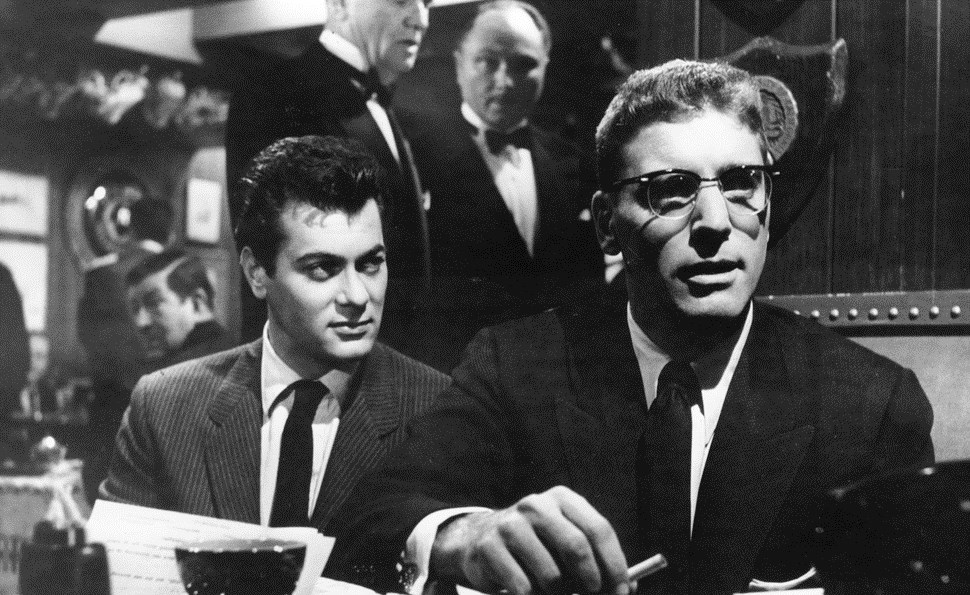
Sweet Smell of Success is often remembered as a film about newspaper corruption, but that description is too tidy for the way Alexander Mackendrick's 1957 movie moves. The corruption does not stay inside a newsroom, a printed column, or one bad man. It spreads across tables, sidewalks, telephones, police favors, nightclub doors, and the bodies of people who have learned to lean toward power before they know what power will ask them to do. Criterion's edition page frames the film around J. J. Hunsecker, Sidney Falco, acid dialogue, noir cityscapes, and the kill-or-be-kill pressure of 1950s Manhattan.[1] The sharper point is that the column has become an atmosphere.
The plot is small enough to fit in a gossip item. Hunsecker, a Broadway columnist with terrifying reach, wants press agent Sidney Falco to break up the relationship between Hunsecker's sister Susan and jazz guitarist Steve Dallas. Britannica summarizes the premise as a ruthless columnist pressuring a desperate publicist into ruining that romance, with the screenplay drawn from Ernest Lehman's story and written by Lehman and Clifford Odets.[5] Yet the film's force comes from making that basic transaction feel like a civic diagram. One private obsession moves through public channels until Manhattan itself seems to be taking dictation.
That is why the movie still feels poisonous rather than merely cynical. Cynicism can sit at a distance and sneer. Sweet Smell of Success is more intimate. It shows people doing tiny calculations at conversational speed: who can be named, who can be planted, who can be humiliated, who can be brought to a table, who can be made useful for five minutes and thrown away after the column closes. BFI calls the film a jet-black satire on the venality of the newspaper business and emphasizes James Wong Howe's luminous cinematography of nocturnal New York.[2] The darkness matters because it is not only visual style. It is the medium in which everyone has learned to breathe.
The column is an operating system
Hunsecker is powerful before he fully appears. Gary Giddins's Criterion essay notes how the film delays his entrance, letting conversation, anxiety, and advertising prepare the space before the man arrives.[3] That delayed entrance is not a trick of suspense alone. It teaches the viewer how power works in the film. Hunsecker does not need to be physically present because his column has already rearranged everyone else's behavior.
Sidney Falco understands that better than anyone. He is not a journalist, not exactly a criminal, and not only a messenger. He is a process. He translates appetite into rumor, rumor into access, access into leverage, leverage into a printed line. The tragedy is that he is talented. Tony Curtis gives Sidney speed, charm, timing, and a visible hunger for inclusion. He is compelling because he is always solving the next five seconds. He sees the door, the waiter, the mark, the opening, the favor owed, the phrase that will keep him alive a little longer.
The film's cruelty is that Sidney's intelligence has no honorable object. In another movie, his quickness might be entrepreneurial energy. Here it becomes self-erasure. Every time he makes himself useful to Hunsecker, he becomes less capable of refusing him. The column is not only a place where names appear. It is a ranking system that teaches everyone to convert personality into currency.
Tables replace institutions
The film's most important rooms are not offices. They are tables: restaurant tables, club tables, bar counters, small social islands where a person's standing can change before dessert is cleared. The famous Hunsecker table is a throne, a courtroom, and a switchboard at once. People approach it with requests, gossip, flattery, and dread. They leave with instructions or wounds.
This is why the film's media critique feels larger than journalism. Formal institutions are present, but they seem secondary to informal ones. The police lieutenant who serves Hunsecker's purposes matters because enforcement has been routed through private favor. Public speech is not protected by a public standard; it is filtered through who has access to the columnist and who can survive exclusion. The Library of Congress essay stresses that the film emerged from postwar conditions that made smaller, riskier independent productions possible and that Lehman's press-agent background fed the material.[4] That production context helps explain the movie's edge. It does not attack power from outside the entertainment economy. It understands the economy's etiquette from within.
The table also clarifies Hunsecker's weakness. Burt Lancaster plays him with terrifying stillness, but the stillness is defensive. The glasses, the posture, the flat control of the voice, the refusal to be openly needy: all of it tries to turn emotional dependence into imperial command. Hunsecker cannot tolerate his sister's independent attachment, so he launders possessiveness through reputation management. He does not say simply, "I want control." He makes control look like taste, protection, family honor, public morality, and professional necessity.
That is the film's most modern insight. Power rarely introduces itself as appetite. It calls itself standards.
Night makes everyone available
James Wong Howe's black-and-white cinematography does more than make Manhattan look beautiful. It makes the city legible as pressure. BFI singles out the nefarious glitter of nocturnal New York, and Giddins details the film's work between Hollywood interiors and Manhattan exteriors, where Broadway night, loading bays, trucks, signs, clubs, and reflected light create a continuous world.[2][3] The effect is that every exterior seems connected to every interior. A sidewalk can become a corridor to a column. A club can become a trap. A phone call can collapse distance instantly.
The night is crucial because it removes the comfort of separation. Nobody is fully off duty. Sidney hustles as if the city might stop existing if he stops moving. Hunsecker sits as if the city exists to confirm that he does not need to move. Susan and Steve try to build a private relation inside a world that keeps turning privacy into material. Even the jazz rooms, which should promise improvisation and release, are pulled into the film's machinery of watching, accusation, and planted evidence.
That makes the movie more than a newspaper exposé. It is a film about publicity as climate. Once a society treats visibility as survival, invisibility becomes terror. Sidney fears being left out of Hunsecker's column because exclusion means professional death. Steve fears being misnamed because one lie can rearrange his future. Susan fears that every attempt to choose for herself will be interpreted, managed, or folded back into her brother's authority. Nobody owns their image for long.
The real villain is circulation
Hunsecker is monstrous, but the film would be simpler if he were the whole problem. The deeper villain is circulation: the movement by which private malice becomes public fact, and public fact becomes private damage. The rumor must move. The column must print. The phone must ring. The favor must be redeemed. The police must arrive. The nightclub must keep glowing while the bargain curdles.
Giddins argues that the film sits at a meeting point of Broadway movie, urban newspaper movie, press-agent movie, nightclub movie, noir, jazz film, and police-corruption story.[3] That genre convergence is not just film-historical taxonomy. It is how the movie thinks. Each genre contributes a channel of movement. Broadway gives the hunger for reputation. The newspaper gives speed and damage. Noir gives moral compression. Jazz gives the sound of looseness inside a tightly controlled environment. Police corruption gives private power an official arm.
That is why Sweet Smell of Success has not gone stale even though the newspaper column as a media form has changed. The mechanism survives whenever attention, access, and reputation can be converted into punishments faster than truth can catch up. The movie's technology is old; its social physics are not.
By the end, the film does not cleanse the city. It lets daylight arrive, but daylight is not innocence. It is aftermath. What has been done in the night has consequences after the lights come up. Sidney's speed finally meets a limit. Hunsecker's control finally exposes its loneliness. Susan's escape matters because the whole film has shown how difficult it is to leave a system that has already named you, watched you, and made your image useful to someone else.
The lasting brilliance of Sweet Smell of Success is that it makes a gossip column feel architectural. It has doors, thresholds, tables, patrol routes, weather, and oxygen levels. Mackendrick, Lehman, Odets, Howe, Lancaster, and Curtis build a city where publicity is not something printed after life happens. Publicity is the thing life has to move through. The column feels like night itself because everyone in the film is already inside it.
Sources
- The Criterion Collection, "Sweet Smell of Success (1957)" edition page, with film information, restoration notes, cast, credits, and overview of the film's Manhattan noir pressure.
- BFI, "Sweet Smell of Success (1957)" film page, with production credits and critical framing of Mackendrick's satire, film-noir context, and James Wong Howe's nocturnal New York cinematography.
- Gary Giddins, "Sweet Smell of Success: The Fantastic Falco," The Criterion Collection, February 22, 2011, on genre convergence, Falco, Hunsecker, Manhattan exteriors, James Wong Howe, jazz, and the film's 1957 reception.
- Andrea Alsberg, "Sweet Smell of Success," Library of Congress National Film Preservation Board essay PDF, with postwar production context, Lehman/Odets background, James Wong Howe notes, and the LOC still used as the article image.
- Lee Pfeiffer and Encyclopaedia Britannica editors, "Sweet Smell of Success," Britannica, for plot, credits, cast, source-story background, cinematography and score context, and reception summary.