Spoilers follow, including the ending.
A conversation continues, but its words stop arriving clearly. Early in Sound of Metal (2019), drummer Ruben loses access to the chatter around a merchandise table. Ringing and muffled sound move us into his disorientation while the visible world carries on.[1] The frightening gap is between an ordinary social situation and the effort suddenly required to follow it.
Darius Marder's film makes that gap a matter of form. Riz Ahmed supplies the searching face and unsettled body; the soundtrack changes how close we can get to their predicament. Across the film, sound becomes a way of controlling our relationship with Ruben: sharing his alarm, observing a community he is learning to enter, and eventually staying with him when he stops trying to retrieve his old life.
Give the opening something to lose
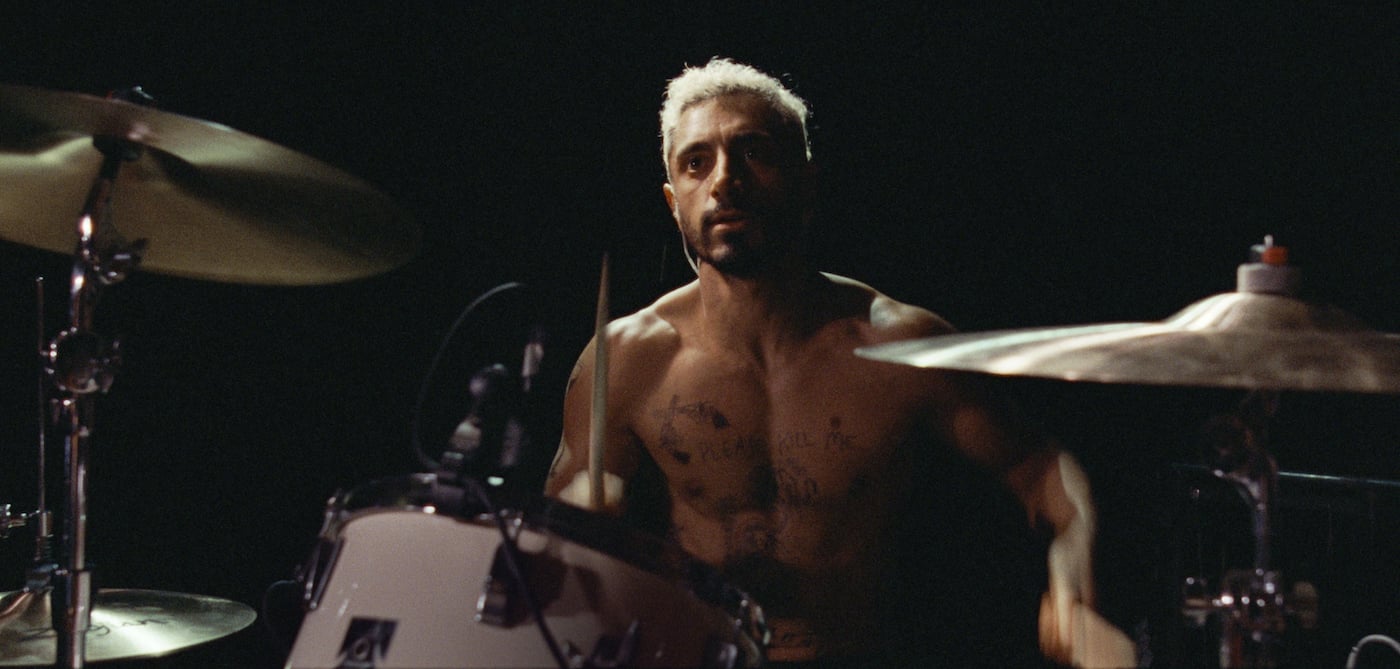
The concert that introduces Ruben and his partner Lou has the force of a working relationship. Marder told Film Independent that Ahmed and Olivia Cooke performed before a live audience, with Cooke playing guitar, screaming, and operating pedals in real time. Both actors had to acquire the musical skills for the scene.[2]
That preparation gives the noise a human source. We can connect what we hear to people making decisions together, under pressure, in a room. Their coordination is part of the couple's intimacy. When listening becomes difficult, the film has already established a shared activity whose future is at stake.
This also gives the sound team a concrete starting point. The opening offers a performance we can remember, with bodies and instruments attached to it. Later changes in texture carry the memory of that first encounter.
Record a body that keeps making sound
Supervising sound editor Nicolas Becker began discussing the film with Marder before shooting. He also recorded Ahmed using a stethoscopic microphone, sensitive contact microphones, and a microphone designed to go inside the mouth. Heartbeat and other bodily sounds became material for the soundtrack.[3]
The choice puts physical activity into passages that might otherwise be represented by simply lowering the volume. We remain close to someone breathing and moving. Ruben can lose reliable access to a conversation while the soundtrack still gives his body a palpable presence.
Let the edit decide when to listen
Editor Mikkel E. G. Nielsen described spending his first weeks watching and selecting footage before beginning to cut. He wanted to discover the material's rhythm. One useful discovery was Ruben's morning routine: coffee, a smoothie, exercise, and the everyday sounds that make a life feel settled.[4]
Such ordinary actions establish expectations at a smaller scale than the concert. A familiar task can remain visually recognizable while its sound changes. The audience brings a memory of how the world previously fitted together; the edit can use that memory without requiring Ruben to explain it.
Becker also resisted a fixed rule that every close-up must trigger subjective sound. He told JumpCut that constantly alternating internal and external perspectives could become tiring. The team established its vocabulary, then loosened it, sometimes retaining an external sound perspective over Ruben's face.[3]
That flexibility matters. A mechanical rule would make us anticipate an effect whenever the camera approached him. Varying the relationship allows us to look at Ruben without assuming we have been given total access to his experience.
Understanding has more than one channel
The film's treatment of American Sign Language extends this control of access. In a National Board of Review conversation, Marder discussed how captions allow understanding to develop alongside Ruben's comprehension. He also distinguished theatrical open captions from selectable captions, whose settings give viewers control over access.[5]
Those decisions belong beside the microphone work. They determine what a viewer can understand and when. Ruben's initial difficulty participating does not mean the people around him lack a rich social world; it means he is still learning how to join it.
Ahmed described the performance as an emotional approach to the character, rather than a claim to share his lived experience. Marder likewise acknowledged the impossibility of perfectly simulating it.[5] The same boundary helps us read the mix: it constructs this character's perspective, and cannot stand in for every deaf person's experience.
Reassemble the familiar until it feels strange
For the passages following activation of Ruben's cochlear implants, Becker used a different method. He told KCRW that software let him separate tonal and harmonic material, noise, and the attacks of sounds, then recombine those elements. A recognizable human voice remained the basis of the effect, but its components no longer seemed to fit naturally together.[6]
The distinction is audible in the film's approach to discomfort. Information returns without delivering the effortless familiarity Ruben hoped to recover. At the later gathering in France, Becker also designed conflicting spatial cues to make sounds difficult to locate.[6]
These are deliberate dramatic constructions. Their force comes from the mismatch between expectation and experience: Ruben wants a route back, while the mix makes recognition laborious. Increasing the amount of sound cannot, by itself, restore the relationship he once had with it.
The ending changes the terms again. Seated outside, Ruben disconnects his external processors and remains still.[1] Nielsen connected that seated figure with the drummer waiting at the beginning: two compositions whose emotional directions have changed.[4]
We have spent the film learning to treat altered sound as an urgent demand for attention. Now the absence of sound accompanies a pause in Ruben's effort to fix everything. His future remains beyond the frame. For this moment, Ahmed's face can hold our attention without a performance to begin, a conversation to decipher, or a familiar world to force back into place.
Sources
- Roxana Hadadi, “Sound of Metal: Throbbing Eternity,” The Criterion Collection, September 27, 2022 — film context, the merchandise-table scene, and the final removal of the processors.
- Matt Warren, “Darius Marder on Acting, Authenticity and the Aural Experience of ‘Sound of Metal’,” Film Independent, May 3, 2021 — interview with the director about live performance and preparation.
- Fiona Underhill, “Interview: ‘Sound of Metal’ Sound Designer Nicolas Becker,” JumpCut, November 21, 2020 — body recordings and listening perspective.
- Chris Koseluk, “Oscar-Nominated Editor Mikkel E.G. Nielsen on Giving ‘Sound of Metal’ its Rhythm,” The Credits, Motion Picture Association, April 24, 2021 — interview on editing, routines, and the opening/closing relationship; Amazon Studios film still.
- National Board of Review, “Sound of Metal — Q&A with Darius Marder and Riz Ahmed,” December 16, 2020 — captions, character perspective, and the limits of simulation.
- Michell Eloy, “Oscar contender ‘Sound of Metal’: What happens when a musician loses his hearing,” KCRW, April 16, 2021 — written interview with Nicolas Becker on sound decomposition and spatial disorientation.