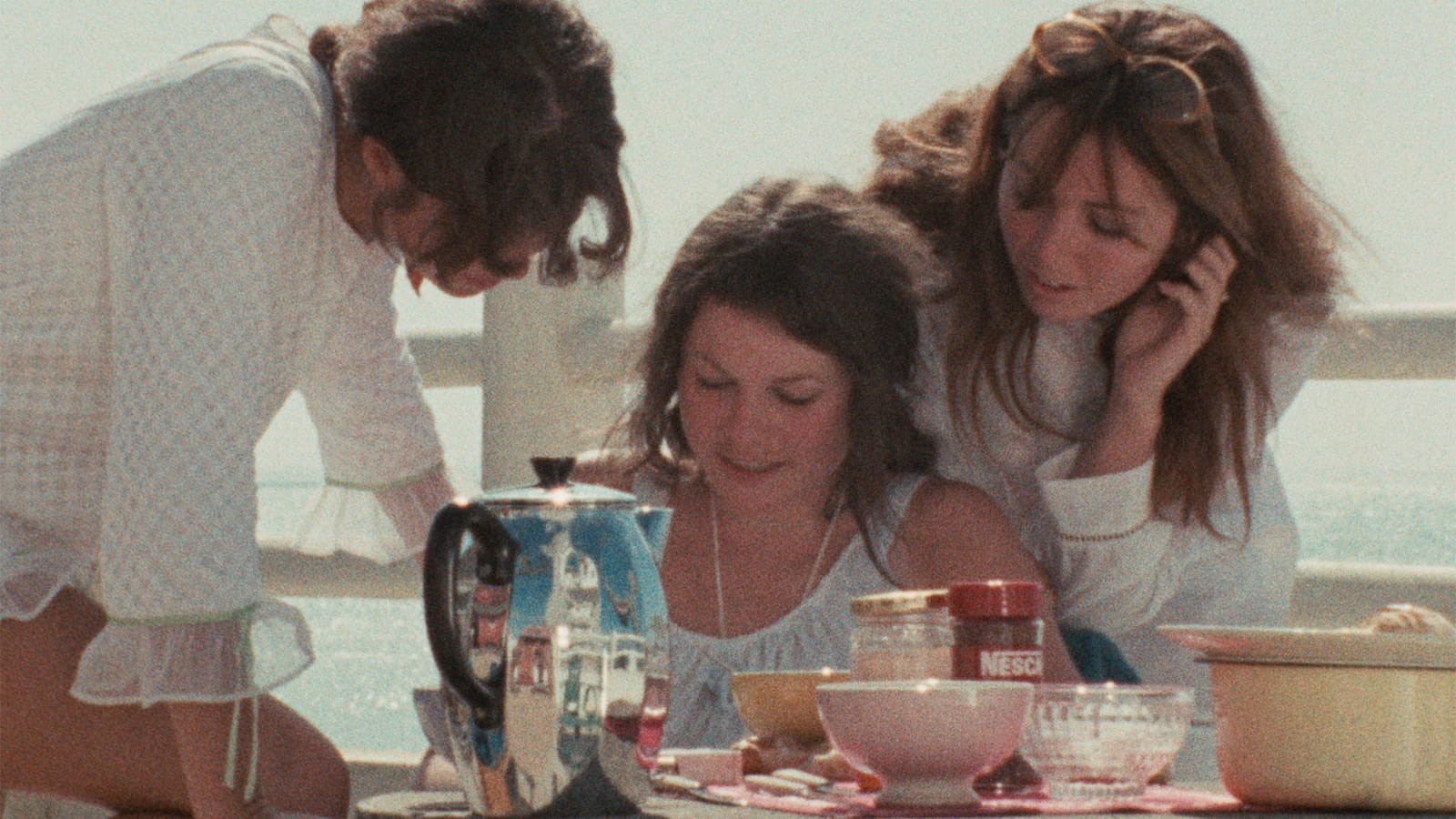
Before the beach in Jacques Rozier's Near Orouët, there is the office: women at electric typewriters, a male supervisor bustling between them, orders interrupting the clatter. Then three friends leave Paris for the Atlantic coast. Their days fill with eating, wading, laughing, and the sort of shared nonsense that becomes inexplicable when retold at work. Eventually, the supervisor turns up too. He discovers that authority travels badly.[1][2]
Across Rozier's films, a holiday allows people to try out another arrangement of their lives. A boss becomes an awkward guest; a railway employee edges toward show business. The pleasure comes from watching the change take longer than a punch line. The ache comes from knowing that someone will eventually have to go home.
Spoiler note: discusses the closing movements of Adieu Philippine and Maine-Océan Express.
A New Wave career with long intervals
Rozier belonged to the French New Wave, though his career never acquired the regular momentum that the label can suggest. After film school, he worked on Jean Renoir's French Cancan (1955). His short Blue Jeans drew Jean-Luc Godard's attention; Godard later introduced him to producer Georges de Beauregard, helping open the way to Adieu Philippine (1962).[3]
That first feature earned passionate critical support and failed commercially. Television work continued during the long interval before his second feature. The contrast matters: a filmmaker associated with idle afternoons spent much of his working life making things outside the theatrical spotlight. His short documentary Paparazzi, made around the production of Godard's Contempt, turned its attention to photographers pursuing Brigitte Bardot.[3]
From a television studio to the machinery of celebrity, Rozier knew the labor surrounding an apparently effortless image. That knowledge gives his escapes their particular flavor. His people arrive at leisure carrying habits learned elsewhere.
The war beyond the beach
In Adieu Philippine, Michel, played by Jean-Claude Aimini, works in television and meets two aspiring actresses, Liliane and Juliette. Advertising jobs expose them to another kind of performance: a director's evasions when it is time to pay. Their trip to Corsica develops into a romantic triangle under the pressure of Michel's approaching military service in Algeria.[4]
The war sets a limit that flirtation cannot negotiate. A casual afternoon can expand in the telling while remaining frighteningly finite in Michel's life. This is the force of placing youthful distraction beside an obligation whose consequences extend far beyond the holiday.
Rozier gives the distraction enough room to become valuable in itself. The friendships and jokes need their own rhythms; reducing them to a symbol of endangered youth would empty out the very life the film preserves. We feel the deadline because the intervening hours have acquired substance.
The office follows them to Orouët
Near Orouët, also known as Du côté d'Orouët, brings the pressure closer to home. Joëlle's boss Gilbert, played by Bernard Ménez, wants her affection. Once he enters the holiday household, his workplace standing offers little protection from embarrassment. Meanwhile, attraction moves in other directions: Joëlle is interested in the sporty Patrick, who flirts with Kareen.[2]
The arrangement produces a quietly uncomfortable question: what remains of a person when the setting that makes others listen to him disappears? Gilbert's persistence can be funny and painful within the same stretch of film. The women have escaped an office hierarchy, but desire introduces fresh inequalities of attention.
Rozier allows conviviality to continue around these tensions. Eating and laughing occupy time that a more impatient comedy might reserve for romantic advances. As David Hudson's Criterion account observes, drama emerges remarkably late in the film.[1] By then, a change in the group's ease can register like a change in the weather.
Making room for an accident
In its written account of Rozier's 1986 conversation with André S. Labarthe, the Cinémathèque française describes Orouët as a small production: five performers, five technicians, a villa, and the beach. Its technical luxury was two cameras, borrowed from television practice, letting scenes continue through laughter, embarrassment, and fatigue.[5]
Two cameras could preserve a shared moment without requiring each response to be repeated for a reverse angle. Yet Rozier challenged the assumption that an apparently improvised film must be unwritten. The account also describes him editing by ear, attending to relationships among speech and sound.[5]
Duration becomes an expressive choice: how long to keep a hesitation alive, when to let another voice intrude, how much discomfort a laugh can contain. Welcoming an accident still requires judgment about what belongs in the film.
The film's dates bear traces of another kind of waiting. Shot in 1969, it first screened at the Cinémathèque in 1971 and reached a limited theatrical release in 1973.[5]
A conductor briefly becomes someone else
In Maine-Océan Express (1986), a ticket problem starts a chain of encounters involving a Brazilian dancer, railway conductors, a lawyer, and a boatman. The story's movements eventually carry a conductor played by Ménez into a samba gathering and the possibility of an entertainment career.[4]
Joachim Lepastier's Cinémathèque essay draws attention to the film's play with accents and verbal misunderstandings, as well as the boat-to-boat journey near its end.[6] Speech and transportation both become unreliable guides. People must keep adjusting to companions who do not quite share their vocabulary, destination, or assumptions.
Read beside Gilbert's holiday, the conductor's adventure reveals the generosity of Rozier's comic casting. Ménez can embody someone whose official position has ceased to explain him. The uncertainty leaves room for a different self to appear, however briefly. Getting back to ordinary duty then has a physical cost: there is distance to cross, and the adventure refuses to end at the convenient moment.
Rozier completed five features between 1962 and 2001, alongside a much broader body of television and short work. A CNC remembrance records his frustration at spending so long finding finance, only to face extraordinary urgency once filming became possible.[7] The relaxed surface of the films should never be mistaken for an easy working life.
Perhaps that helps explain their sensitivity to borrowed time. A holiday, a gathering, a film shoot: each creates conditions that cannot last indefinitely. Rozier's gift was to stay with people long enough for those conditions to change them—and to make their return feel like something more complicated than the end of a joke.
Sources
- David Hudson, “Jacques Rozier: Chronicler of Summer.” The Criterion Collection, August 15, 2024 — the office opening, holiday rhythms, and delayed drama in Near Orouët.
- Janus Films, “Near Orouet” — film identification, characters, synopsis, and the official photographic still used here.
- David Hudson, “Jacques Rozier: Risk and Desire.” The Criterion Collection, June 5, 2023 — training, Godard's support, the reception of Adieu Philippine, and television and documentary work.
- Film at Lincoln Center, “FLC and Janus Films announce ‘Jacques Rozier: Chronicler of Summer,’ August 16–22.” July 15, 2024 — credits and narrative premises for Adieu Philippine and Maine-Océan Express.
- Joachim Lepastier, written contextual essay accompanying “Jacques Rozier à la Cinémathèque française.” La Cinémathèque française, HENRI — the 1986 discussion with André S. Labarthe, two-camera production, editing by ear, and Orouët's screening history.
- Joachim Lepastier, “Jacques Rozier, l'égarement joyeux.” La Cinémathèque française, 2021 retrospective essay — language, duration, and the maritime passages in Rozier's films.
- Centre national du cinéma et de l'image animée, “Jacques Rozier, en liberté.” June 5, 2023 — the breadth of the career and Rozier's account of financing delays and production urgency.