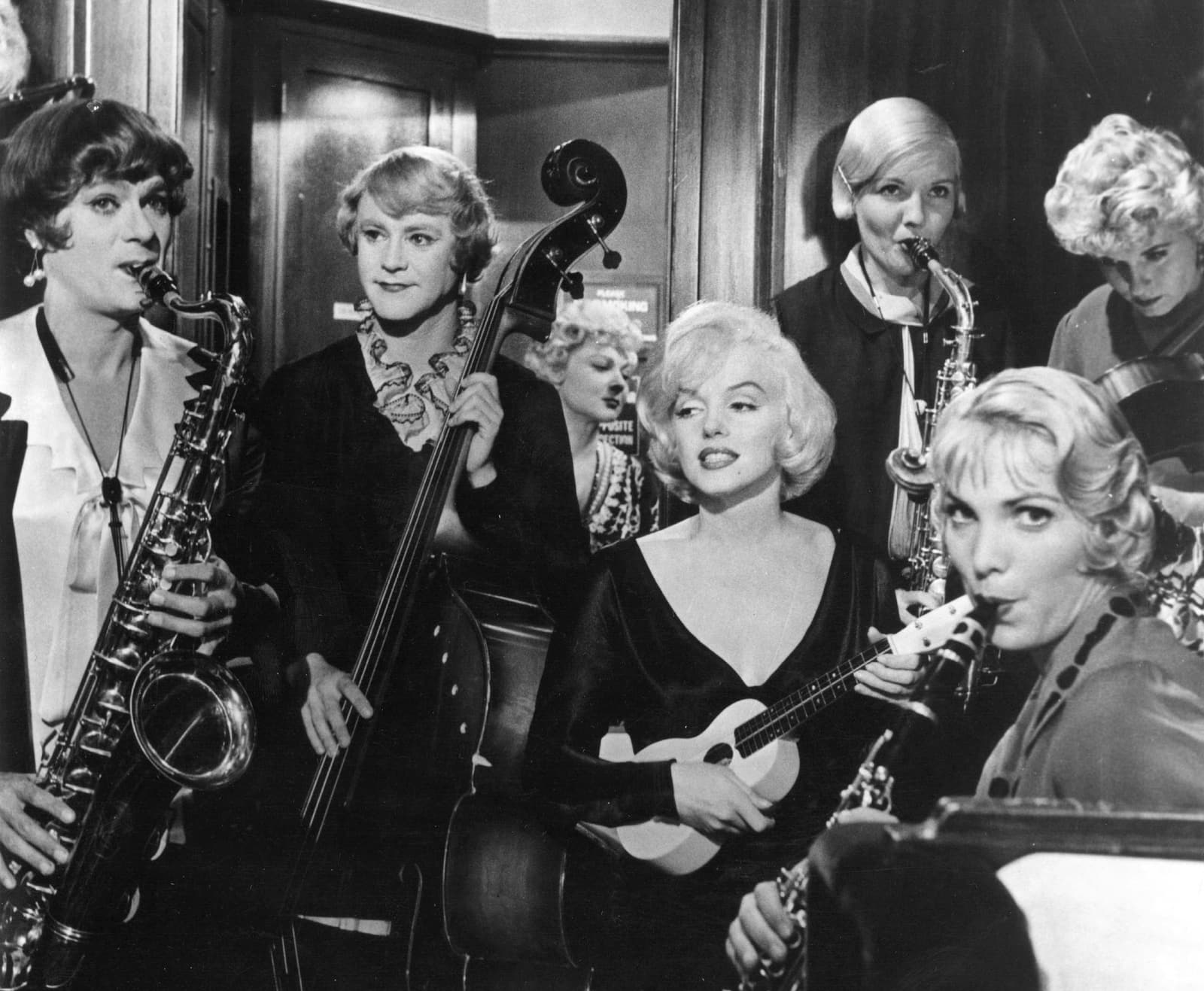
Billy Wilder's Some Like It Hot begins with the wrong genre on purpose. It opens in 1929 Chicago with speakeasy raids, mob pursuit, and a massacre-like killing that sends two broke musicians running for their lives. BFI's film page calls out the St. Valentine's Day echo and the way the story then turns toward cross-dressing comedy, Tony Curtis and Jack Lemmon hiding inside an all-female band with Marilyn Monroe's Sugar Kane at the center of the heat.[1] The joke survives because the danger does not disappear. It keeps time.
That timing is the film's real invention. Some Like It Hot is often remembered as a drag farce with a perfect final line, but it is better understood as a genre collision engineered around speed. Gangster film gives the plot a clock. Screwball comedy gives the dialogue a ricochet rhythm. Backstage musical logic turns bodies, trains, instruments, hotel corridors, and rehearsal spaces into moving parts. Sex comedy tests what 1959 Hollywood could say before the Production Code fully lost authority. Wilder and I.A.L. Diamond do not merely stack those traditions. They make each one push the others faster.
Crime Gives The Comedy A Reason To Run
The premise would be thinner if Joe and Jerry simply chose disguise for convenience. BFI's recent programme notes stress that Wilder's film made the musicians' masquerade a flight response after they witness the St. Valentine's Day-style violence; that life-or-death motive lets the cross-dressing plot move beyond a detachable costume gag.[2] The gangster engine matters because it stops the movie from pausing to ask permission. Joe and Jerry are not tourists in another identity. They are fugitives, and the comedy begins when survival requires performance.
That is why the Prohibition setting does more than provide period flavor. Speakeasies, hidden booze, all-night trains, Florida millionaires, and mob hotels give the film a world where almost everyone is already performing around the law. The BFI notes place Some Like It Hot among 1959 comedies that challenged Eisenhower-era conformity, but Wilder goes further by making illegality feel ambient rather than exceptional.[2] Sugar keeps liquor close. Spats Colombo works inside a public economy of intimidation. Joe invents a millionaire because wealth itself is another costume. Jerry becomes Daphne because the safest available identity happens to be a woman in Sweet Sue's band.
The trick is that none of these disguises cancels the others. The film keeps changing the reason a costume matters. At first, Josephine and Daphne are camouflage. On the train, they become access. In Miami, they become social roles with different rules. In the yacht scenes, Joe's Shell Oil heir persona becomes another mask layered over Josephine, which means the heterosexual romance plot is itself built out of impersonation. The gangster film gives the farce forward motion; the farce quietly turns the gangster premise into a study of how quickly social categories can become stage business.
The Band Turns Identity Into Timing
The all-female band is not just a hiding place. It is a tempo system. Joe and Jerry have to walk differently, sit differently, sleep differently, drink differently, and listen differently because they are now inside a collective working body. BFI lists the central trio and gives the official running time as 120 minutes, but the movie feels quicker because Wilder treats rooms as musical arrangements.[1] The train aisle, the upper berth, the hotel lobby, the beach, the yacht, and the ballroom all function like changes in key.
That rhythm is why the film belongs to more than one comedy tradition. It borrows from screwball's speed, but screwball usually thrives on talk between people who can spar openly. Joe and Jerry cannot. They have to improvise under surveillance, which makes every conversation double-voiced. It borrows from backstage musical structure, but the numbers do not simply interrupt the story. They expose the gap between public performance and private desire. It borrows from gangster film, but the threat is comic precisely because the gangsters are also performers, repeating old tough-guy poses with dead seriousness.
TCM's production history notes how Wilder's casting road eventually settled into the Curtis-Lemmon-Monroe triangle that gives the movie its elastic shape.[4] That elasticity matters. Curtis is sharp because Joe is always calculating the next angle. Lemmon is explosive because Jerry begins as the nervous partner and then discovers that Daphne has a social life he did not predict. Monroe gives the whole machine a pulse because Sugar is neither merely innocent nor merely knowing. She is trying to keep moving too, away from saxophone players, bad promises, and another version of the same mistake.
Joe And Jerry Do Not Learn The Same Joke
The smartest thing in Some Like It Hot is that its two disguises do not produce the same result. Joe treats Josephine as a tool. He uses the access to learn Sugar's vulnerabilities, then builds the Shell Junior fiction around them. The comedy keeps that behavior funny by making the mechanics dazzling, but it does not make Joe morally clean. He is still a saxophone player who has found a more elaborate way to play.
Jerry's story bends differently. Daphne begins as the same survival tactic and gradually becomes a social possibility that Jerry cannot quite reduce to strategy. The maracas, the tango, the engagement, and the delighted panic around Osgood are funny because Jerry keeps trying to return to a fixed explanation after his own behavior has outrun it. The film is not a modern theory of gender. It is a 1959 studio comedy with period blind spots, broad gags, and obvious limits. But within that frame, it does something still lively: it makes rigidity look less natural than improvisation.
That is where the final exchange earns its reputation. AFI notes the film's later canonization, including its selection as AFI's number one comedy and the iconic status of the closing line.[3] The line lands because it releases pressure the movie has been building for two hours. It does not solve gender, romance, fraud, or desire. It changes the beat. Osgood's response treats the supposed revelation not as a catastrophe but as one more imperfect fact inside a world already full of masks. The laugh is a rhythm change, not a legal ruling.
Sugar Is The Film's Emotional Key, Not Its Prize
It is easy to misread Sugar as the reward that motivates Joe's escalating deception. Wilder does let the plot move that way, but Monroe's performance keeps resisting the reduction. BFI's programme notes call attention to her luminous centrality and to the way the film remained attached to Monroe's legend, but the performance is most interesting when it is practical.[2] Sugar knows the pattern she is trapped in. She keeps choosing musicians who disappoint her, then tries to sing, drink, flirt, and dream her way into a better room.
That practical sadness changes the film's texture. When Joe listens as Josephine, he hears what Joe would normally not be trusted to hear. The disguise creates intimacy before it creates romance. That does not excuse his manipulation; it sharpens it. The movie's comic brilliance lies partly in forcing Joe to understand Sugar more accurately through a lie than he ever did through ordinary seduction. He becomes a better listener for the wrong reasons.
Monroe also changes the tempo of scenes around her. The men often move as if they are escaping a trap. Sugar moves as if she has survived enough traps to expect the next one. Her songs slow the movie without stopping it. They make glamour look like labor: breath, timing, costume, microphone, and the brittle courage of appearing relaxed while hoping this version of the story will not collapse. That is why the trio image used for this article works as more than publicity. It catches the film as an unstable band, with everyone playing a part and no one fully in control of the arrangement.[5]
Censorship Heard The Heat
The film's reputation as a Code-breaker is not a decorative footnote. BFI notes that United Artists released Some Like It Hot without Production Code certification and that the film helped loosen censorship boundaries.[1] The programme notes add the local friction: Kansas censors objected to the yacht scene, cuts were negotiated, and some jurisdictions treated the movie as adult material.[2] That history matters because the film's comedy depends on making official categories look slow.
The censors could identify the surface provocations: cross-dressing, innuendo, Monroe's costumes, the yacht seduction, the possibility that same-sex attraction might not be treated only as panic. What they could not fully control was the movie's deeper method. Some Like It Hot makes transgression rhythmic. It does not stop to argue that norms are unstable. It lets a train compartment, a band rehearsal, a hotel lobby, and a ballroom prove it through motion.
That is why the movie's black-and-white photography is more than a practical choice. In a film full of unstable roles, the monochrome image keeps the surface crisp. The dresses, instruments, cigarette smoke, beachwear, tuxedos, and mob suits all register as readable shapes. The clarity makes the instability funnier. Nobody is visually confused about what is happening; everyone is socially confused about what it means.
The Genre Machine Still Feels Modern
AFI's catalog records the film's Oscar recognition, its later AFI comedy ranking, and its position among the most highly regarded American comedies.[3] BFI's 2022 Sight and Sound page places it in both the critics' and directors' greatest-films polls.[1] Those rankings can make a comedy feel embalmed, as if laughter has become homework. Some Like It Hot escapes that fate because its design is still kinetic. It does not ask to be admired for importance before it starts moving.
The durable lesson is not simply that old Hollywood could be naughtier than its reputation. The sharper lesson is structural. Wilder and Diamond found a way to make genre boundaries behave like social boundaries: firm enough to be legible, flexible enough to be broken, and funniest when crossed at speed. Gangster danger pushes the musicians into disguise. Disguise gets them into the band. The band creates intimacy. Intimacy exposes selfishness, loneliness, delight, and a future nobody in the first reel could have named.
So Some Like It Hot remains great not because its attitudes map perfectly onto the present. They do not. It remains great because it understands comedy as motion under pressure. Every category in the film is a tempo waiting to be changed: man, woman, crook, millionaire, musician, lover, witness, star. The movie keeps the beat fast enough that fixed identity starts to look like the least interesting option in the room. By the time the last joke arrives, perfection is no longer the point. Keeping time is.
Sources
- British Film Institute, "Some Like It Hot (1959)" - film page with synopsis, credits, running time, censorship context, and 2022 Sight and Sound poll placement.
- BFI Southbank Programme Notes, "Some Like It Hot" - Steven Cohan excerpt on 1959 comedy context, St. Valentine's Day premise, censorship friction, previews, and canonization.
- AFI Catalog, "Some Like It Hot" - production, reception, awards, AFI 100 Years...100 Laughs ranking, and historical catalog notes.
- Turner Classic Movies, "Some Like It Hot (1959)" - production-history article on casting, Wilder, Curtis, Lemmon, Monroe, and the film's comic setup.
- Wikimedia Commons, "File:Some like it hot film poster.jpg" - 1959 public-domain trailer screenshot source for the downloaded article image.