Spoiler warning: this close reading discusses the film's central revolver setup and its ending.
Germaine Dulac's The Smiling Madame Beudet is brief enough to sound simple in synopsis: a woman is trapped in a bad marriage to a boorish husband who repeatedly stages a tasteless joke with an unloaded revolver, and her private fantasy of escape begins to leak into action.[1][2] But the film's real subject is not the mechanics of a murder attempt. It is the feeling of a room that has learned how to keep a person inside it.
That is why the title is so cruel. Madame Beudet is not smiling in any uncomplicated sense. She is enclosed by furniture, manners, marriage ritual, provincial respectability, and the performance of being a wife who must absorb public humiliation without breaking the room's social surface.[1][3] Dulac turns that surface into cinema. Doors, mirrors, tables, windows, gestures, and cutaways do not decorate the drama. They become the pressure system through which a bourgeois home stops looking like shelter and starts looking like a trap.
The date itself carries a small archival wobble: BFI catalogues the film as a 1922 French work, while Britannica and the Cinematheque francaise list it as 1923.[1][2][4] That uncertainty is useful, not because it changes the viewing, but because the film now reaches us as both object and recovery. It belongs to the early-1920s French avant-garde and impressionist moment, yet it still feels unsettlingly immediate because Dulac's method is so concrete. She does not argue for interior life by announcing it. She gives interior life a set of visible obstacles.
The joke is a household machine
The revolver gag is the film's brutal motor. Monsieur Beudet performs a faux-suicide routine often enough that it becomes part of domestic weather: he points the weapon, teases danger, and relies on everyone else knowing that nothing will happen.[2] The joke is ugly because it turns fear into his property. He gets to enjoy the little shock, then the relief, then the reminder that the household still bends around his appetite for theatrical cruelty.
That repetition matters more than the weapon alone. A single revolver would make the story melodramatic. A repeated fake threat makes it structural. Madame Beudet is not merely frightened by an object; she is exhausted by a ritual that forces her to rehearse powerlessness. Each performance teaches the same lesson: the husband may disrupt the room, but the wife must restore it. His childishness becomes her discipline.
This is where Dulac's close-up and editing logic turns social critique into form. BAMPFA's program note describes the film as using cinematic means to render the frustrations and fantasies of a young wife trapped in a loveless marriage.[3] The phrase is exact because Dulac does not only show unhappiness. She changes the film's texture when Madame Beudet's mind resists the room. Fantasy, distortion, subjective emphasis, and rhythmic repetition become ways of showing that the marriage is lived as a spatial condition before it becomes a plot.
The room keeps producing doubles
The bourgeois interior in The Smiling Madame Beudet is orderly, but order is not calm. It is the film's main instrument of pressure. Madame Beudet sits, reads, waits, listens, glances, and endures inside a world arranged to make her stillness look natural. The room tells visitors that everything is proper. Dulac shows that propriety can be a kind of violence when it requires one person to carry the cost of everyone else's comfort.
Mirrors sharpen that point. In many films, mirrors reveal vanity, deception, or divided identity. Here they do something more domestic: they multiply enclosure. Madame Beudet can look at herself, but the reflected self is still inside the room. The image doubles her without freeing her. The mirror gives vision but not exit, and that distinction is the film's central spatial wound.
That is why the fantasy passages do not feel like escapes in the simple sense. They are eruptions from inside confinement. Madame Beudet imagines a different force entering the scene, a different body, a different outcome, but the fantasy has to begin from the same domestic pressure that makes fantasy necessary.[3] Dulac's cinema is not saying that imagination solves the marriage. It is saying that imagination becomes active when ordinary speech has been stripped of consequence.
A feminist film because it studies procedure
The film is often described as a landmark of feminist cinema, and the label is earned if it is handled carefully.[3] Its importance does not rest on making Madame Beudet simply admirable or her husband simply grotesque, though the husband is grotesque enough. The sharper achievement is procedural. Dulac studies how an unequal marriage reproduces itself through jokes, outings, visitors, habits, gestures, and the requirement that a wife remain legible as composed.
That procedure is why the film has more bite than a straightforward revenge fantasy. Monsieur Beudet's cruelty is not grand. It is petty, theatrical, ordinary, and socially survivable. He does not need to be a Gothic villain because the room is already on his side. The household gives him stages; friends give him audience; routine gives him cover. Madame Beudet's crisis is therefore not only whether she can act. It is whether action can break a system that is strongest when it looks normal.
Britannica's plot summary emphasizes the husband's repeated unloaded-pistol joke and Madame Beudet's entrapment in marriage.[2] Those two facts should be read together. The revolver matters because it literalizes a condition already present. Danger has been domesticated. Violence has been converted into play. A household object can become a threat, then a joke, then a threat again, depending on who controls the script.
When fantasy touches the object
The turn in the film comes when Madame Beudet's private revolt attaches itself to the revolver. This is not a clean liberation scene. Dulac makes it disturbing because the act grows out of accumulated compression rather than sudden villainy. A repeated joke has trained the room to ignore danger; Madame Beudet uses the same training against the man who invented it.
That reversal is formally elegant and morally uncomfortable. The husband has made the revolver safe by repetition, and the wife makes repetition unsafe by changing one condition. The plot becomes a close reading of habit. What if the thing everyone assumes is harmless has been harmless only because someone unseen kept absorbing the harm? What if the ritual's safety depends on the submission of the person most injured by it?
The answer is not triumph. Dulac is too rigorous for that. When the gun plot fails to deliver a simple escape, the film does not retreat into consolation. It leaves the viewer with the deeper trap: Madame Beudet has reached for agency through the only available object the marriage has made theatrical enough to matter, but the same social structure that made her desperate can also absorb the event and keep going.
This is the film's cruelest insight. A bad marriage can survive evidence. It can survive a nearly visible rupture if the surrounding rituals are strong enough to rename the rupture as misunderstanding, accident, mood, nerves, or feminine excess. Dulac's ending hurts because it does not need melodramatic punishment. Continuity itself is punishment.
Why the film still feels modern
The Cinematheque francaise record fixes the production in concrete terms: Germaine Dulac directs, Germaine Dermoz plays Madame Beudet, Alexandre Arquilliere plays Monsieur Beudet, and the film belongs to French silent cinema's early-1920s field of experiment.[4] Those credits matter because the film's modernity is not abstract. It comes from the way performer, room, object, and camera collaborate to make feeling visible without turning feeling into a speech.
Dermoz's performance is central to that balance. She does not play interior life as one big emotion. She plays it as modulation: boredom, recoil, fantasy, humiliation, calculation, exhaustion, and a kind of suspended alertness. Her face and posture keep adjusting to small insults before the plot gives those insults a weapon. The film asks the viewer to read those adjustments as seriously as an action scene.
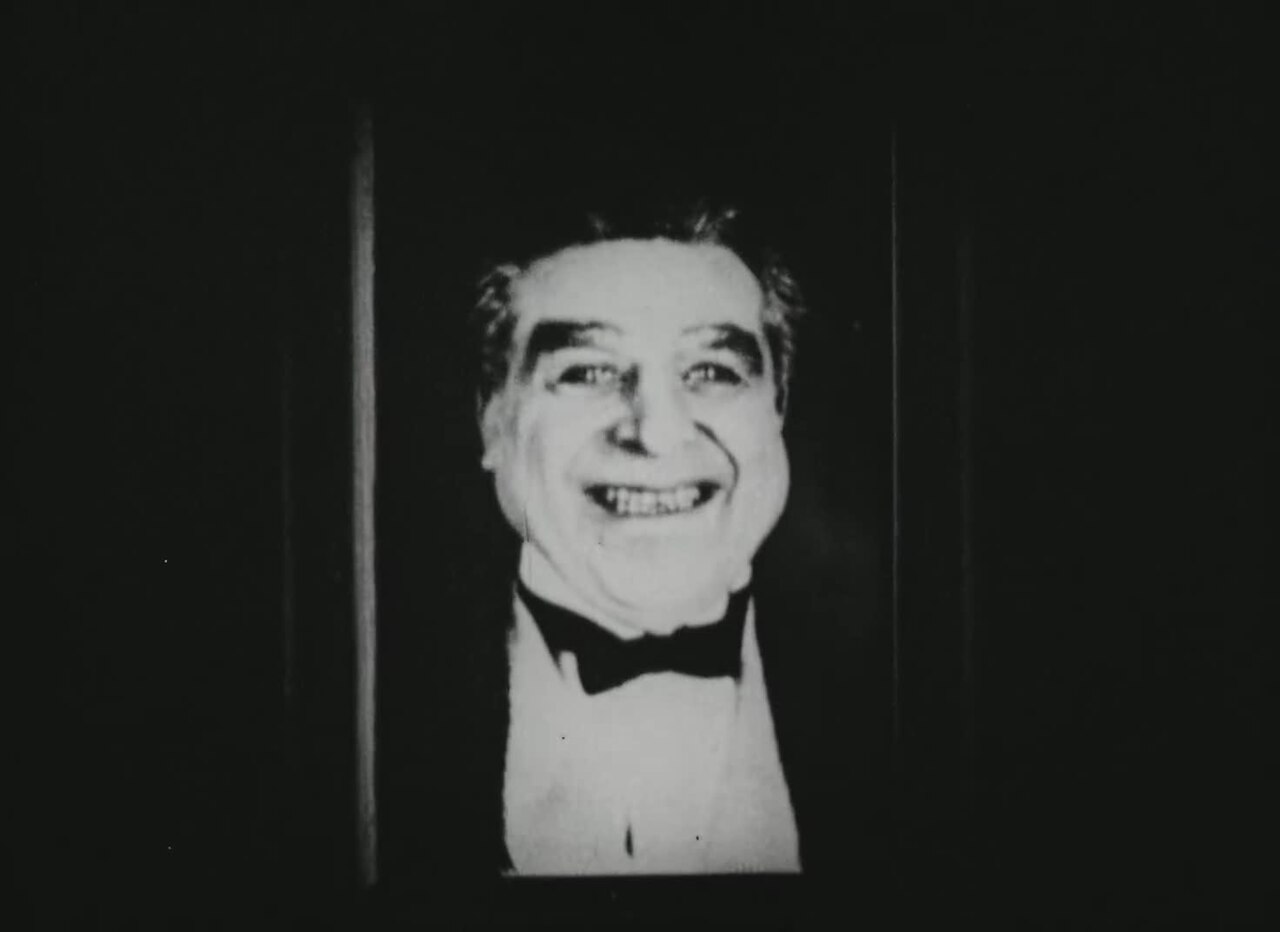
The Commons file used for this article's image preserves a frame from the film itself rather than a later poster or interpretive graphic.[5] That distinction matters here. A poster would advertise the work; a frame gives us the film's actual evidence. Madame Beudet's world is not frightening because it looks spectacular. It is frightening because it looks furnished, respectable, and complete.
So The Smiling Madame Beudet lasts not simply because it came early, or because it can be placed in feminist-film history, or because Dulac was a pioneering woman director. It lasts because its formal idea remains sharp. Marriage becomes visible as architecture. A joke becomes visible as control. A mirror becomes visible as enclosure. A revolver becomes visible as habit waiting to change state.
The film's title promises a smile and then makes the viewer ask who required it, who benefited from it, and what kind of cinema is needed to show the cost. Dulac's answer is still bracing. Do not explain the trap from outside. Film the room until the walls begin to speak.[1][3][4]
Sources
- British Film Institute, "La Souriante Madame Beudet (1922)" film page, with catalogue date, country, director, credits, and availability context.
- Encyclopaedia Britannica, "The Smiling Madame Beudet" film page, summarizing the marriage premise and repeated revolver joke.
- BAMPFA, "The Smiling Madame Beudet and Abstract Shorts by Germaine Dulac" screening note, describing Dulac's use of cinematic means to render frustration and fantasy.
- La Cinematheque francaise, "La Souriante madame Beudet" catalogue record, with 1923 dating, credits, production company, cast, format, and duration.
- Wikimedia Commons, "File:The Smiling Madame Beudet (1923) by Germaine Dulac.webm," source page for the real frame used as the article image.