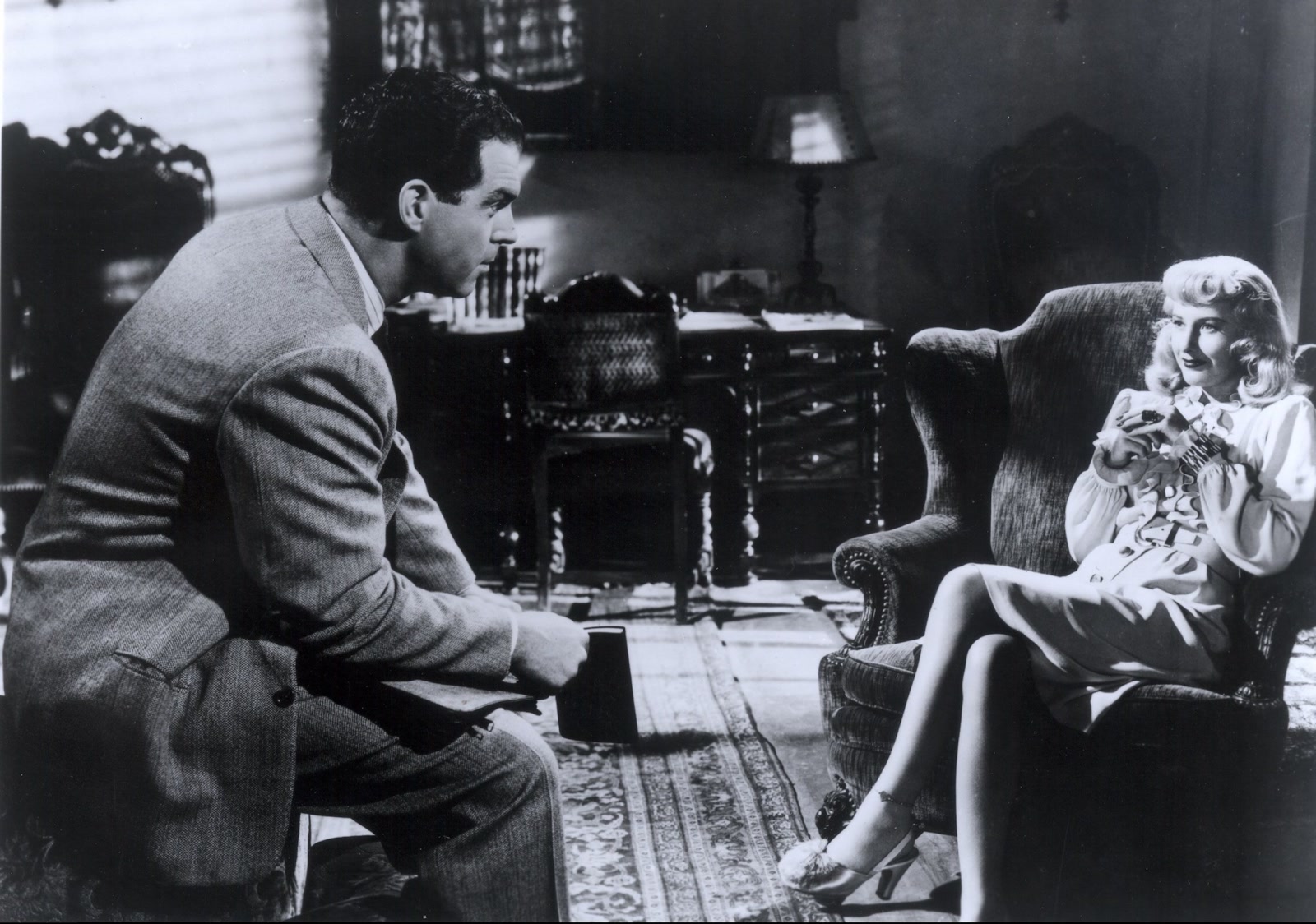
Many noirs are remembered for alleys, nightclubs, and revolvers. Double Indemnity earns its force somewhere less glamorous: the insurance office. The Library of Congress description places the film's design in exactly the right place, beginning with Walter Neff's dictaphone confession and unfurling the story as a flashback shaped by a claims man's ear.[3] That framing choice matters. Billy Wilder does not treat murder as an eruption outside ordinary professional life. He treats it as something that grows out of rate tables, policy language, door-to-door sales confidence, and the fatal vanity of a man who thinks knowing the system means he can master it.[2][3]
Spoiler note: this essay discusses the film's ending and its central murder scheme.
Criterion's recent essay on the film argues that Double Indemnity endures because it compresses alienation, desire, and the dreams and fears of white America into one especially sharp noir object.[1] One way to feel that sharpness is to stop calling the movie only a tale of lust and betrayal. It is also an office thriller. The seduction works because both Walter and Phyllis understand that paperwork can disguise appetite. Desire does not arrive in the film as pure impulse. It arrives disguised as product knowledge.
Image context: the lead image is an archival 1944 publicity still of Barbara Stanwyck and Fred MacMurray, preserved on Wikimedia Commons.[5] A real period still belongs here because this essay is about the way Wilder makes flirtation and conspiracy live in the same frame: two people standing close, already measuring risk, timing, and advantage.
The first seduction is a sales call
Walter does not enter the Dietrichson house as a gangster or adventurer. He enters as a salesman on business, and the entire film keeps faith with that origin point.[2][3][4] The opening exchange is charged because it merges commercial routine with erotic reconnaissance. Walter is supposed to be talking about accident coverage; instead he begins reading the room, the absent husband, the staircase, the towel, the anklet, and the opening for a private side deal.[4] In another noir, desire might interrupt the plot. Here desire is the plot because it hijacks a professional script already in motion.
That is why the title matters so much. "Double indemnity" is first a clause, a technical feature of an insurance contract. Wilder and Raymond Chandler turn that clause into a moral accelerator.[2][3] Once Walter sees how an accidental death could pay out at the right premium multiplier, romance and paperwork lock together. The murder scheme is not imagined in spite of office knowledge. It is imagined through office knowledge.
The movie gains a peculiar chill from that fact. Walter never feels like a born criminal. He feels like a salaried man intoxicated by the thought that expertise can outrun consequences. He sells policies for a living, understands how adjusters think, and believes that institutional familiarity gives him an advantage over the institution itself.[3][4] That confidence is erotic for him. Phyllis wants money and escape; Walter wants the darker pleasure of proving that technique can beat scrutiny.
Barton Keyes is the film's moral weather system
If Phyllis supplies the spark, Barton Keyes supplies the climate.[2][3] The movie would still be suspenseful without Edward G. Robinson's claims ace, but it would lose its deepest intelligence. Keyes is what keeps Double Indemnity from becoming a private melodrama. He represents the office as a living mind: pattern-recognition, habit, suspicion, and the almost sensual pleasure of smelling fraud before the file closes.
The Library of Congress notes that Walter's boss is the man trying to untangle the web of deception, and that phrase is more revealing than it first looks.[3] Keyes does not catch Walter by superior force. He catches him by professional instinct. Wilder's office world is not mechanical. It has nerves. A claims department accumulates the traces of motive, error, greed, and statistical abnormality. Walter mistakes bureaucracy for paperwork; Keyes experiences it as judgment.
That is why their relationship gives the film its emotional depth. Criterion's essay stresses the film's collaborative power and its complexity around masculinity and desire.[1] Nowhere is that complexity clearer than in Walter's attachment to Keyes. The film's great heartbreak is not that Walter loses Phyllis. It is that he betrays the one person whose professional respect actually mattered to him. The dictaphone confession lands so hard because it is directed into office equipment for Keyes, not into some romantic diary. Even Walter's final self-knowledge has to travel through institutional hardware.[3]
The house, the train, and the office form one closed loop
What makes Double Indemnity feel so severe is that it never really leaves the office behind, even in its apparently freer spaces.[2][3] The Dietrichson house is the site of flirtation, but it is also where policy terms are discussed. The train is the murder machine, yet its purpose is to manufacture a claim. Walter's apartment seems like a private refuge until it becomes another place where the logic of exposure settles in. Every room is tethered to the filing cabinet waiting at the end.
This is where John F. Seitz's cinematography matters beyond generic noir atmosphere. Criterion's film page and the Library of Congress registry notes both foreground the hard-edged visual design.[2][3] The shadows do more than make the film look dangerous. They give white-collar interiors the same moral pressure that gangster films get from streets and hideouts. Venetian blinds, doorframes, stair rails, and office partitions break the frame into strips and traps, as if professional life itself had become a visual accomplice.
The result is that murder never feels liberating. It feels administrative. Walter and Phyllis plan carefully, improvise cleverly, and still cannot escape the procedural afterlife of what they have done. Tickets, signatures, witness timing, medical suspicion, claim review, missed rhythms in a rehearsed story: the film keeps translating passion back into process.[3][4] That translation is the real source of dread. A crime of desire becomes more frightening once it has to survive audit conditions.
Why the movie still feels modern
The continuing life of Double Indemnity is easy enough to document. The Criterion edition frames it as a canonical American film, while the Library of Congress keeps it in the National Film Registry and the LOC blog notes its seven Oscar nominations, even if it famously went home empty-handed.[2][3][4] But the movie's modernity lies somewhere else. It understands that institutions do not cancel desire. They format it.
That insight still bites. Plenty of thrillers treat bureaucracy as dull scenery surrounding the real drama of temptation. Wilder treats procedure as the medium of temptation itself. Policies, endorsements, sales patter, memoranda, dictation, and claims review are not neutral containers around Walter's fall. They are the route by which the fall becomes thinkable.
That is why Double Indemnity remains more than a classic noir with a lethal blonde at its center. It is a study of white-collar intimacy under fluorescent moral pressure, a film where the office teaches people how to count risk and then watches them confuse calculation with freedom. By the time Walter speaks into the dictaphone, the movie has closed its cruelest circle. He has not escaped into passion. He has merely converted passion into a file that somebody better trained was always going to read.[1][3]
Sources
- Angelica Jade Bastien, "The Black Heart of Double Indemnity," The Criterion Collection.
- The Criterion Collection, "Double Indemnity" film page and edition notes.
- Library of Congress, National Film Registry description for Double Indemnity (1944).
- Neely Tucker, "The (Very Polite) Letters Behind "Double Indemnity"," Library of Congress blog.
- Wikimedia Commons file page for the 1944 Double Indemnity publicity still used as the lead image.