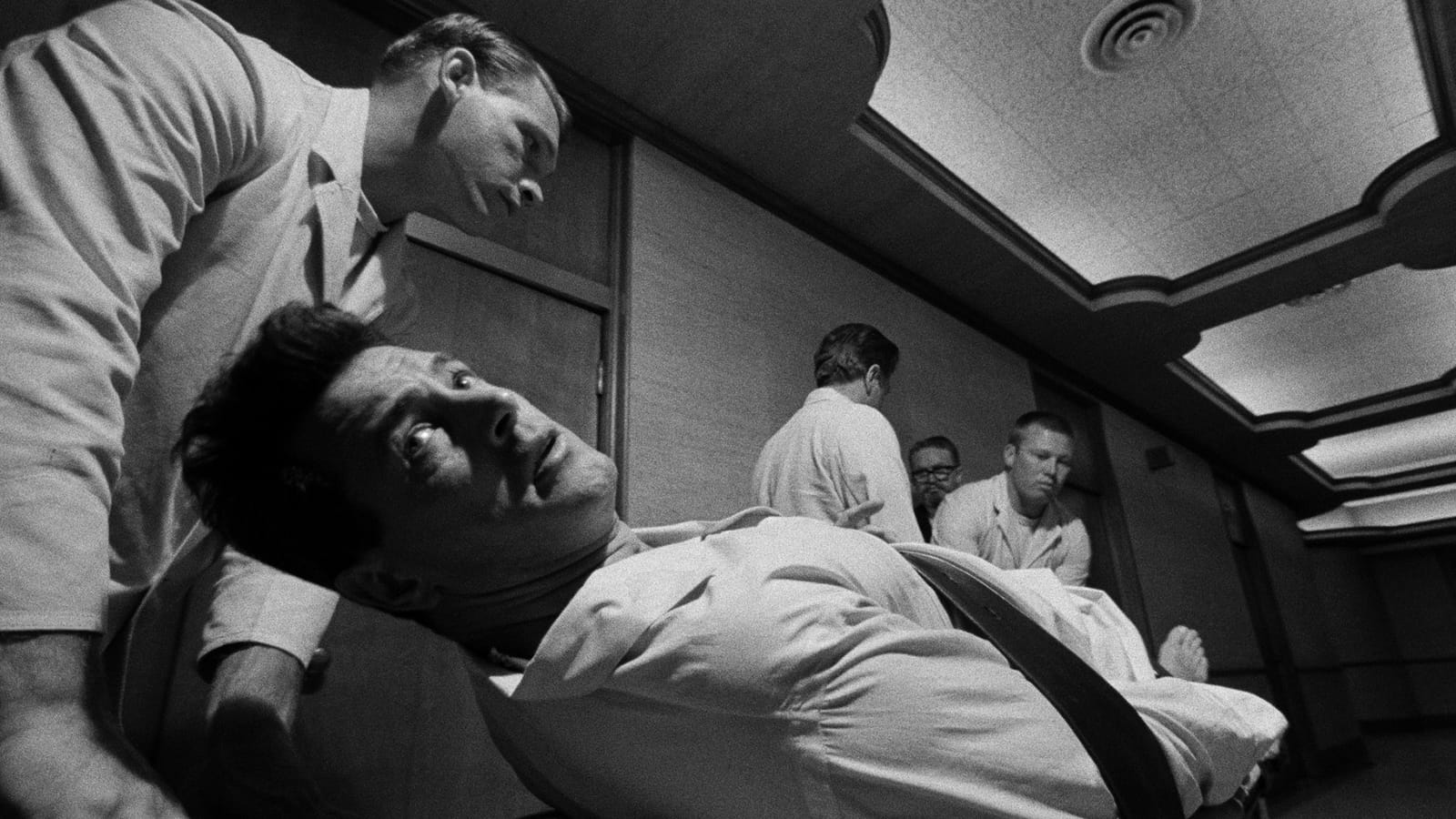

Criterion's "Three Reasons: Seconds" is short enough to look like a promotional teaser, but it is best watched as a compact map of the film's trap.[1] John Frankenheimer's 1966 thriller has a clean speculative premise: a tired banker pays a secret company to fake his death, remake his body, and install him in a younger, more glamorous life.[2][4] The terrible part is not simply that the bargain goes wrong. The terrible part is that the bargain works exactly as a company would make it work. Desire becomes intake. Regret becomes leverage. A new face becomes a deliverable. The self is treated as a customer problem.
That is why this video belongs in annotated-viewing form. It does not need to summarize every beat of Arthur Hamilton's transformation into Antiochus "Tony" Wilson. Instead, it points to the film's governing pressure: Seconds is not a fantasy of escape that becomes horror by accident. It is a corporate nightmare in which escape has already been productized.[3] Criterion's film page calls the movie a "paranoiac symphony" of canted angles, fragmented editing, and layered sound design, and that phrase gets close to the real mechanism.[2] Frankenheimer does not merely tell a story about identity collapse. He makes the image behave as if identity is being handled by equipment.
The lead still makes that logic visible before the article even reaches the embed. A man is strapped to a table; attendants occupy the frame as technicians rather than rescuers; the ceiling tilts enough to make the room feel professionally designed and psychologically wrong at the same time.[6] Nothing here looks like gothic horror. It looks like service delivery. That is what makes the film so modern.
The video sells rebirth as a procedure, not a miracle
The first thing to watch for is how quickly the clip treats transformation as physical process.[1] There is no soft dissolve into a dream self, no comforting fantasy of becoming young by wishing hard enough. The video foregrounds bodies under pressure: faces examined too closely, skin made strange by lenses, men moved through rooms whose geometry feels slightly hostile. Britannica's synopsis gives the story's practical contract: Arthur Hamilton is "reborn" as Tony Wilson after a mysterious organization stages his death and gives him a new identity.[4] The Criterion clip makes the emotional cost of that contract more immediate. Rebirth is not transcendence. It is administration plus surgery.
David Sterritt's Criterion essay is useful because it places this bargain inside Frankenheimer's broader 1960s paranoia, after The Manchurian Candidate and Seven Days in May.[3] The shared anxiety is control: who owns the mind, the body, the public role, the story a person tells himself about freedom? In Seconds, control is not imposed by a visible state machine alone. It arrives as an offer. The Company does not begin by chasing Arthur down an alley. It sells him a correction to his own disappointment.[3]
That sales logic is what makes the film nastier than a simple cautionary tale. Arthur's old life is not presented as secretly wonderful. It is stale, lonely, and professionally hollow.[3][4] The Company is dangerous partly because it diagnoses something real. It understands the vacancy in the customer before it exploits him. The clip's quick flashes of clinical space and altered faces preserve that contradiction: the old self is unlivable, but the purchased new self is not life. It is a managed replacement.
James Wong Howe makes the face stop being trustworthy
Around the middle of the video, the strongest visual idea is distortion.[1] Faces loom, bend, fragment, and refuse ordinary social distance. That is not just a horror flourish. It is the film's central argument about identity. If the face is what lets other people recognize you, then Seconds asks what happens when recognition can be engineered, bought, and reassigned.
Walter Chaw's Criterion essay on James Wong Howe calls Seconds an outlier in the cinematographer's career because of its extreme close-ups, fish-eye effects, and ostentatious visual language.[5] Chaw's point matters because Wong Howe was not simply showing off technique. The technique fits a story in which the surface of the body has become both evidence and fraud. A face can certify a person in ordinary life, but here the face is the first thing the Company learns to falsify.
The clip understands that. It does not sell Rock Hudson only as star glamour.[1] It lets the viewer feel the instability beneath that glamour. Hudson's Tony is handsome, but handsomeness does not solve the problem of being Arthur. The new body carries an old panic. The new beach life, the new artist persona, and the new social script all look suspicious because the film has already taught us to distrust the surface that makes them plausible.[2][3][4]
This is where Seconds becomes more than a period piece about middle-class malaise. Contemporary culture is full of smaller, softer versions of the same promise: optimize the body, refresh the brand, change the image, start again under a better name. Frankenheimer's film is harsher because it refuses to separate image renewal from institutional power. The clip's distorted faces say what the plot later proves: a redesigned surface can become another enclosure.
The Company turns freedom into a closed workflow
The video's final value is how little liberation it allows into the frame.[1] Even when the premise gestures toward Malibu, painting, sex, youth, and a second chance, the visual field keeps tightening. Rooms feel overdetermined. Men appear where they should not. Social scenes carry the rhythm of surveillance. The Company is frightening because it does not merely perform the initial operation and disappear. It keeps owning the conditions under which the new life can be interpreted.[3]
Criterion's film page notes the restored 4K transfer and lists the movie's key collaborators: Frankenheimer, screenwriter Lewis John Carlino, novelist David Ely, cinematographer James Wong Howe, composer Jerry Goldsmith, and title designer Saul Bass.[2] That collaboration matters because Seconds is a systems film in its making as well as in its subject. Bass's title logic, Goldsmith's unease, Wong Howe's distorted camera, and Frankenheimer's hard spatial control all push in the same direction. The movie feels processed because every formal layer participates in processing the viewer.
The most disturbing implication is that Arthur never really buys freedom. He buys membership in a workflow whose exit terms were written before he arrived.[3][4] The Company can create a new identity, but it also defines failure, compliance, and disposal. That is why the story's science-fiction premise feels so close to noir. The trap is contractual. The customer signs because the old life feels dead. Then he discovers that the new life was only another room in the same building.
Watched closely, Criterion's short video makes that room visible in miniature.[1] The canted frames, medical handling, distorted faces, and cool institutional surfaces all point to one conclusion: Seconds is frightening because it understands that modern nightmares do not always begin with violence. Sometimes they begin with a professionally phrased offer to make you better.
Sources
- CRITERION, "Three Reasons: Seconds," YouTube video.
- The Criterion Collection, "Seconds (1966)" film page.
- David Sterritt, "Seconds: Reborn Again," The Criterion Collection.
- Encyclopaedia Britannica, "Seconds" film entry.
- Walter Chaw, "James Wong Howe's Way with Light," The Criterion Collection.
- Criterion Collection carousel still used as the article image, Seconds (1966).