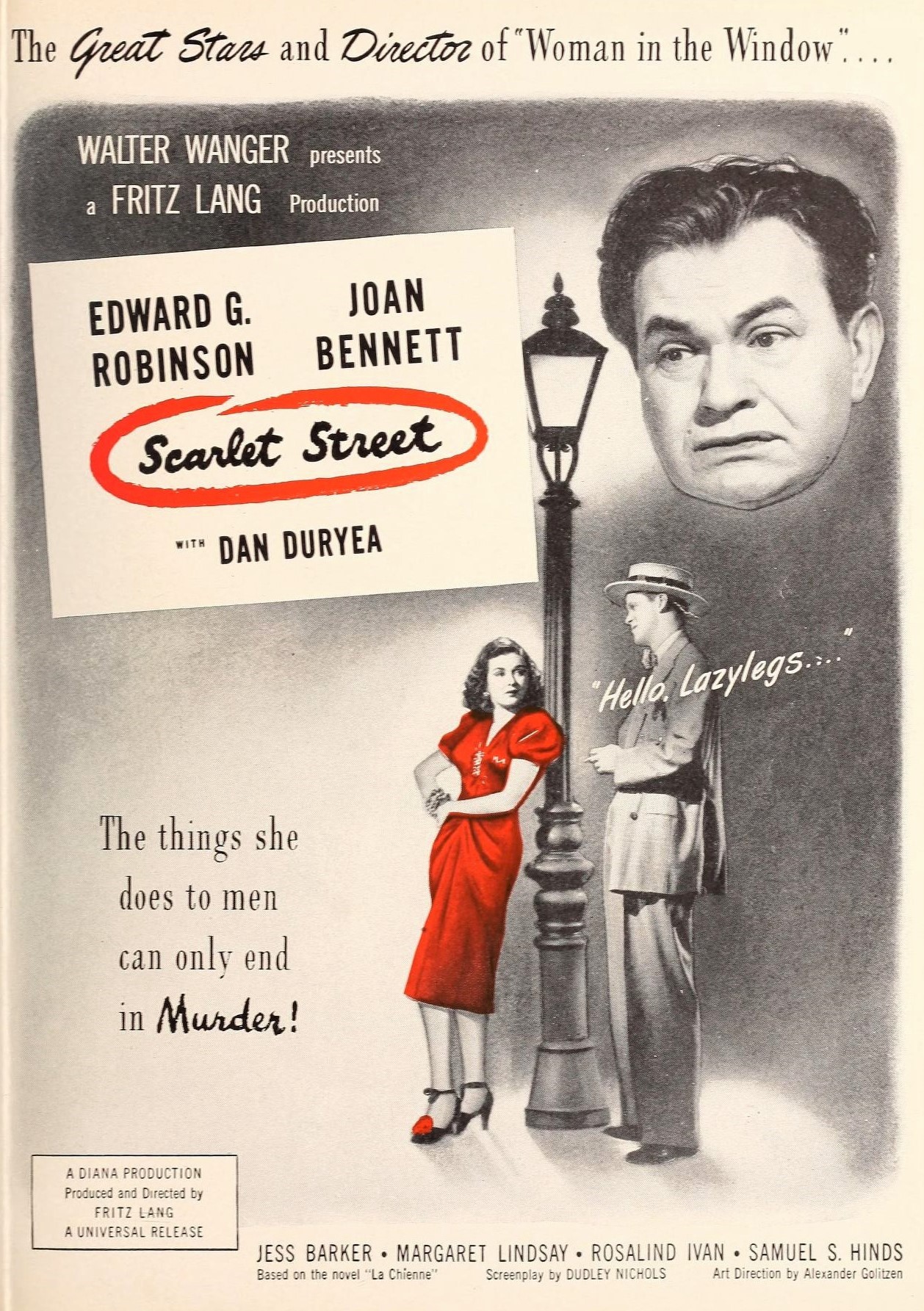
Fritz Lang's Scarlet Street (1945) is often introduced as one of the great American noirs, and it earns that place easily.[1][2][3] But the film's special cruelty does not come only from murder, blackmail, or the fatal woman plot. It comes from a more embarrassing subject: what happens when a person makes pictures in order to protect a private self, then discovers that pictures can be stolen, mislabeled, commercialized, and used to expose the very self they were meant to shelter.[1][3][4]
That is why the movie feels harsher than a simple downfall story. Christopher Cross is not a detective, gangster, or professional drifter. He is a cashier and Sunday painter, a man whose artistic life exists in the leftover corners of routine and ridicule.[1][4] Lang does not treat painting as a decorative hobby pasted onto a noir plot. He treats it as the hinge of the whole trap. Chris wants art to be the one place where desire can stay unpunished, where looking can become form instead of shame. Scarlet Street keeps proving the opposite. In this film, painting is the route by which shame acquires a market.
Spoiler note: this essay discusses the film's final stretch, including the false attribution of the paintings and Chris's ending.
Image context: the cover uses a real 1946 publicity still of Edward G. Robinson and Joan Bennett from Scarlet Street. It fits this essay because the image condenses the film's whole structure into one gesture: a meek man extends the instrument of authorship toward the woman who will become his fantasy, his false muse, and finally the public surface under which his work disappears.[5]
Chris paints because ordinary life has already humiliated him
One reason Lang's film hurts so much is that Chris is diminished before the noir machinery fully starts.[1][3] The cashier job, the anniversary dinner, the watch for twenty-five years of service, the nagging domestic life waiting at home: the world has already arranged him as a man who can be thanked without being seen. BFI's account of Lang's Hollywood noirs is useful here because it places Scarlet Street among the director's bleakest studies of ordinary men pulled into criminality through desire and bad luck.[2][3] Chris is not ruined because he once had too much power. He is ruined because he has almost none.
Painting is what gives him a second interior life.[1][4] In those scenes with brushes, canvas, and rented studio space, Chris does not look liberated exactly, but he does look less legible to the humiliations that organize the rest of his day. He can choose a line, a color, a way of framing a face. That matters because Lang's cinema is full of people cornered by systems larger than themselves, and Scarlet Street begins by offering Chris one small room where causality appears to answer to his hand.[3] The tragedy is that he mistakes this room for privacy.
The encounter with Kitty March feels like the opening of that room into life.[1][4] Chris rescues her from Johnny Prince's street violence, sees youth and beauty turn toward him, and begins treating the whole affair as if it were a painting already halfway composed. He does not merely desire Kitty. He aestheticizes her. That is his first mistake. He imagines that devotion, patronage, and authorship can be folded into one tender arrangement. Lang knows better from the start.
The paintings become valuable only after they are detached from the painter
The film's nastiest insight is that Chris's work starts circulating successfully only once it has been reassigned to somebody more marketable.[1][4] Kitty cannot paint, Johnny cannot paint, and neither one understands the pictures except as opportunity. Yet the art world they stumble into does not ask first about labor or sincerity. It asks for a story, a face, a usable identity. Kitty can supply that. Chris cannot.
This is where the movie stops being only a noir and becomes a vicious essay on authorship.[4] Chris paints from obsession, loneliness, and private fantasy. Johnny instantly recognizes that these paintings can be sold more profitably if the "artist" is a glamorous young woman with an aura of mystery. Kitty turns into the signature while Chris is reduced to invisible labor. Lang makes the arrangement feel tawdry, but not implausible. The fraud works because the market wants style attached to a body it already knows how to desire.
That logic poisons every relationship in the film.[1][4] Chris does not simply lose the woman; he loses the right to name what he made. Kitty does not simply receive stolen credit; she becomes the public mask through which the paintings acquire price, prestige, and gossip-value. Johnny becomes the manager of falsity, the middleman who understands that modern commerce often rewards performance more quickly than craft. By the time collectors and critics begin praising "Kitty's" work, Scarlet Street has already made its verdict: humiliation arrives not after art enters the market, but through the very terms by which the market recognizes art at all.
Lang films humiliation as a repeating form
The movie's emotional atmosphere is so suffocating because Lang refuses to isolate humiliation into one spectacular scene.[2][3] He makes it rhythmic. Chris is belittled at home, patronized at work, mocked by Johnny, manipulated by Kitty, and finally erased by the social success of his own paintings.[1][4] Each scene alters the pressure slightly, but the pattern is constant. A person speaks to him as though he were small, and the film records the injury as one more layer of enclosure.
That is why Edward G. Robinson's performance matters so much. BFI's film page and the Senses of Cinema profile both help place Scarlet Street inside Lang's run of "average Joe" tragedies, where ordinary men discover that decency offers no immunity from trapdoors.[1][3] Robinson does not play Chris as a grand tragic hero. He plays him as a man perpetually trying to recover a little dignity one scene too late. The delay is everything. It makes each compromise feel less like melodramatic weakness than like the cumulative effect of living too long under condescension.
Lang's visual method sharpens that feeling.[2][3] Rooms seem either cramped or falsely elegant, never restful. Doorways expose. Mirrors mock. Studio corners promise refuge and then turn into sites of extortion. Even the paintings themselves, which ought to hold some residue of private freedom, become accusatory objects once Johnny and Kitty start moving them through apartments, bars, and salesrooms.[4] Chris made them in solitude; now they return to him as proof that solitude has already been breached.
The ending refuses the fantasy that art redeems suffering
Many films about artists finally grant their suffering some conversion into meaning. Scarlet Street does not.[1][3][4] It comes closer to the opposite proposition: art can intensify degradation when authorship, money, and desire have already been corrupted. Chris survives the legal machinery for a while, but the survival is hollow. The world praises the paintings under the wrong name, executes the wrong man, and leaves the real maker wandering through a city where his work has achieved visibility only by excluding him from it.[3][4]
This is one reason Lang reportedly preferred Scarlet Street to The Woman in the Window, the earlier Robinson-Bennett-Duryea collaboration that softened its noir logic with a dream reveal.[2][3] Scarlet Street does not soften. It keeps the punishment alive after the plot has technically ended. Chris is not merely guilty; he is forced to watch authorship detach itself from life and continue without him. The torment is metaphysical as much as criminal. He is haunted by voices, yes, but also by a cultural fact: the image can circulate while the maker disintegrates.
That ending is what gives the film its modern edge in 2026.[1][4] It understands a condition that extends far beyond mid-century noir. Labor disappears behind branding. Credit follows the face that can be sold. Private making gets recoded as public content. The person who actually did the work may remain present, may even see the work admired everywhere, and still become socially unintelligible inside its success. Scarlet Street states that nightmare with unusual bitterness. It says the worst theft is not only of money, love, or reputation. It is of authorship itself.
Seen from that angle, Lang's film is not simply about a weak man destroyed by lust. It is about the indecency of watching expression become merchandise under somebody else's name. Chris Cross paints to escape humiliation and ends by discovering that humiliation has learned to sign the canvas.[1][2][3][4]
Sources
- BFI, "Scarlet Street (1945)" film page.
- Matthew Thrift, "Fritz Lang: 10 essential films," BFI.
- Senses of Cinema, "Lang, Fritz" (Great Directors).
- Filmsite, "Scarlet Street (1945)".
- Wikimedia Commons, "File:Edward G. Robinson and Joan Bennett in 'Scarlet Street', 1946.jpg".