
Janus's 2024 4K restoration trailer for The Umbrellas of Cherbourg is only 106 seconds long, but it understands something essential about Jacques Demy's film.[1] It does not try to rescue the movie from its own artificiality by cutting around the all-sung form or by pretending the film is "really" a conventional romance with a few musical flourishes attached.[1][2][3] It leans into the exact opposite truth. This is a movie in which speech has already become melody, décor already behaves like emotional weather, and ordinary places like a family shop, a garage, and a railway station are asked to carry the weight that other love stories might assign to private confession.
That choice matters because the film's premise can sound lighter on paper than it feels on screen. BFI's capsule description gets the balance right: Demy's story is ravishing and melancholy at once, with Michel Legrand's score, Bernard Evein's color-coded design, and Jean Rabier's camerawork turning chance and fate into something sensuous rather than abstract.[2] Janus's press notes make the same point from another angle, stressing both the lovers' youth and the way Algeria, separation, and adulthood force the story out of first-love fantasy.[3] The trailer below is strong because it compresses those pressures without overexplaining them. It sells the film by showing that color, song, and space are already the plot.
BFI's obituary for Nino Castelnuovo is helpful here because it recalls Guy not as a generic romantic lead but as the garage mechanic whose life with Geneviève is routed through work, bicycles, narrow streets, and then military departure.[4] The trailer never forgets that practical world. Even at its most lush, it does not float free of labor, shops, or transport. That groundedness is what keeps The Umbrellas of Cherbourg from becoming mere confection.
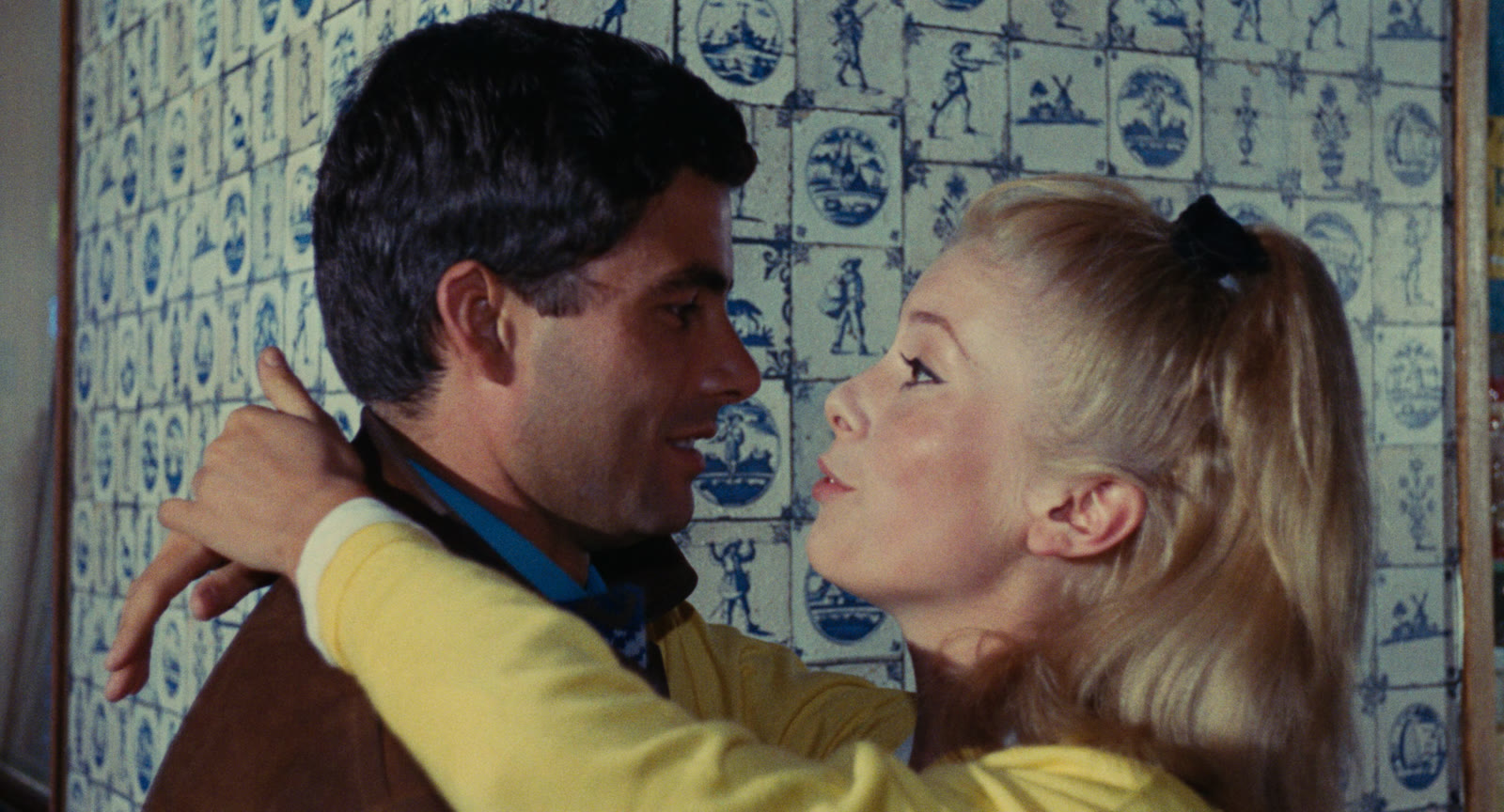
Image context: the lead image uses one of Janus Films' archival stills of Catherine Deneuve and Nino Castelnuovo. A real production still is the right image here because the trailer's entire argument depends on bodies being inseparable from designed space: lovers are framed as part of a colored commercial world, not as figures who escape it.[5]
From 0:00, the trailer tells you that color is not packaging but narrative pressure
The first thing the trailer sells is not plot information.[1] It sells a chromatic order. Instead of behaving like a dutiful summary that races to establish who marries whom and what goes wrong, it moves through saturated interiors, close faces, and street-level movement with the confidence of a preview that knows the film's deepest hook is formal.[1][2][3] The result is that color stops feeling like decorative excess. Pinks, blues, reds, and the polished brightness of the umbrella shop do not sit on top of the love story. They make the love story legible.
That is one reason Demy's film remains harder than its reputation. People who have not seen it often imagine it as a pastel object first and a tragic one second. The trailer understands the opposite sequence. It lets the film's visual abundance arrive before any heavy statement, but the abundance already contains pressure.[1][2] BFI's note that the movie transforms a sombre storyline into something enchanting is exactly right, because enchantment here is not an escape hatch. It is the delivery system.[2] The surfaces are what make fate hurt.
Around the middle stretch, the trailer keeps returning to shops, service spaces, and movement because workaday places are the film's true skeleton
One of the smartest things about this preview is that it does not isolate Geneviève and Guy in some abstract zone of lyrical feeling.[1] It keeps them attached to the environments that define them: her mother's umbrella business, his mechanic's world, the streets they move through, and the travel infrastructure that will eventually split them apart.[3][4] The romance is therefore never presented as pure transcendence. It is a love story that has to pass through counters, wages, errands, family pressure, and departure clocks.
That is more than good background detail. It is the film's method. When the trailer keeps circling back to retail and service spaces, it reminds you that The Umbrellas of Cherbourg is a musical built from ordinary transactions.[1][3] Song does not lift the characters out of daily life; it saturates daily life. Because everyone sings all the time, the movie removes the usual musical distinction between "real speech" and "heightened performance." The trailer grasps this completely. It does not present the music as a special event. It presents singing as the condition under which these people already live.
This is also why the film's emotional pitch feels so adult. The lovers are young, but the world around them is full of money trouble, illness, military service, and parental calculation.[2][3][4] By keeping the garage and the shop in view, the trailer quietly insists that heartbreak here will not come from abstract destiny alone. It will come from social timing.
In the last third, the trailer becomes honest about time: war, waiting, and the station turn melody into distance
The back end of the trailer is where the film's real severity starts to show.[1] Janus's description is blunt about the hinge: Guy is sent to fight in Algeria, and the two lovers are forced to grow up quickly.[1][3] The preview does not need a long explanatory detour to make that felt. What changes is the sense of interval. The bright, singing nearness of the early passages gives way to a harsher awareness that time will not preserve feeling in the form where it first appeared.
That is why the station material matters so much. In Demy's film, railway space is not just a place where people say goodbye. It is the architecture of contingency. The platform, the departure, and the later encounter in winter turn love into something measured by missed timing rather than by melodramatic revelation.[1][2][3] The trailer is wise enough to remember that The Umbrellas of Cherbourg reaches its greatest emotional exactness not when it is most florid, but when all that earlier color has to survive contact with delay, compromise, and changed circumstance.
This is where the all-sung structure proves its genius. If the movie used songs only for peaks of feeling, the later pain might arrive as a contrast effect. But Demy makes melody the texture of the whole world, which means loss arrives inside the same formal beauty that once carried desire.[2][3] The trailer does not reduce that contradiction. It puts it on display. Beauty remains; fulfillment does not.
That is why this short trailer works so well as criticism.[1] It understands that the film should not be marketed as kitsch, not even affectionate kitsch. It is a rigorously designed work in which color behaves like destiny, commerce behaves like setting and prison at once, and a station in the cold becomes the place where first love discovers it cannot return in its original form.[2][3][4] Janus is technically advertising a restoration, but the preview ends up advertising something more interesting: a musical in which artifice does not soften life. It makes life's timing visible.
Sources
- JANUS, "THE UMBRELLAS OF CHERBOURG - 4K Restoration Trailer," YouTube video.
- BFI, "The Umbrellas of Cherbourg (1964)."
- Janus Films, The Umbrellas of Cherbourg press notes PDF, including plot framing, production history, and 4K restoration details.
- BFI, "Nino Castelnuovo: remembering the Umbrellas of Cherbourg star, 1936 to 2021."
- Janus Films stills package, The Umbrellas of Cherbourg archival production stills ZIP.