Akira Kurosawa’s Rashomon (1950) is frequently summarized as “a film where everyone lies,” but that shorthand hides its real achievement. The movie does not merely present conflicting testimony; it builds a formal engine where image, performance, and edit rhythm make contradiction itself legible.
Set around one murder and one sexual assault recounted through mutually inconsistent accounts, the film runs about 88 minutes yet feels larger because each retelling rewires space, motive, and moral emphasis.[1][2] Kurosawa and cinematographer Kazuo Miyagawa do not neutralize these conflicts. They intensify them, then force the audience to work through the gap between plausibility and truth.
Spoiler note: this essay discusses the film’s testimony structure and ending turn.
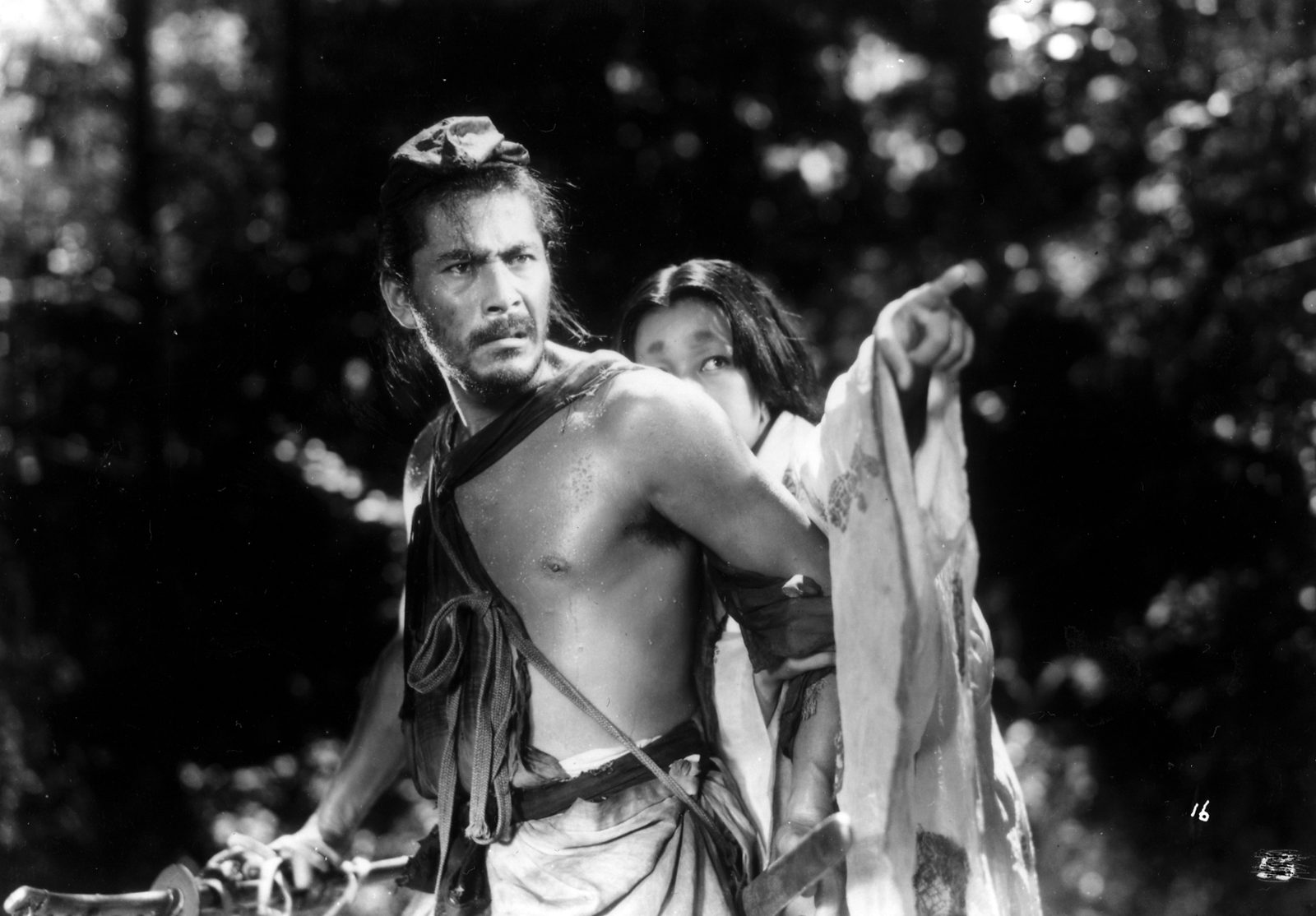
Image context: the cover still of Tajōmaru and the wife frames one of the film’s key craft tensions—performance as persuasion. In Rashomon, characters do not just remember events; they stage themselves inside those events.
1) The sun-shot gamble: uncertainty starts in the image, not in dialogue
One of Rashomon’s most cited craft moves is direct shooting toward sunlight through leaves in the forest sequences, a choice that was treated as technically risky in its production era.[1][3] In practice, this does two things at once.
First, it destabilizes visual certainty. The frame pulses with glare, branch shadows, and moving brightness, so the forest never settles into objective geography. Second, it makes testimony feel physically contingent: each account seems to emerge from a world where seeing itself is already partial.
The result is crucial for narrative trust. If the image world were clean and stable, contradictory testimony would read as a script puzzle. Because the image world is unstable, contradiction reads as the film’s governing condition. Kurosawa is not saying “there is no truth.” He is showing that access to truth is filtered by angle, ego, fear, and performative self-defense.
2) Testimony editing: repetition with drift, not repetition with confirmation
The famous structural loop—bandit account, wife account, dead husband account through a medium, and woodcutter account—works because each repetition is built with targeted drift rather than broad variation.[1][4]
Core actions recur: encounter in the grove, confrontation, blade violence, aftermath. But across versions, three variables keep shifting:
- Initiative (who drives the sequence),
- Honor framing (who appears dignified or degraded),
- Violence texture (duel-as-legend, panic-as-chaos, or humiliation-as-memory).
This is an editorial choice, not just a writing trick. The cuts preserve enough overlap for comparison while changing emphasis enough to trigger reinterpretation. Each testimony feels internally coherent while colliding with the others on motive and tone.
That is why the film stays alive on rewatch. The viewer is not just sorting facts. The viewer is measuring how cinematic form itself can convert self-interest into believable narrative.
3) Blocking as argument: where bodies stand decides what “truth” can look like
In Rashomon, blocking is moral rhetoric. In the gate scenes, the woodcutter, priest, and commoner are arranged in shifting triangles under heavy rain, and that spatial setup externalizes interpretive tension: grief, skepticism, and opportunism occupy different positions in the same frame.[1]
In the forest testimonies, body distance and eye-line geometry become part of each narrator’s self-portrait. Characters who appear heroic in one version appear exposed or frantic in another. Kurosawa repeatedly stages figures with asymmetric depth—one body advancing, another retreating, a third collapsing the line—so “what happened” is inseparable from “how someone wants to be seen.”
Even in the trial framing, where the court itself is not shown as a conventional objective master space, performance is centered over institutional authority. The film denies viewers a neutral judicial anchor and instead gives them contested presentations.
Craft takeaway: the movie’s epistemology is built in staging. Blocking does not decorate testimony; it produces testimony.
4) Sound, weather, and pacing: contradiction needs atmosphere to stay credible
The Rashōmon gate downpour is more than mood. Rain creates a continuous present tense in which the men retell the case while physically trapped together.[1] The weather becomes structural glue between flashback blocks, keeping the film from fragmenting into disconnected episodes.
Music and pacing also regulate credibility. Testimonies are not all cut at the same emotional speed. Some passages accelerate toward bravado; others linger in shame or confusion. Those shifts prevent the film from reducing every narrator to the same kind of liar.
BFI’s Kurosawa overview describes Rashomon as a key entry point into his larger concern with truth, illusion, and human self-justification.[3] That concern lands because craft supports it at scene level: image instability, repeated-but-shifting montage, and actor-centered blocking all pull toward the same thematic center.
5) Why this craft model still matters in 2026
The term “Rashomon effect” is now common in journalism, legal reasoning, and social analysis, often used for contradictory witness accounts.[5] But the film’s durable lesson is more specific: disagreement becomes narratively meaningful only when form clarifies what is changing and what is not.
Kurosawa keeps event anchors stable enough for comparison while allowing identity performance to mutate around them. That balance is why the film could become both a historical milestone—its 1951 Venice breakthrough helped open global attention to Japanese cinema—and an enduring craft manual.[2][3][6]
For filmmakers and critics, the practical model is still sharp:
- Keep shared event anchors visible.
- Let perspective differences alter motive, rhythm, and bodily relation.
- Refuse fake objectivity when the story is about contested perception.
Rashomon remains essential not because it says truth is impossible, but because it demonstrates how cinema can stage the cost of claiming truth.
Sources
- Wikipedia — Rashomon (film production, structure, release baseline)
- Encyclopædia Britannica — Rashomon (film entry and awards context)
- BFI — Where to begin with Akira Kurosawa (historical reception and thematic framing)
- Encyclopædia Britannica — Kurosawa Akira biography (1950s period and international breakthrough)
- Wikipedia — Rashomon effect (concept afterlife and multidisciplinary usage)
- Encyclopædia Britannica — Venice Film Festival (Golden Lion context)