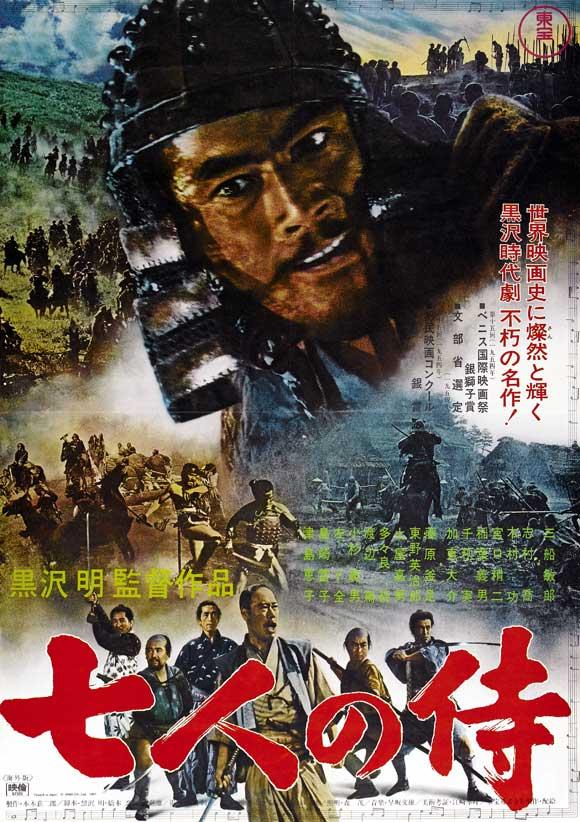
Akira Kurosawa is often summarized with one adjective: classical. That word is not wrong, but it misses the part of his practice that can still be treated as a living technical toolkit. He built a directorial method around three repeatable operations: a weather-first dramatic clock, geometric shot architecture, and scene-level rhythm that lets each cut inherit causality from the previous one.
This profile looks at those operations with one goal in mind: extract principles that remain usable in modern filmmaking, not produce a nostalgic canon list.
Weather as clock, not decoration
Kurosawa’s weather choices are often described in passing—rain, wind, mist—but the effect is more precise than atmosphere. In Rashomon and Seven Samurai, weather changes when emotional pressure crosses a threshold. It does not only decorate the image; it shifts where attention can live.
Rain in Seven Samurai is practical and symbolic at the same time: practical because muddy surface and reduced visibility make movement physically harder, and symbolic because ensemble control becomes visibly expensive. Camera placement follows that pressure. Characters are not only blocked for readability; they are blocked to preserve orientation while emotional and physical force is rising.
That logic reappears in his later work, whether in the civic stillness of Ikiru or the moral disarray of Red Beard. Weather is not a mood preset in advance. It is an information stream that edits the scene’s internal grammar. In practical terms: the same character action has different weight when the same cut lands under wet light versus dry light.
Geometry that lets action breathe
Kurosawa repeatedly uses a wide frame to keep action and consequence inside one legible surface. The frame carries three things at once: where bodies are, where they will move next, and what the cut will have to preserve. This is visible in battle scenes, but it is also visible in smaller scenes where gesture is the argument.
A useful shorthand for this style is “long-axis discipline.” He often arranges action so that movement vectors remain legible across cut direction, so the viewer tracks causal arcs without effort. You can see this in crowd choreography, where the wide shot is not just spatial context, it is the rulebook for how the cut will distribute tension.
The immediate result is viewer trust. If an audience can read the geography, the scene can carry psychological weight without forcing exposition. The director is not withholding information to create mystery; he is staging action so that information is visible before it is interpreted.
Ensemble rhythm as narrative engine
Kurosawa’s films are frequently discussed through protagonists, but his practical craft is frequently ensemble-first. He distributes focus across multiple trajectories and lets scene logic decide which trajectory claims authority in each moment. The technique is visible in Seven Samurai’s village defense sequence: one group builds perimeter, another secures mobility, another absorbs pressure. The scene’s meaning is generated by the timing between these layers, not by a single hero line.
That structure explains why he can pivot between spectacle and intimacy without changing tone mechanically. Cut rhythm is inherited from group behavior, and group behavior is visible because of framing choices. The film keeps its emotional line because it keeps its spatial and operational line.
In director terms, this is useful beyond period drama: if scene rhythm is built from actor behavior and environmental pressure, the emotional center can stay stable even when the storyline is broad. The director controls what the audience can compare, not what the audience is told to feel.
Production scale and control under pressure
The canonical stories about Kurosawa often move from art to personality and back to industry conflict. The production side matters because it intersects with his method. Multiple interviews and production notes around Seven Samurai and Rashomon repeatedly foreground practical constraints: weather planning, location control, crew coordination, and the cost of repeating action tests.[1][2]
What matters for a director profile is not the trivia itself, but the adaptation strategy. Constraints did not merely force compromises; they reinforced the method. He kept the shot plan connected to actor movement and weather continuity, which reduced the interpretive burden in the edit suite and kept the film’s visual argument coherent over time.
That is why his influence remains portable. A modern director can carry Kurosawa’s geometry not as style imitation but as a process: define the pressure source, fix spatial legibility before emotional overexplanation, then let action carry argument through accumulated beats.
Why these methods stay usable in 2026
If you strip away period references, the method maps to contemporary production with surprising precision:
- Design weather early as a narrative variable, not a last-minute filter.
- Preserve a legible frame geometry that supports action continuity for both long and short shots.
- Distribute scene pressure across ensemble trajectories so that the cut feels like consequence, not decoration.
- Let mise-en-scène carry causality before dialogue completes interpretation.
This is not a plea for imitation. It is a reminder that some classic systems remain durable because they were already process architecture, not period performance.
Sources
- Encyclopaedia Britannica — Akira Kurosawa biography (life timeline, major works, career context).
- Criterion Collection essays and filmography notes on Kurosawa’s recurring visual and production methods (release context and restoration notes).
- IMDb film credits and production references for Rashomon and Seven Samurai.
- Criterion Collection — Rashomon and Seven Samurai supplementary essays on framing, weather, and ensemble blocking.
- BFI Screenonline — Kurosawa profile and selected film context.
- Academy Awards archive and restoration records for major title releases and institutional reception.