There are two John Kennedys aboard the night train in Anthony Mann’s The Tall Target. One has the other’s coat, ticket, and seat. The other has the considerable advantage of being played by Dick Powell. We have followed Powell onto the train, so we know which man to believe. Imagine having to settle the question if you were the conductor. What better evidence could a passenger offer than the ticket you came down the aisle to collect? [1][2]
Mann’s 1951 film gives its detective a grand errand. The year is 1861, Abraham Lincoln is on his way to his inauguration, and Kennedy believes someone means to kill him in Baltimore. Most viewers could tell you before the lights go down that Lincoln made it to Washington. Asked to guess how a man without a ticket will persuade a railroad employee to let him stay aboard, those same viewers might like another minute. Here the suspense fits in a coat pocket. [1][2]
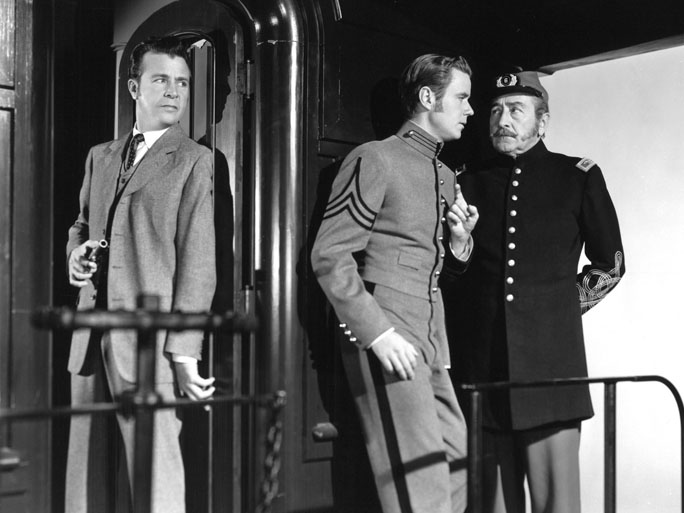
A seat makes a better witness
Notice how much work the stranger can do by staying put. Kennedy has had to scramble aboard. His friend Reilly was supposed to meet him with his ticket. By the time Kennedy finds Reilly on an exterior platform, all he can do is reach for him. The body slips away. The one man who could explain the mix-up has vanished, and the movement of the train makes going back to get him quite impossible. Inside, meanwhile, a passenger sits comfortably in Kennedy’s things. One man has an extraordinary story about what just happened outside. The other can hold out a piece of paper. [2][4]
There’s a small pleasure in watching Will Geer play the conductor because his job would make perfect sense in an entirely different movie. He has passengers to seat and a timetable to keep. Each time the detective needs him to stop and listen, somebody else has a claim on his time. Kennedy could explain the entire plot against Lincoln and still owe the railroad a fare. The stranger has found the cheapest possible disguise. All he needs to do is look like a customer whose business is settled. [1][4]
Colonel Jeffers, played by Adolphe Menjou, can straighten things out. He identifies Kennedy and offers him room in his compartment. It feels good to get out of the aisle. Then consider what just happened to the detective’s standing. He entered the carriage as a man who could speak for himself. He gets to stay because another passenger has spoken for him. The favor gives Jeffers an intimacy with Kennedy that he could scarcely have secured by walking up and introducing himself. A sleeping arrangement does the work of several pages of getting-to-know-you dialogue. [2][4]
The wheels keep their own time
Listen underneath these disputes. For much of the ride, the clatter of the train occupies the place where a thriller might put an orchestral score. The wheels have a particularly fine indifference to who wins an argument. They keep turning while the detective waits for someone to believe him. Baltimore gets a little closer even when the people on screen have spent the last minute discussing a seat. [5]
That sound also makes the conductor’s impatience easier to share. To Kennedy, a delay buys precious time. To the man charged with running the train, each delay is another thing he will have to answer for. The same rhythm supplies both performances with a reason to hurry. Geer can fuss, Powell can press his case, and neither actor has to turn to the audience and explain what the hour is getting to be. [1][5]
Think back to the ticket. In a station, Kennedy might have taken his complaint to a clerk, found a witness, or simply waited for the next departure. On a moving train, every minute he spends proving who he is carries him farther from the people who know him. Mann gets all that distance into the scene without needing a view out the window. You can hear it going by.
Sources
- Toronto Film Society, program notes for The Tall Target, including the cast and the film’s contemporary reception.
- American Film Institute, The Tall Target, catalog synopsis and production credits.
- Festival La Rochelle Cinéma, Le Grand Attentat, retrospective program and film still.
- Laura’s Miscellaneous Musings, review of the Warner Archive edition of The Tall Target.
- Cinema Talk, The Tall Target, on the train sounds and the film’s handling of suspense.