Spoiler note: this essay discusses the endings of Kanał, Eroica, Ashes and Diamonds, and How to Be Loved.
A national cinema can raise a monument to its heroes. The Polish Film School did something more difficult: it made the monument testify.
In the films that erupted after Poland's political thaw of 1956, wartime courage is rarely denied. It is cornered, cross-examined, dressed in the wrong clothes, trapped underground, or asked to survive after the public ceremony has ended. Andrzej Wajda gives heroic myth its most incandescent images, then plants those images in sewers, ruined churches, and a rubbish heap. Andrzej Munk answers with skeptical comedy, but his joke is never simply that courage is false. It is that a community may need the story of courage even when the facts refuse to cooperate.
That disagreement is the movement's engine. The Polish Film School was not a manifesto, a house style, or even an uncontested name. It was a network of filmmakers using a narrow political opening to argue over a recent past that official culture had distorted and private memory had not finished mourning.[1] What made it a “school” was not one answer to history. It was the pressure with which its films forced history to answer back.
A school built from an opening, not a manifesto
The label sounds more orderly than the phenomenon was. Culture.pl's movement history stresses incompatible themes, styles, and ideologies, and notes that filmmakers themselves disputed whether a coherent school existed at all.[1] The useful center is therefore institutional and generational rather than doctrinal.
The Łódź Film School, founded in 1948, brought together directors including Wajda, Munk, Kazimierz Kutz, and Janusz Morgenstern, alongside cinematographers such as Jerzy Wójcik and Witold Sobociński. After the 1956 thaw, its curriculum opened further toward international film culture, and its screening room circulated American and western European work unavailable through ordinary distribution.[2] Production units such as Kadr supplied another shared room: directors, writers, cinematographers, and artistic managers could collaborate, disagree, and sometimes defend difficult projects together.
The thaw eased censorship; it did not remove it. That distinction shaped the films. Subjects suppressed under Stalinism—especially the Home Army, the Warsaw Uprising, and the violent uncertainty of the postwar settlement—could reach the screen, but not in a language free of official pressure. Allegory, expressive composition, irony, ellipsis, and divided protagonists were not ornamental flourishes. They were ways to make contradiction visible without pretending that every contradiction could be spoken plainly.[1][3]
This is why it is too simple to call the movement anti-heroic. Socialist realism had offered certainty: history advanced in the correct direction, and a positive hero learned to march with it. The Polish Film School replaced that certainty with cases. Who gets called heroic? Who pays for the name? Does a failed action become noble because memory needs it to be? Can a person leave the war when the nation still lives inside its symbols?
Wajda makes the monument collapse inward
Kanał, made in 1956 and released in 1957, confronted the 1944 Warsaw Uprising after years in which it could not be represented honestly in Polish public culture. Wajda and screenwriter Jerzy Stefan Stawiński refuse the suspense of possible victory from the start: the narration announces that the doomed company we see is all that remains. The film then moves from shattered streets into the sewer system, reversing the war film's usual spatial promise. There is no hill to take and no open road home. Progress means descent.[3]
The sewers are at once location, ordeal, and historical argument. Fighters lose contact with one another; messages fail; darkness turns military organization into isolated bodies feeling along walls. At the most devastating exit, daylight and the far bank of the Vistula are visible through iron bars, but escape remains impossible. The image says more than the film could state directly about political abandonment. It also refuses the consolation many surviving participants and families wanted: not moral victory after defeat, but exhaustion, error, and death in the tunnels.[3]
The response proves how quickly the film became more than an artwork. The Polish Film Academy records 4.2 million domestic viewers in its first year and sales to 24 countries in 1957–58.[3] At Cannes, Kanał shared the 1957 Special Jury Prize with Ingmar Bergman's The Seventh Seal.[10] International recognition did not settle the Polish argument; it intensified the fact that an argument could now be seen.
Wajda's Ashes and Diamonds turns the next historical threshold into a single feverish day. On 8 May 1945, Maciek, a young Home Army fighter, is ordered to assassinate Szczuka, a Communist official. Wajda does not distribute innocence cleanly. Maciek has already killed the wrong men, but Zbigniew Cybulski's nervous charisma makes him feel painfully available to ordinary life. Szczuka represents the incoming order, yet he is also an exhausted anti-fascist trying to reach a son aligned with the opposing underground. Their conflict is political, generational, and almost familial at once.[5][6]
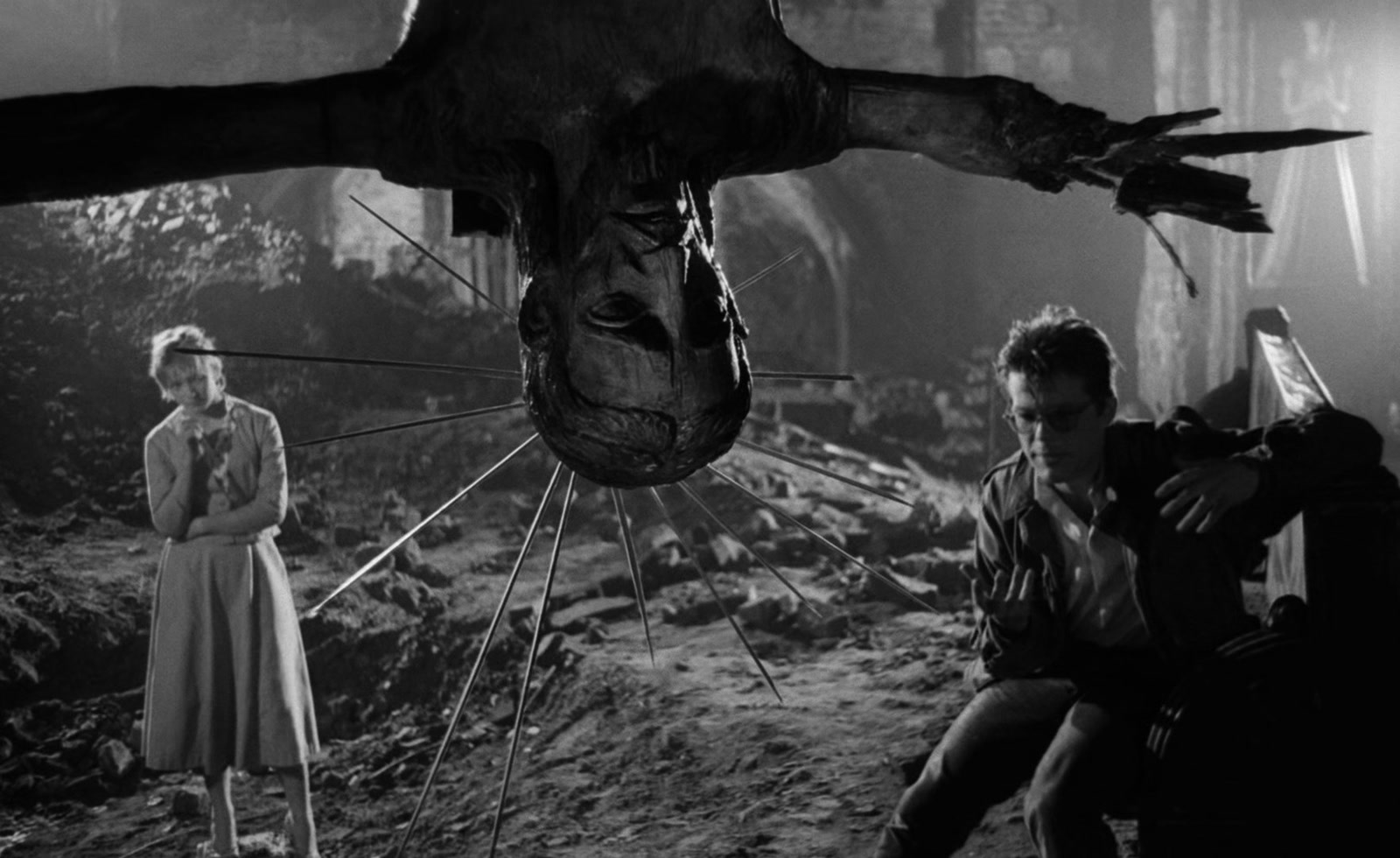
The film's symbols never sit still long enough to become emblems. Vodka glasses burn like candles for dead comrades. A crucifix hangs inverted in a bombed church. Fireworks celebrate peace while covering an assassination. A formal polonaise turns a dawn banquet into a dance of paralysis. Cinematographer Jerzy Wójcik's deep-focus frames keep rival meanings active in foreground and background, so history appears not behind the characters but around them, crowding the room.[6]
Even Maciek's dark glasses do double work: they can suggest damage from the Warsaw sewers and the cool of a contemporary young man who does not look like a museum soldier. Wajda's official film page recalls how Cybulski's clothes, glasses, gestures, and manner connected the character to a younger audience.[5] That connection made Maciek harder to contain within an approved denunciation of the anti-Communist underground. His final collapse on a rubbish heap strips away romantic posture, yet it does not make him disposable. The body is abject; the loss is not.
Wajda's achievement is therefore not the preservation of an intact heroic tradition. It is the ruined monument: an image beautiful enough to summon national feeling and unstable enough to expose what that feeling cannot repair.
Munk asks who needs the legend
Munk's films are often positioned as the rational, ironic answer to Wajda's tragic romanticism. The contrast is real, but “romantic versus anti-romantic” becomes another tidy legend if pushed too far. Munk does not merely puncture heroism. He studies how institutions manufacture it, how accidental people acquire it, and what may collapse when the legend is withdrawn.
His Man on the Tracks (1956), identified by the Polish Film Academy as an early anti-Stalinist film and a harbinger of the movement, reconstructs a railway worker's death through conflicting accounts.[7] Its form makes judgment procedural rather than automatic. Testimony shifts as motives and institutional incentives emerge; the supposedly backward saboteur cannot be understood through the first official explanation. Here the heroic problem is epistemic before it is military: a system that already knows the verdict cannot see the person.
Eroica, produced in 1957 and premiered in January 1958, announces its method in the subtitle “Heroic Symphony in Two Parts.” The musical joke has two movements and no simple punch line. In the first, Dzidziuś—a self-protective civilian with no appetite for martyrdom—undertakes a dangerous liaison mission during the Warsaw Uprising, discovers its futility, and still returns to the besieged city. In the second, Polish officers in a prisoner-of-war camp preserve morale through the story of a comrade who escaped. The supposed escapee is actually hidden in the camp, and the truth would destroy the very hope his legend supplies.[4]
The shared screenwriter matters. Stawiński wrote both Kanał and Eroica, so the films' disagreement occurs inside the same creative network and around related wartime experience.[3][4] Wajda makes defeat tragic by giving bodies and ruins the weight of a national lament. Munk changes the key: bravery may be reluctant, useless, misrecognized, or fictional, while cowardice may contain an honest perception of the odds. Yet Eroica does not conclude that myths are worthless. It asks the more uncomfortable question of whether people can live without the myths they know to be untrue.
That is why Munk's irony cuts deeper than mockery. Mockery stands outside its object. Munk remains inside the social need that produces the object, watching a heroic story fail as fact and continue working as shelter.
The war leaves the battlefield
If the Polish Film School were only a duel between Wajda and Munk, it would be smaller and neater than the films themselves. Its most revealing afterlife comes when war memory migrates away from military action.
Tadeusz Konwicki and Jan Laskowski's The Last Day of Summer (1958) reduces the visible world to two unnamed people on a nearly empty Baltic beach. Aircraft pass overhead; intimacy repeatedly approaches and withdraws. The Polish Film Academy places the film within the School's reckoning with collective trauma but emphasizes how radically it shifts the terms: sparse dialogue, location shooting, a minimal cast, and psychology in place of national spectacle.[8] War survives as interruption, failed closeness, and the sensation that an apparently open landscape still has no exit.
Wojciech Jerzy Has's How to Be Loved (1962) moves the argument into a woman's memory. Felicja shelters Wiktor, an actor wanted during the occupation, and sacrifices her public reputation to keep him hidden. He receives the fantasy of underground heroism; she receives the social stain of collaboration. Recalled during a postwar flight, their relationship turns national sacrifice into unequal domestic labor and unreturned love. The Polish Film Academy describes the film as an intimate response to the movement's martyrological and romantic tendency.[9] Casting Cybulski as the vain, fearful Wiktor makes the revision sharper: the body that had carried Maciek's tragic glamour now plays a man unable to bear the heroic image he wants.
These films do not abandon history. They change its scale. A beach, an apartment, a woman's professional exile, or the failure of two people to touch can hold the war as decisively as rubble can. Heroism is no longer only an action performed under fire. It is also a public role distributed afterward—and often distributed unjustly.
A movement held together by disagreement
The year 1958 alone makes a single-style definition impossible: Eroica, Ashes and Diamonds, The Last Day of Summer, Wojciech Jerzy Has's Farewells, and Tadeusz Chmielewski's comedy Eve Wants to Sleep all belong to the period's surge.[1][4] Tragic expressionism, skeptical comedy, chamber drama, noir-inflected atmosphere, and popular farce coexist. What connects them is less a visual signature than a new permission to distrust the finished story.
The movement traveled abroad in that plural form. A 1960 Museum of Modern Art programme placed Kanał, The Last Day of Summer, Eroica, and Eve Wants to Sleep within the same series of ten postwar Polish films.[11] The grouping is revealing. Internationally, Polish cinema did not arrive as one solemn national epic. It arrived as a field of incompatible tones generated by the same historical pressure.
That is the Polish Film School's durable intervention in the war film. It does not replace propaganda with a cleaner truth and call the work complete. It turns truth into a contested arrangement of testimony, performance, space, and memory. Wajda asks what happens when the heroic image remains emotionally irresistible after its political certainty has broken. Munk asks what happens when irony discovers that a false story may still keep people alive. Konwicki and Has ask who carries the past when public heroism has chosen the wrong body.
The movement put heroism on trial, but it refused to deliver a final verdict. That refusal is not evasive. It is the point. A verdict would close the case; these films keep the witnesses speaking.
Sources
- Culture.pl, “The Polish Film School” — overview of the post-1956 phenomenon, its disputed identity, incompatible styles, principal filmmakers, and selected filmography.
- Łódź Film School, “History” — the school's 1948 founding, early directing and cinematography cohorts, 1956 curricular opening, screening culture, and institutional atmosphere.
- Marek Hendrykowski, “The Canal.” Polish Film Academy — the Warsaw Uprising's prior public suppression, Kadr production context, Stawiński's experience, reception, audience, and export history.
- Andrzej Bukowiecki, “In Excellent Company.” Polish Film Academy — Eroica's 1958 premiere, two-part structure, Stawiński collaboration, Kadr context, and debate with heroic legend.
- Andrzej Wajda official archive, “Popiół i diament” — film record, Wajda's account of Cybulski's performance, production credits, and the Wiesław Zdort / Filmoteka Narodowa archival still used as the article image.
- Paul Coates, “Ashes and Diamonds: What Remains.” The Criterion Collection, 2021 — censorship boundary, Home Army conflict, visual doubling, deep focus, ruined-church imagery, and the film's competing historical claims.
- Polish Film Academy, “Andrzej Munk” — director profile covering Man on the Tracks, Eroica, Bad Luck, Kadr, and Munk's place in the Polish Film School.
- Andrzej Bukowiecki, “The Last Day of Summer.” Polish Film Academy — Konwicki's thaw-era reckoning, the film's minimal production, psychological war memory, and relation to the Polish School and New Wave.
- Mariola Dopartowa, “How To Be Loved — Or Ophelia's Dead.” Polish Film Academy — Felicja's memory, female civilian experience, non-heroic daily life, and the film's response to the School's romantic tradition.
- Festival de Cannes, “Kanał” — official 1957 competition record, credits, and shared Special Jury Prize.
- Museum of Modern Art, June 1960 schedule — archival programme listing Kanał, The Last Day of Summer, Eroica, and Eve Wants to Sleep in its “Ten Post-War Polish Films” series.