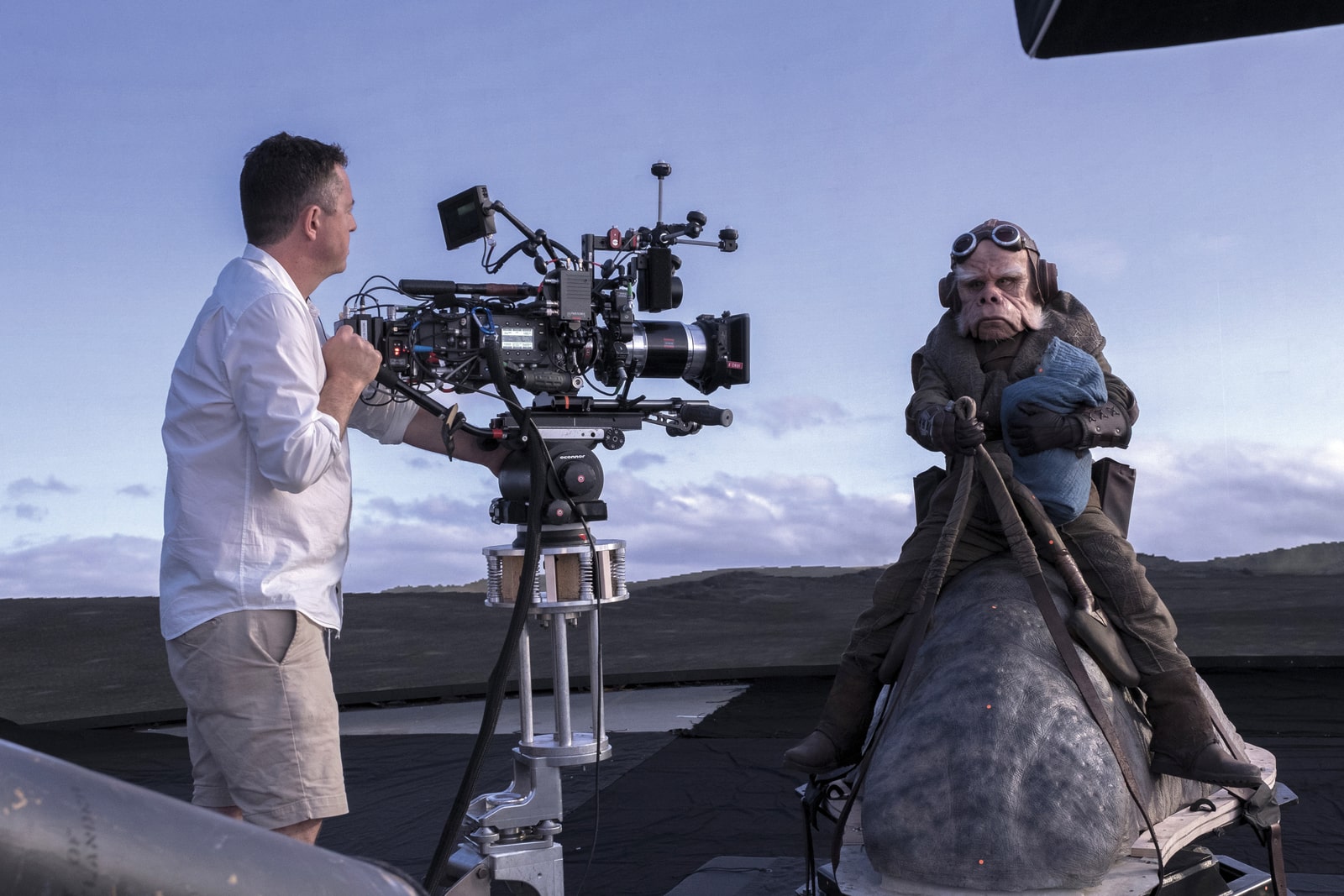
The sales pitch for an LED volume is a magician's one: walk onto a soundstage, press a button, and turn a wall into a desert, a city, or deep space. The useful truth is less magical and more interesting. An LED volume does not make the background disappear into technology. It gives the background a call time.
Digital scenery must now arrive prepared for principal photography. It has to know where the camera is, which lens is mounted, how quickly the camera is moving, what color the panels are actually emitting, and where the physical floor ends. If those systems agree, actors, props, reflections, and a virtual horizon can share the photographed frame. If they disagree, the illusion fails immediately. The horizon slips, the wall blooms, pixels form a moire pattern, or the light on a face belongs to a different world.
That is the real industrial change behind in-camera visual effects. The LED volume moves a large part of visual-effects judgment from an invisible postproduction handoff into a live, collaborative stage workflow. It can save a location move and give filmmakers a finished-looking image while everyone is still present to change it. It can also demand weeks of earlier decisions, a new technical crew, and a level of synchronization that a passive backdrop never needed.
A window that moves with the camera
An LED volume is not simply a very large television playing a panoramic plate. Its defining trick is perspective. A tracking system reports the live camera's position and orientation; lens data describes its field of view; a real-time engine renders the portion of the virtual set that this camera should see; and a cluster of processors distributes that image across the wall. As the camera moves, the rendered perspective changes with it. Virtual architecture gains parallax, so a column in the foreground appears to slide against a distant mountain as it would on a real location.[1][2]
ILM's first widely publicized StageCraft volume for The Mandalorian made the physical scale of the system unusually clear: a 20-foot-high, 270-degree LED wall and ceiling wrapped around a 75-foot-diameter performance area. Practical objects occupied the center while digital environments extended them. ILM reported that the virtual scene was rendered from the camera's perspective in real time, allowing photographed sets, actors, and the wall to form a composite during the take.[1]
The crucial area is often called the inner frustum: the camera-correct window rendered at the quality and perspective required for the shot. The rest of the wall can do other work. It can carry lower-detail scenery outside the photographed field, provide ambient color, or become a programmable lighting surface. Epic's technical overview describes the method as a synchronized mixture of LED display, live camera tracking, real-time rendering, and off-axis projection. None is sufficient alone.[2]
This is why the effect has a point of view. The image can look spatially correct to the tracked camera while looking stretched from somewhere else on the stage, much as a Renaissance perspective painting resolves from its intended viewing position. The volume is not manufacturing a complete physical world for everyone in the room. It is continuously manufacturing one convincing view for the lens.
The background comes to work early
Green-screen photography preserves a particular freedom: the background can remain undecided. That freedom is also a debt. Performers, camera operators, and cinematographers may have to commit without seeing the final spatial relationship, while compositors inherit the work of reconciling light, edges, reflections, and perspective later.
An LED volume pays down some of that debt on set by moving the decision earlier. The digital environment needs a production design, a time of day, working geometry, textures that survive photography, and controls that can be adjusted without stopping the day. Greig Fraser's account of StageCraft work describes backgrounds for The Mandalorian being committed far in advance, and his conversations on The Batman influenced scenes written for the volume's strengths: controlled dawn or dusk, long dialogue, and simple geometric structures.[5] The technology was already shaping the screenplay and schedule before it shaped the frame.
The seam between real and virtual must also be designed. A physical doorway may continue into a digital corridor. A built rock or vehicle may hide the point where the practical floor meets the screen. Perspective, texture scale, black level, and atmospheric depth have to carry across that join. Epic's production guidance repeatedly emphasizes testing on hardware comparable to the stage and optimizing the exact scene for real-time playback; an environment that looks beautiful on an artist's workstation is not automatically ready to drive a wall during a take.[3]
This changes who must be in the conversation. Production design, cinematography, visual effects, lighting, camera tracking, playback, and the operators commonly called the brain bar all touch the same photographed result. American Cinematographer's account of LED-stage lighting describes that crew taking tracking data into the rendering system and returning the imagery to the screens while filmmakers reshape virtual light from the stage.[4] The background is no longer a note that says “VFX to come.” It is a live department with cues.
Light is the killer feature, and the trap
The most persuasive argument for an LED wall may be what happens in front of it. The panels emit the colors of the environment onto actors and practical objects. A moving sky can roll across a polished helmet. A neon street can tint a windshield. A bright patch of virtual cloud can become soft toplight. Those reflections are photographed on the real surfaces that produce them, reducing the need to reconstruct every interaction afterward. ILM identified this interactive light as a central benefit on The Mandalorian, whose reflective armor made environmental continuity unusually valuable.[1]
The wall can be divided conceptually into scenery the camera sees and lighting the camera does not. Outside the inner frustum, operators can place virtual white cards, colored fills, or dark shapes that behave like flags and negative fill. American Cinematographer describes cinematographers changing those surfaces during close-ups, sometimes darkening entire off-camera wall sections or adding small highlights for the eyes.[4] The background and the lighting plan have become two outputs of the same display.
But an LED wall is not an artificial sun. Its light is broad and emissive; a hard, high-intensity source still often requires a conventional lamp. That lamp can strike the screen, lift its blacks, and reveal the wall as a wall. Even a modest reflection or bounce can contaminate the display, so fixtures and flags must be positioned with unusual care.[4] The enclosure adds another physical limit: a rigid curved wall can create difficult acoustics, and ceiling panels occupy space that grips might otherwise use for lighting and rigging.[5]
The volume therefore works best when the lighting logic of the scene suits it. Overcast exteriors, twilight, vehicle interiors, windows, reflective costumes, and sustained dialogue can benefit greatly. Noon sunlight, a camera racing close to the wall, or a scene built around wind, water, soil, and deep foreground interaction may expose its compromises. The correct question is not “Can this location fit on a screen?” but “Which parts of this shot should be emitted, which should be built, and which should remain for post?”
Pixels can betray the stage
The camera is photographing a display made of repeating light elements, so the relationship between two grids matters: the panel's pixels and the camera sensor's photosites. When their patterns interfere, moire can crawl across the image. Distance, lens choice, focus, sensor resolution, panel pitch, and shooting angle all change the risk. Epic recommends keeping the wall slightly out of focus and testing the camera-to-wall geometry rather than assuming that a finer panel alone will solve the problem.[2]
Color has a similar double life. A virtual sunset may look correct on a workstation, different on the LED processor's output, different again through the camera's spectral response, and different once a display transform is applied downstream. SMPTE researchers have documented saturated LED-wall colors shifting hue in conventional camera pipelines, including changes that can vary as focus moves toward or away from the wall.[6] SMPTE's broader color-management guidance treats calibration as an end-to-end problem: creative intent has to survive the virtual asset, stage display, camera, monitors, visual-effects work, and final grade rather than being declared correct at any single device.[7]
Time is the third grid. Tracking, rendering, panel refresh, camera shutter, and clustered render nodes must stay aligned. A slow drift can bend perspective; a fast move can reveal lag. Real-time also means a fixed performance budget. Epic's guidance tells artists to build for what the camera can actually resolve on the wall and to test the heaviest stage configuration early, because unnecessary geometry, expensive lighting, or unsynchronized media can turn an apparently finished environment into a dropped-frame problem.[3]
These constraints explain why “final pixels in camera” is a goal, not a purity test. Productions may replace part of the inner frustum with green, patch a seam, remove tracking hardware, extend a set, or revise an element later. The volume's achievement is not the abolition of postproduction. It is the ability to make more of the final relationship among performance, lens, light, and environment visible at the moment of photography.
The economics move rather than vanish
ILM reported that more than half of The Mandalorian's first season used its new workflow.[1] That figure helped make the volume look like a location-replacement machine, but the cost story is better understood as a transfer. A production may avoid travel, weather holds, repeated company moves, and the narrow daily window for natural twilight. In exchange, it needs an equipped stage, panels, processors, render nodes, trackers, calibrated cameras and lenses, virtual art, technical rehearsal, and operators who can solve the system while cast and crew wait.
The schedule moves too. Work once deferred to visual effects must become shoot-ready earlier. That can be valuable: the director, cinematographer, production designer, actors, and visual-effects supervisor see the same decision together, and a mistake can be corrected before the set is struck. It can also be expensive if a digital environment arrives late or has been designed without the real stage, lens package, lighting plan, and blocking in mind. A volume does not make preparation optional; it makes preparation photographable.
That boundary is why the technology should remain a choice rather than a default. Its best scenes do not merely hide the fact that a location is virtual. They use the wall's control over time, perspective, and reflected light to make a better working environment for a particular image. Its weakest scenes ask a luminous enclosure to imitate every physical property of the outdoors.
The phrase “virtual production” can suggest that filmmaking has become less material. An LED stage proves almost the opposite. Pixels have weight in the schedule. Color has to be measured. A horizon has to hit its mark. The background needs a crew, a rehearsal, and a call time—because by the time the camera rolls, it is already part of the set.
Sources
- Industrial Light & Magic, “Groundbreaking LED Stage Production Technology Created for Hit Lucasfilm Series The Mandalorian” (2020) — StageCraft stage dimensions, camera-tracked parallax, interactive light, and first-season production use.
- Epic Games, “In-Camera VFX Overview” — LED-volume architecture, off-axis projection, synchronization, panel selection, moire, and color considerations.
- Epic Games, “In-Camera VFX Best Practices” — real-time performance budgets, stage testing, clustered playback, lighting, and asset-preparation constraints.
- Noah Kadner, “Lighting for LED Stages.” American Cinematographer, September 13, 2021 — interactive illumination, virtual light cards, brain-bar workflow, hard-light supplementation, and screen contamination.
- Joe Fordham and Noah Kadner, “The Evolving Art of Visual Effects.” American Cinematographer, 2023 — the production photograph, early environment commitments, acoustics, tracking limits, and scene-design boundaries.
- Michael D. Smith and Michael Zink, “Hue-Preserving Color Transforms for LED Wall Virtual Production Workflows.” SMPTE 2021 Annual Technical Conference, DOI 10.5594/M001953 — measured hue shifts and their relationship to focus and moire control.
- David Long et al., “Color Management Principles for LED Panels in On-Set Virtual Production.” SMPTE Motion Imaging Journal 134, no. 2 (2025), DOI 10.5594/JMI.2025/XEJK1138 — end-to-end calibration and color-workflow principles.