
PlayTime has been called many things over the years: a bank-breaking folly, a prophecy about modern urban life, a comedy so meticulous that it almost behaves like architecture itself.[2][4][5] All of that is true, but Criterion's short video "PLAYTIME: How Jacques Tati Develops a Single Gag" is useful because it refuses the grand legend for a moment and asks a narrower question: how does Tati actually make one joke keep expanding across a shot?[1] That question gets closer to the film's real achievement than the usual stories about production cost or visionary ambition.
The answer is that Tati does not build comedy around a single privileged point in the frame.[1][3] He gives you glass walls, repeated doorways, matching chairs, tourists who drift into the wrong rhythm, and tiny sound cues that seem trivial until they suddenly redirect your eye.[1][4][6] The joke is rarely "here" in the emphatic sense. It moves laterally. It waits. It doubles back. By the time a comic payoff lands, the viewer has often done half the editing work internally.
That is why Janus's capsule description remains so accurate: every inch of the frame is "crammed with hilarity and inventiveness" even though the film is nearly wordless and outwardly calm.[5] PlayTime does not chase the forceful punch-line grammar of a faster comedy. It creates an environment where people become briefly unreadable to one another, then legible again, and the audience enjoys the delay.
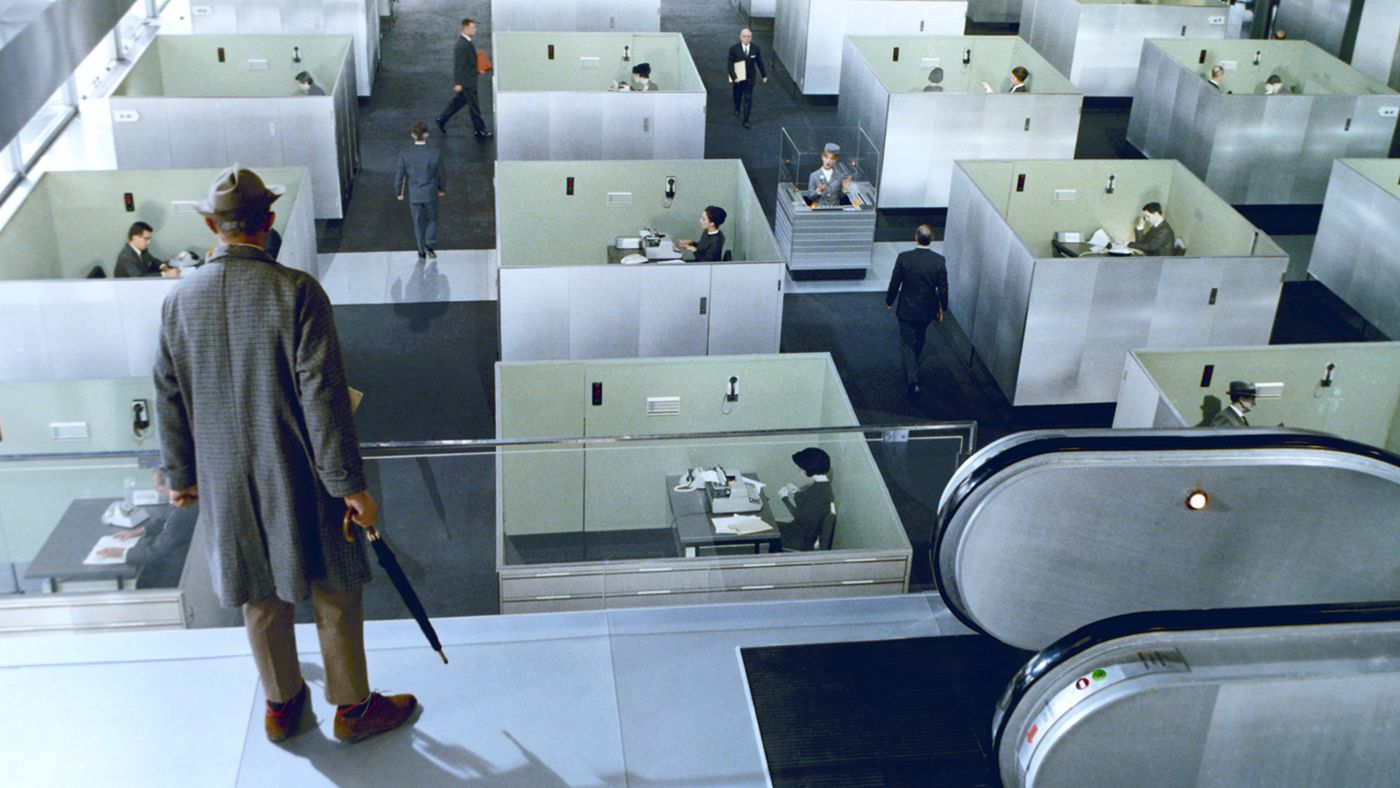
Image context: the cover uses an official Janus still from PlayTime. A real production still is the right image here because this article is about how Tati turns reflective modern interiors into comic systems of partial visibility: people seen through glass, mistaken for one another, or framed as if they were already part of the building's design.[5]
A single gag becomes a traffic system
The video's key insight arrives immediately in its title and opening examples: in PlayTime, one gag is rarely a one-beat event.[1] Tati takes a simple premise, such as a person trying to navigate a glass-heavy office complex or a crowd following the wrong visual cue, and lets it circulate through the whole space. Instead of isolating Hulot with a close-up and then cutting to a reaction, Tati makes the room itself do the comic work. Transparent walls keep characters visible and inaccessible at the same time. Doors imply access, then deny it. Reflections create false continuities. By the time one person figures out the geometry, someone else has already misread it.
That is why the film's modernity feels comic rather than merely cold. Roger Ebert wrote that Tati's city turns people into consumers, workers, and tourists in spaces where everything begins to look the same.[4] What the Criterion video adds is a formal explanation for how that sameness becomes funny.[1] Standardization does not only flatten experience; it creates temporary navigational errors. The joke is not simply that modern Paris is impersonal. The joke is that impersonal design produces a constant stream of tiny social misfires.
Jonathan Rosenbaum's essay on the film calls attention to the dance-like movement of bodies and objects through the frame.[3] That language matters. PlayTime is not cluttered for its own sake. It is choreographed. Each passerby, each turn of a chair, each opening and closing door helps establish a beat pattern that can then be delayed, echoed, or quietly contradicted. The film teaches you to watch horizontally, almost musically, because the important event may be arriving from the edge rather than from the center.
Glass is not just a look. It is a comic machine
The office windows, polished partitions, and reflective doors are often treated as visual shorthand for postwar modernism. That is only the surface level. In PlayTime, glass is a working comic device because it lets Tati split seeing from reaching.[1][4] You can spot the person you need, but you cannot get to them cleanly. You can read the layout for a second, then lose it because another reflection folds the space back on itself. You can assume that transparency will simplify movement, only to discover that it has produced another layer of confusion.
That repeated separation between visibility and access is what makes the film's wide frame so alive. Many comedies ask you to lock onto the star and follow the star's problem. PlayTime keeps distributing relevance outward. Hulot matters, but he is not the only engine. Tourists, receptionists, salesmen, waiters, cleaners, and accidental bystanders all inherit fragments of the joke.[3][4] The viewer cannot afford to be loyal to one face for too long, because the movie keeps rewarding peripheral attention.
This is also why the film still feels contemporary. Plenty of modern movies portray technology or urban design as alienating. Tati does something subtler. He makes designed environments produce behavioral scripts, then watches those scripts fail in small, revealing ways.[1][4][5] The comedy comes from friction inside systems that are supposed to feel seamless.
The soundtrack tells your eyes where to drift
The film is often described as nearly silent, but that can be misleading.[5] PlayTime is not silent at all. It is acoustically busy in a very selective way. James Quandt's essay on Tati's sound work emphasizes how carefully he composed image and audio together, treating noises, scraps of speech, and environmental signals as part of the frame's timing structure.[6] That is exactly what the Criterion clip helps you hear. A buzz, a squeak, a footstep, a swivel, an intercom murmur, or a chair leg scraping the floor can push your attention sideways before you consciously know why.[1][6]
This matters because Tati refuses to use dialogue as the main guide rope. Speech in PlayTime often arrives as texture or misheard business rather than as informational command.[4][6] Instead of telling you where the joke is, the soundtrack keeps seeding possibilities across the room. The eye wanders, the ear catches something, and then a visual payoff ripens half a beat later. That delayed coordination is one of the film's deepest pleasures.
It also makes the movie's famous late chaos feel earned rather than merely expansive. By the time the social order starts loosening, the film has already trained the viewer to enjoy misalignment, echo, and improvised adjustment. Tati's world does not suddenly become comic in the last act. It has been comic all along at the level of circulation, only the circulation becomes easier to notice once order begins to fray.
What to watch for after the video ends
On a replay, resist the urge to ask where the joke is supposed to be. Ask instead what line, reflection, noise, or repeated movement is teaching you how to scan the frame.[1][3][6] Watch how often Tati lets a character become briefly decorative before restoring that person's comic force. Watch how modern interiors turn everyone into both spectator and obstacle. Watch how glass promises clarity and then produces another layer of social delay. The film's comedy is generous because it does not hoard intelligence in one protagonist. It lets almost anyone in the frame borrow the scene for a few seconds.
That is the lasting achievement of PlayTime. It turns comic attention into a democratic art. The wide frame is not there to show off production scale by itself. It is there to make the viewer work differently: less obediently, more curiously, with a willingness to notice that the crucial event may be happening one pane of glass away from where the narrative seems to point. Criterion's short essay is valuable because it names that mechanism directly.[1] Once you see it, the film stops looking like an expensive period curiosity and starts feeling like one of cinema's great lessons in how to look.
Sources
- CRITERION, "PLAYTIME: How Jacques Tati Develops a Single Gag," official YouTube video essay.
- The Criterion Collection, "PlayTime" film page.
- Jonathan Rosenbaum, "The Dance of PlayTime." The Criterion Collection.
- Roger Ebert, "Great Movie: PlayTime" (1967).
- Janus Films, "PlayTime" film page and stills.
- James Quandt, "Jacques Tati: Composing in Sound and Image." The Criterion Collection.