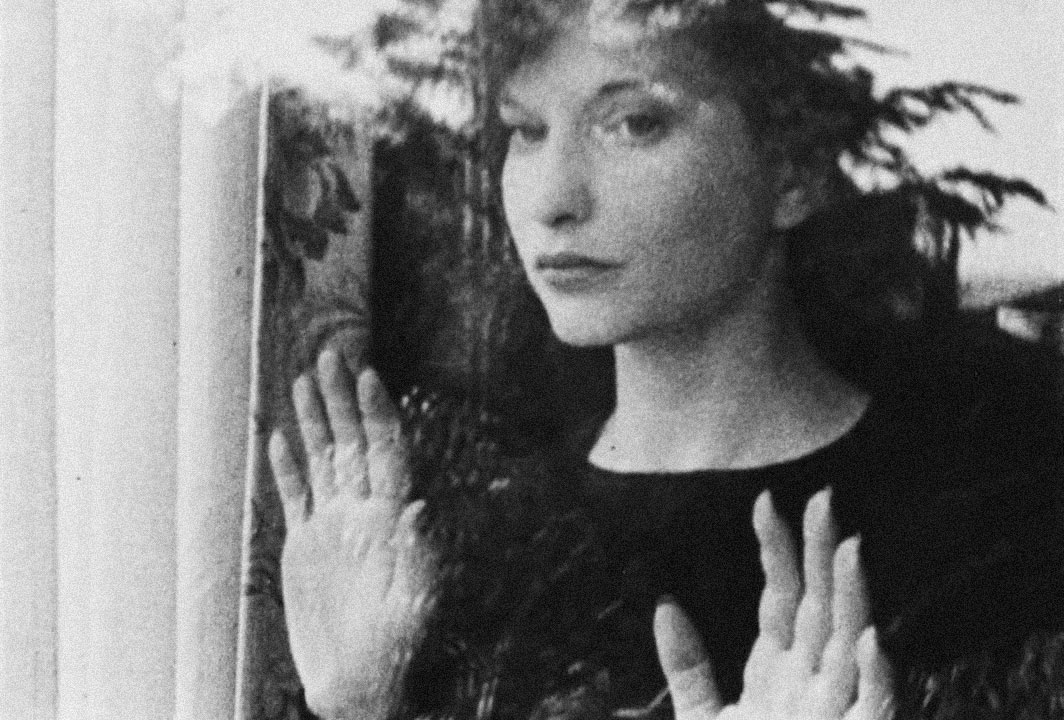
Maya Deren made only a small body of films, but she changed the scale of what experimental cinema could do with a room, a body, and a cut.[1][2][3][4] Her work still feels modern because it does not treat avant-garde film as a license for looseness. It does something harder. It takes precise gestures, repeated objects, and unstable transitions between spaces, then uses editing to make those things feel inevitable rather than decorative.[2][3]
That is why Deren remains larger than her runtime. The films are short, but they keep reopening the same question in different forms: what happens when movement through space stops being simple travel and becomes a ritual passage through states of mind, social positions, and versions of the self?[2][3][4] Meshes of the Afternoon (1943) turns an apartment into a looping machine of pursuit.[3][4] At Land (1944) makes geography itself unstable, as if a body could cross from shoreline to dining table to driftwood without asking permission from ordinary continuity.[2][3][5] Ritual in Transfigured Time (1946) shifts that logic into social space, where greetings, dances, and party manners harden into choreography.[2][3][6]
Image context: the cover uses a real still from Meshes of the Afternoon. It matters here because the film's window, staircase, key, knife, and cloaked figure are not just surreal props; they are the concrete objects through which Deren teaches the viewer how thresholds can carry a whole film's logic.[4][7]
Deren's method was never just dream imagery
It is easy to file Deren under dream cinema and stop there. The imagery invites that reading: a flower left on a path, a key in a hand, a record player, a staircase ascent, a knife on bread, a hooded figure with a mirrored face.[3][4] But the more useful description is structural. Deren does not scatter uncanny images at random. She arranges them so that each return slightly alters the viewer's relation to cause, time, and bodily orientation.[2][3]
That is why her background matters. Biographical and museum accounts alike stress that Deren emerged from a broader artistic practice shaped by writing, dance thinking, photography, and a sustained interest in ritual rather than by commercial studio norms alone.[1][2] Together those sources point to the same conclusion: Deren's films are built less from story beats than from recurring physical problems. How does a body enter a frame? What kind of cut makes a step feel continuous when the place has changed? When does repetition stop looking like narrative delay and start looking like ceremony?[1][2]
Meshes of the Afternoon: the apartment becomes a loop
The plot description of Meshes of the Afternoon is almost comically plain compared with the effect of the film: a woman enters her home, falls asleep, and experiences a dreamlike sequence in which recurring objects and actions return with accumulating force.[4] That plainness is useful because it reminds us how little Deren needs in order to build pressure. The film has a house, a path, a staircase, a few props, and Deren's own body. Out of those elements she makes one of cinema's most durable studies of recursion.[3][4]
What makes the film so potent is that each repetition is legible and destabilizing at the same time. You know you have seen the key before. You know the movement toward the stairs is familiar. You know the cloaked figure belongs to the system the film has already established. Yet each return carries a slight shift in angle, urgency, or implication, so that the apartment stops behaving like shelter and starts behaving like a trap designed by habit itself.[2][3][4]
Deren's performance matters here, but not in the usual character-study sense. She performs like a body trying to catch up with a pattern that has already started moving ahead of it. The result is neither classical suspense nor pure oneiric drift. It is a cinema of threshold stress: doors, windows, stair landings, table edges, and cuts between gestures all become pressure points. BFI is right to treat Meshes as the work that guarantees her legend, because it already contains the core Deren proposition that a domestic space can be edited until it feels like an interior weather system.[3]
At Land: continuity migrates from place to movement
If Meshes makes one apartment infinite, At Land takes the next step and makes the world itself discontinuous.[2][3][5] BFI describes the film through its startling transitions: Deren emerges from the sea, moves across driftwood, arrives at a dinner table, passes through landscapes, and keeps carrying her body across spaces that do not obey ordinary geographic connection.[3] That description gets to the center of her method. In Deren's cinema, continuity often belongs less to location than to gesture. A crawl, a turn of the head, a climb, or a reach can bridge spaces that realism would insist are separate.[2][3][5]
This is where Deren's relation to dance becomes decisive. The film does not ask the viewer to believe in literal travel. It asks the viewer to accept movement itself as the unit of thought.[2][3] Once that premise locks in, the cut stops reading as interruption and starts reading as transit. The body does not merely occupy space; it manufactures space by moving across it.
That insight helps explain Deren's influence. So much later experimental film, video art, and movement-based cinema depends on the idea that a cut can preserve kinetic logic even while destroying geographic realism.[2] Deren did not invent montage, but she used it with unusual bodily clarity. The viewer feels the shift in location, yet the movement continues with such conviction that the discontinuity becomes the point.
Ritual in Transfigured Time: society becomes choreography
By the time of Ritual in Transfigured Time, Deren had pushed the same formal intelligence into collective behavior.[2][3][6] The film is often summarized as a work about social ritual, and that is accurate so far as it goes. But the real achievement lies in how it shows social interaction turning physical. A greeting, a thread being wound, a party entrance, a dance, a chase: each begins as a recognizable human action and then hardens into patterned movement.[2][3][6]
This matters because Deren is not filming ritual as an ethnographic spectacle observed from the outside. She is showing how everyday social forms already contain ritual pressure.[2][6] Etiquette, flirtation, performance, and flight all operate like scripts the body half-knows before it consciously chooses them. The title is exact. Time itself feels transfigured because the film keeps converting familiar gestures into a more charged order.
Seen together, Meshes, At Land, and Ritual in Transfigured Time form a remarkably coherent director profile. Deren begins with the apartment, expands into landscape, then turns to society, but her governing question barely changes. She wants to know how cinema can make passage visible: passage from one state of self to another, from one location to an impossible next one, from ordinary interaction to ceremony.[2][3][4][5][6]
Why Deren still teaches directors in 2026
Deren's importance is often described in canon language, and the canon case is real. Meshes of the Afternoon entered the National Film Registry in 1990, and both MoMA and major film histories continue to place her near the center of American avant-garde film history.[1][2][4] But the more interesting reason she remains current is practical. She still teaches directors that abstraction works best when it is anchored in concrete physical decisions.
Her films never need huge scale to produce magnitude. They need a hand taking a key, a foot on a stair, a body crossing a threshold, a glance that restarts a pattern. That discipline is useful well beyond experimental film. Narrative directors can learn from the way she builds motifs without flattening them into symbols. Editors can learn from the way she lets motion carry continuity across impossible cuts. Choreographers and cinematographers can learn from the way camera position and bodily action generate meaning together rather than in sequence.[2][3]
The deepest Deren lesson may be that the mysterious in cinema becomes stronger when it is built from plain materials. A hallway is enough. A table is enough. A piece of coastline is enough. What matters is whether the filmmaker can make those places behave like thresholds rather than backdrops. Deren could, and that is why her films continue to feel less like historical curiosities than like live devices waiting to be activated again.
If you only have one evening, where to enter Deren
- Start with Meshes of the Afternoon if you want the cleanest statement of her method: repetition, domestic pressure, and editing as psychic architecture.[1][3]
- Move to At Land if you want to feel how she turns bodily movement into a continuity system stronger than geography.[2][3]
- End with Ritual in Transfigured Time if you want to see how the same intelligence scales outward into parties, dances, and social scripts.[2][3]
Sources
- Wikipedia, "Maya Deren."
- Sally Berger, "Maya Deren's Legacy," MoMA Modern Women course PDF.
- BFI, "Maya Deren: 7 films that guarantee her legend" (2017).
- Wikipedia, "Meshes of the Afternoon."
- Wikipedia, "At Land."
- Wikipedia, "Ritual in Transfigured Time."
- Wikimedia Commons file page for the Meshes of the Afternoon still used as the lead image.