
The revealing word in Netflix's behind-the-scenes documentary on Guillermo del Toro's Pinocchio is not “realistic.” It is “performance.” The film's makers talk about armatures, silicone skin, replacement faces, modular scenery, miniature lights, and 3D printing, but they keep returning to what those systems let an animator express.[1] The technology matters because a puppet has to hesitate, breathe, lose balance, or meet another character's gaze. Fabrication becomes acting by other means.
That distinction helps explain why the 2022 film, co-directed by Guillermo del Toro and Mark Gustafson, never treats polish as its highest virtue. Its wooden protagonist is asymmetrical and visibly unfinished. Sets retain texture. Movement sometimes carries the tiny disturbances that conventional animation would smooth away. Netflix's production history calls the intended result “perfectly imperfect” and describes a puppet hospital that adjusted joints and tension for the needs of individual shots.[2] These are not charming defects around a finished performance. They are part of the performance's vocabulary.
The featurette is especially valuable because it connects choices that are usually discussed separately. Puppet design changes the kinds of gestures available; scale changes how bodies relate inside a frame; a removable wall changes where a camera can stand; light changes whether a miniature feels inhabited. Watch those connections rather than treating the video as a parade of craft facts. The central argument emerges gradually: in stop motion, character does not reside in one object. It is distributed across bodies, materials, animators, sets, lenses, and time.[1]
2:36–6:45 — Imperfection has to be engineered
Early in the documentary, the puppet workshop reveals that “handmade” and “digital” are not opposing camps. Pinocchio's body combines a metal armature with printed and molded components, while other characters use intricate mechanical heads beneath flexible skins.[1][4] Frame.io's production interview describes the primary Pinocchio puppet as roughly nine inches tall and explains how metal printing, color printing, and traditional fabrication were assigned different jobs.[4] The point was not to prove one technique purer than another. It was to make a durable object whose pose could be changed minutely without losing its identity.
That durability creates an apparent paradox. Stop motion requires extreme control, yet the finished movement needs to feel capable of surprise. Around 5:16, the featurette emphasizes missed actions, incidental contact, and the slight accidents that make a gesture look discovered rather than diagrammed.[1] Film Independent's discussion with the directors similarly describes animators adding small improvisations and ordinary behavior to a shot.[5] A hand does not simply travel to its mark; it may search, overshoot, or settle. A torso prepares for motion before a limb completes it.
Those irregularities are not randomness. They are controlled evidence of effort. Because every frame is intentional, an animator must deliberately restore the uncertainty that continuous human movement supplies for free. The armature's resistance, the surface's compression, and the animator's sense of rhythm all contribute. By 6:45, when the documentary frames animators as actors, the claim no longer sounds metaphorical.[1] Their performance is indirect, but it is embodied: they feel a gesture, translate it into a sequence of poses, and leave just enough friction for the puppet to appear to own the result.
7:14–12:23 — One character can require several bodies
The section on Pinocchio's lanky design makes asymmetry readable as psychology. His limbs look assembled rather than standardized; his movement has to negotiate the body he has been given.[1] This is why the character's incompleteness is more than a visual reference to carved wood. It affects timing. A conventional boy puppet could inherit familiar balance and proportion. This Pinocchio has to invent them, so awkwardness becomes a credible stage in learning how to occupy the world.
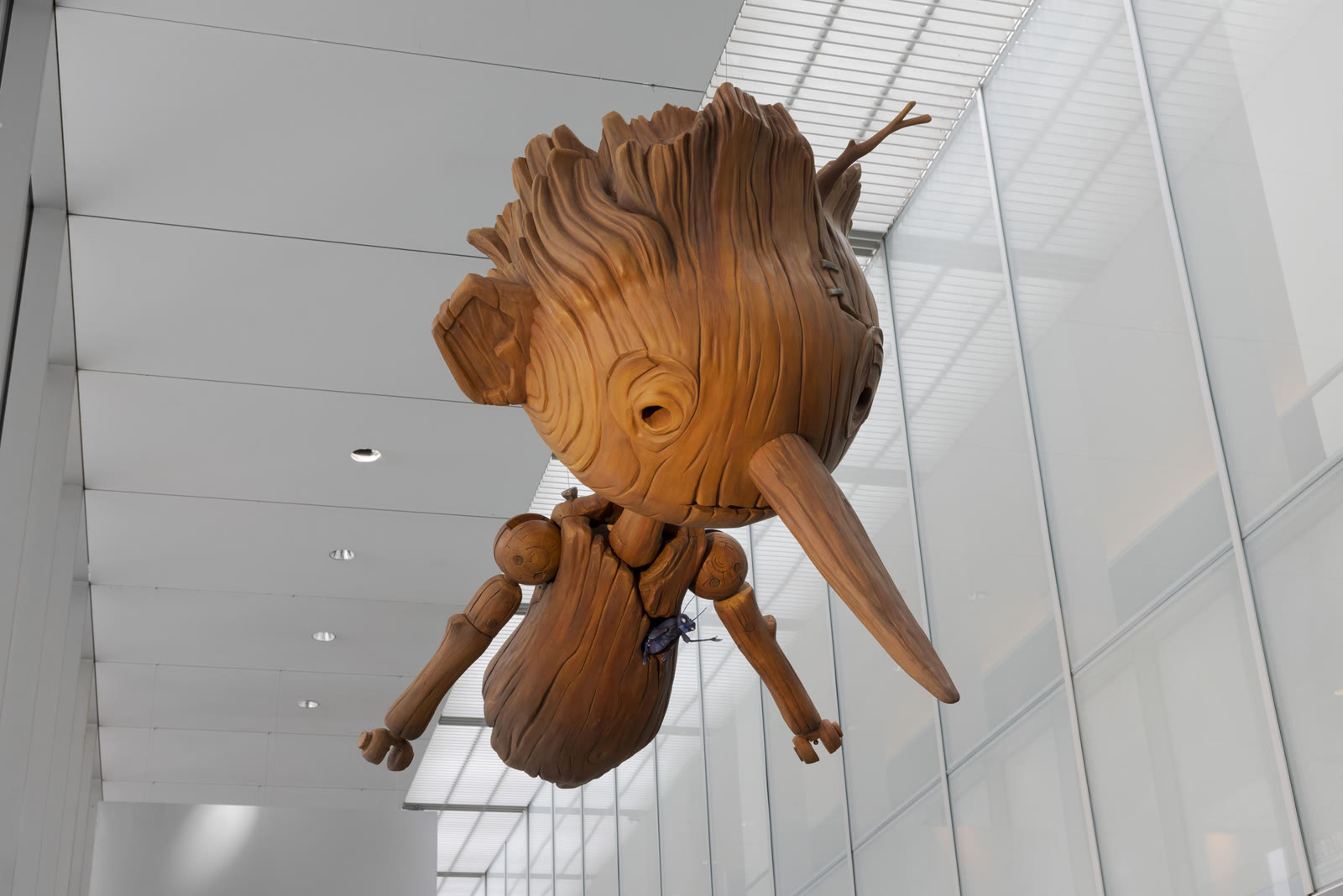
Then the documentary brings in scale. A shot with Geppetto asks for one set of proportions and eyelines; a shot organized around Sebastian J. Cricket may need another. Different-sized versions preserve the same character while changing what the camera and animator can do.[1] The MoMA exhibition later made this principle unusually concrete by placing an enlarged Pinocchio beside Cricket, turning the insect's viewpoint into a gallery encounter.[3] Scale here is not a claim about Pinocchio's literal height. It is a way of staging a relationship.
That is the key to understanding production duplicates. Netflix records that the crew made 32 Pinocchio puppets, allowing many units to work while maintaining a recognizable design.[2] But duplication and scale variation solve more than scheduling problems. A larger hand may permit a more articulate touch in close-up. A smaller body may allow a wider composition without building an impossibly vast set. The nine-inch primary puppet described by Frame.io is therefore not the one true Pinocchio from which every other body is a compromise.[4] Screen identity survives across objects because proportion, surface, pose, voice, framing, and movement keep agreeing about who the character is.
The result resembles editing as much as model making. Cinema routinely lets a face persist across a wide shot and a close-up even though its photographed size changes radically. Stop motion externalizes that operation: sometimes the production changes the physical object as well as the lens. What viewers experience as one continuous person is an achievement assembled across discontinuous materials.
12:23–18:20 — The world performs with the puppet
The documentary's tour of the sets expands the argument beyond character models. Walls and ceilings had to detach so animators could reach a puppet and cameras could move through spaces that still appear architecturally whole.[1] The Motion Picture Association's interview with animation supervisor Brian Leif Hansen describes several units working across dozens of sets, with workshops split or opened to accommodate particular shots.[6] A miniature room is therefore both fictional location and working instrument. It must hide the access that makes its performance possible.
Historical research and surface wear give those rooms weight, but detail alone does not make them cinematic. The featurette's later passages concentrate on moving cameras, a complex shot involving the monkey Spazzatura, and lights built into miniature practical sources.[1] Camera movement changes the animator's problem: the puppet's action must remain legible while viewpoint, parallax, focus, and illumination also change. A lamp inside the set does more than decorate it. Its light can model a face from frame to frame and bind the character to the room.
This is where the film's relation to live action becomes most interesting. It does not imitate live action by concealing every trace of animation. It borrows the expressive coordination of actor, camera, set, and light, then rebuilds that coordination at a scale where each element can be moved by hand. Digital tools assist that system rather than canceling its material basis.[1][4] The achievement is hybrid and practical at once.
What changing scale finally means
The film's craft supports a larger idea about personhood. Pinocchio does not become convincing because his wooden body disappears beneath perfect simulation. He becomes convincing because many collaborators discover how that particular body can act. Its stiffness can become resolve, its imbalance can become curiosity, and its visible construction can become vulnerability. The more plainly the movie acknowledges that he is made, the less it needs to equate humanity with a natural-looking surface.
Changing puppet scale sharpens that idea. There is no single object whose physical continuity guarantees the character. Pinocchio persists through a network of versions and relationships. He is large or small relative to the creature looking at him, close or distant relative to the camera, easy or difficult to move relative to the animator. What remains constant is not matter but a pattern of attention: how he meets a gaze, enters a room, reaches, stumbles, and recovers.
That is why this making-of deserves attentive viewing rather than admiration at arm's length. Its workshop footage does not merely reveal how an illusion was manufactured. It shows that manufacturing is the film's dramatic method. Scale chooses a point of view. A joint sets the range of an emotion. A removable wall opens a path for the camera. A tiny imperfection allows intention to look newly formed. In Guillermo del Toro's Pinocchio, the puppet is not built first and performed later. Building and performing are the same continuous act.[1][2][5]
Sources
- Still Watching Netflix, “Guillermo del Toro's Pinocchio | Step Inside the Magic of the Epic Filmmaking | Netflix,” YouTube video.
- John DiLillo, “Inside the Stop-Motion Magic of Guillermo del Toro's Pinocchio,” Netflix Tudum.
- The Museum of Modern Art, installation view of Guillermo del Toro: Crafting Pinocchio, photographed by Emile Askey.
- Lisa McNamara, “How Guillermo del Toro's Animators Brought Pinocchio to Life, One Frame at a Time,” Frame.io Insider.
- Gabriel Giammarco, “Directors Close-Up Recap: Guillermo del Toro's Pinocchio Has All the Right Moves,” Film Independent.
- Hugh Hart, “Best of 2022: Guillermo del Toro's Pinocchio Animation Supervisor Brian Leif Hansen Packs Puppets With Emotion,” The Credits, Motion Picture Association.