A subway carriage seems an unpromising place to seek a grand widescreen image. Its ceiling is low, its passengers crowd together, and the camera has little room to retreat. When cinematographer Owen Roizman inspected the locations for The Taking of Pelham One Two Three, however, he saw a shape that suited the wide frame. He proposed shooting anamorphic. The producers needed persuading.[1]
That choice gets at the pleasure of Joseph Sargent’s 1974 thriller. Four armed men seize a New York subway car; Walter Matthau’s transit police lieutenant, Garber, has to negotiate with their leader, played by Robert Shaw.[2] The emergency spreads through a city of people doing different jobs. The filmmaking keeps their relationships clear enough for every delay to matter. We can understand the problem without being able to solve it.
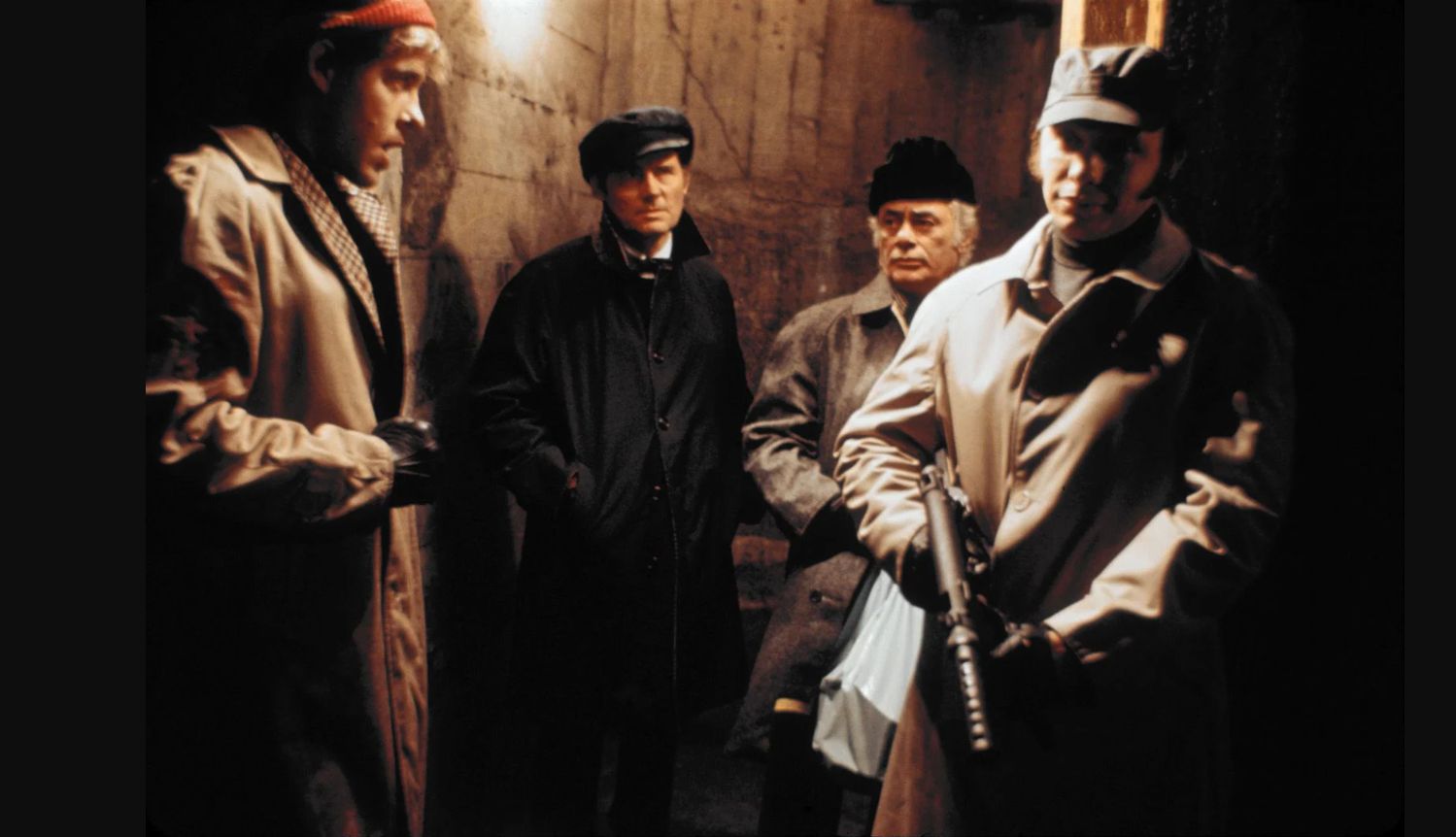
Let the carriage choose the frame
Roizman recalled that the production initially planned a 1.85:1 image. He argued for the wider anamorphic format after riding the trains and examining the station. To demonstrate the difference, he shot tests in both formats, including a carriage full of passengers. Seeing the results projected side by side settled the question.[1]
The useful word here is passengers. A format test could demonstrate sharpness or distortion; this one also tested how people occupied a particular room. Extra width allows a face to retain company. Another person can remain beside it, watching, waiting, or threatening. A close view need not erase the circumstances that make the expression interesting.
That is an especially productive possibility in a hostage film. A frightened person and someone capable of harming them belong to the same immediate space. Holding that relationship within a composition gives the viewer time to inspect it. A cut can isolate a reaction when the film needs one, but isolation becomes a choice. The carriage’s narrowness supplies the pressure; the breadth of the image makes that pressure easier to read.
Prepare the darkness
The appearance of available light required intervention. Roizman told MovieMaker that tunnel bulbs were replaced with brighter photofloods, sprayed to soften their hot spots, and supplemented with a small number of film lights. He also described using a modest modeling light to bring out a face or another detail.[1]
A separate account on the American Society of Cinematographers’ site identifies another part of his method: pre-flashing the stock to recover more shadow detail.[3] This means giving the film a controlled exposure to light before photographing the scene. It changes how the negative records the darker parts of the image; it does not illuminate the tunnel itself.
The distinction helps explain why a convincing dark place can demand so much preparation. The camera has to register the information the scene needs while leaving the space recognizably dim. If every recess disappears, the viewer loses useful relationships. If everything receives equal emphasis, the underground setting loses its particular atmosphere. Here, the technical work serves a dramatic balance: people remain readable inside an environment that still feels enclosing.
The city on screen also combines location work with reconstruction. AFI’s production history places subway filming at the disused Court Street station in Brooklyn and records that the transit command center was recreated at Filmways Studios from the real headquarters.[2] The film’s credibility depends on how these spaces connect, as well as on where the camera actually stood.
Make the next room matter
Editors Gerald Greenberg and Robert Q. Lovett move the action among the captive carriage, transit headquarters, police, the mayor’s office and the streets. The Santa Barbara International Film Festival’s discussion singles out this crosscutting as a central source of the film’s momentum: the ransom must travel through a city while the hostages remain confined.[4]
Crosscutting gives a simple deadline several kinds of friction. Agreeing to pay and delivering the money are separate accomplishments. A decision in an office still has to become movement somewhere else. Returning to the carriage reminds us who bears the cost when that movement takes too long.
There is also an uneven distribution of knowledge. The audience can visit places that the people negotiating over the radio cannot see. That wider view makes an interruption intelligible without making it harmless. We understand why one group is waiting and why another cannot instantly satisfy it. Suspense grows from those connections: each room has an immediate task, but success depends on what happens beyond its walls.
Give the disorder a pattern
David Shire approached the music through a related problem of organization. In his StoryBeat interview, he describes spending a month finding the score’s musical basis. He settled on a tone row, an ordered sequence of pitches, within a jazz language he calls “semi-serial.” His image was New York’s unruly life held together by the geometry of streets and avenues.[5]
That recollection offers a useful way to hear the score without turning the film into a music lesson. Shire wanted room for restless activity within a persistent structure. His account also sets a boundary: calling the music semi-serial is more accurate than claiming that every sound obeys an inflexible twelve-tone rule.
The correspondence with the pictures is an interpretation, rather than evidence that Roizman and Shire worked from a shared manifesto. But it is a revealing correspondence. A wide frame gives crowded bodies an arrangement; the editing connects scattered workplaces; the score imagines a city whose disorder has an underlying pattern. Each makes complexity available to the viewer.
That clarity is what makes Pelham so tense. A subway car can be comprehensible and still impossible to leave. The film lets us see enough to know exactly why more room would help.
Sources
- Bob Fisher, “The Taking of Pelham: Then and Now,” MovieMaker, June 10, 2009 — Owen Roizman’s firsthand account of format tests, tunnel lighting and working methods on the 1974 film.
- American Film Institute, The Taking of Pelham One Two Three (1974), AFI Catalog — cast, premise, production locations and the reconstructed transit command center.
- American Society of Cinematographers, “Owen Roizman, ASC: The Taking of Pelham, One, Two, Three,” August 15, 2017 — interview introduction documenting anamorphic photography and pre-flashing for shadow detail.
- Santa Barbara International Film Festival, “The Taking of Pelham One Two Three,” May 12, 2021 — the editors, crosscutting between city locations and the ransom deadline.
- Steve Cuden, interview with David Shire, StoryBeat episode 166, June 22, 2021 — transcript of Shire’s explanation of the score’s tone row and Manhattan street-grid analogy.
- Academy Museum of Motion Pictures, “The Taking of Pelham One Two Three in 35mm,” May 2, 2026 — institutional screening record and source of the photographic film still.