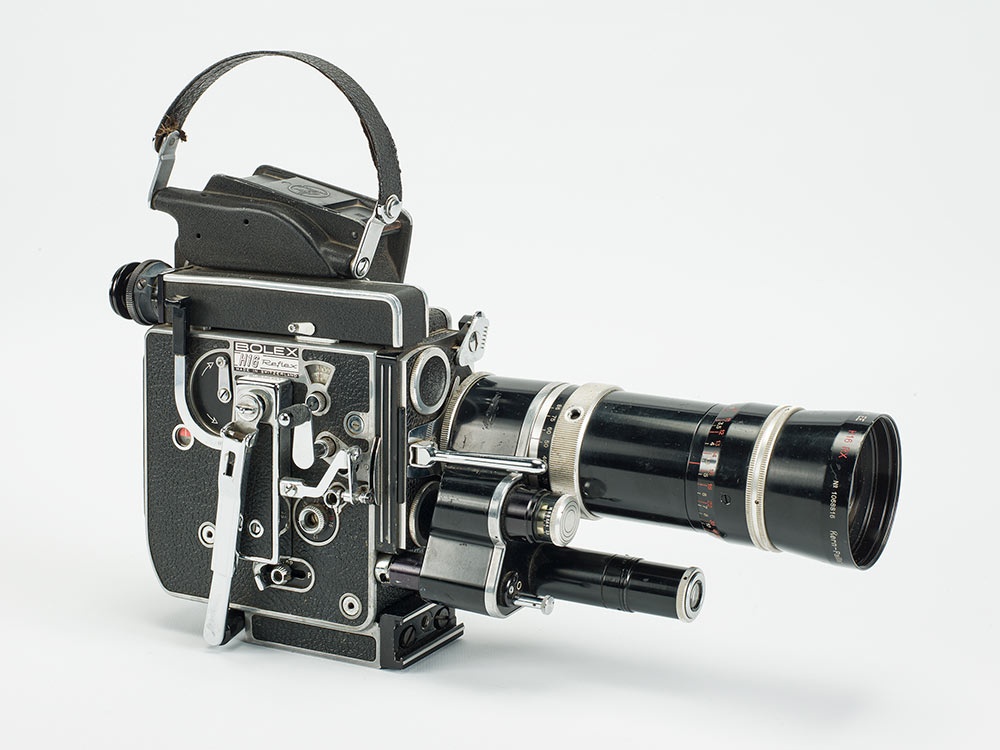
A Bolex begins with a small expenditure of muscle. Unfold the handle, wind the spring, fold the handle away. The camera can then pull film through its mechanism without an electrical supply. On the H16 Rex 5 described in the Evergreen State College operating guide, a full wind gives roughly 28 seconds at 24 frames per second. After that, the hand has another job to do.[1]
This is a useful place to start thinking about independent cinema: with the physical terms on which a shot becomes possible. The Bolex H16 offered portable control over moving images, but that control came with pauses, counters and decisions about how much of an event to record. Its freedom had a handle you could turn and a reserve you could exhaust.
Paillard-Bolex began selling the H16 in 1935. It used 16mm film, a format whose lower cost relative to 35mm helped it spread among documentary makers and amateurs.[2] The familiar name subsequently covered different machines. Girona’s Museum of Cinema dates the introduction of the H16 Reflex to 1956; its example, pictured here, belonged to Catalan filmmaker Jan Baca.[3] Through-the-lens viewing should therefore not be projected backwards onto every earlier H16.
A spring and a spool keep different time
The camera contains two separate limits: the energy available to move the film and the amount of film available to expose. Confusing them makes the Bolex sound much more restrictive than it was.
Paillard’s instructions describe 100-foot spools and specify 40 frames per foot of 16mm film. At 24 frames per second, that works out to approximately two minutes and 47 seconds before allowing for loading losses. The same manual tells the operator to wind the spring again between shooting sequences.[4] A roll could therefore hold numerous shots made across several winds. Winding the motor did not mean replacing the film.
For a filmmaker, the distinction matters. A short encounter could be caught without arranging a power supply. A prolonged action demanded anticipation: when to begin, where an interruption would hurt, whether a second angle could bridge the missing time. These are consequences of the mechanism, rather than evidence that every Bolex owner adopted the same editing style. A mechanical limit can prompt a decision; it cannot make that decision good.
The controls also allowed a more radical economy. Paillard’s manual explains single-frame exposures and reverse winding, with counters that track movement forwards and backwards. It explicitly connects these facilities to animation and effects.[4] Film could be advanced one image at a time, or brought back for another exposure. The operator had access to the strip as a sequence of individual pictures, not merely as a length that disappeared into a sealed machine.
Seeing, and spending light
The Reflex models made another exchange. A prism diverted some incoming light towards the viewfinder, allowing continuous observation through the taking lens. Evergreen’s guide explains the resulting loss of light at the film plane and the need to account for it in exposure.[1] Seeing the frame more precisely had an optical cost.
The point is less the fraction of light lost than the responsibility gained. A filmmaker could judge framing and focus through the lens while working, but still had to understand what the camera was doing. Portability did not remove craft. It concentrated several jobs around one body and one pair of hands.
There was similar concentration in a dissolve. Evergreen describes fading out, winding back over the relevant frames, then fading in the next image onto that stretch of film.[1] A transition could begin at the moment of photography. It required an intended relationship between two shots before the exposed roll had even returned from processing.
These facilities help explain the camera’s attraction beyond straightforward recording. They made duration, overlap and repetition things an individual could manipulate directly. The Bolex was small enough to accompany an encounter and intricate enough to transform it.
The same controls, different purposes
Stan Brakhage described that transformation in a 1973 lecture at the Carnegie Museum of Art. Discussing the speeds available on his Bolex, he explained that he often filmed more slowly for the light or intensity he wanted. He resisted treating 24 frames per second as the natural measure of movement: memory and dreams supplied other tempos. He also described asking someone to remain still while he exposed a succession of single frames to obtain a particular richness of colour.[5]
That testimony gives the settings an artistic purpose without turning the apparatus into the author. Brakhage had reasons for changing speed. A specification sheet alone cannot explain those reasons, and the existence of a single-frame control does not explain which image he chose to hold.
Fieldwork could pull the same camera family in another direction. The Museum of Ethnography in Budapest records that Lajos Boglár used a spring-driven Bolex among Brazil’s Nambikwara in 1959. For work among the Piaroa in Venezuela in 1967–68, he took a heavier camera fitted with an electric motor, enabling longer sequences; ethnomusicologist István Halmos recorded sound alongside him. The museum identifies two resulting films, The World of the Piaroa and The Shaman’s Necklace.[2]
Longer observation could justify more equipment. That makes a useful corrective to the appealing picture of independence as perpetual lightness. Sometimes the work asks the filmmaker to carry more.
Jonas Mekas offered a related perspective at the Harvard Film Archive in 2017. Asked about single frames and the Bolex motor, he described working within the possibilities of his tools; video subsequently opened different possibilities for him.[6] His answer leaves room for affection without making one machine the permanent condition of a personal cinema.
The H16’s significance lies in that room to choose. A hand could supply the power, a counter could help place an overlap, and a speed control could alter the relation between an event and its image. Each convenience carried obligations. The filmmaker still had to decide when the moment was worth the film—and when to lower the camera and wind again.
Sources
- Michael Majoros and Marge Brown, Bolex H16 Rex 5, Evergreen State College Media Loan, hosted by Dartmouth College—spring running time, reflex optics and the lap-dissolve procedure, pp. 1–7.
- Judit Dorottya Csorba, “Narrow-Gauge Motion Picture Cameras in Ethnographic Field Study,” Museum of Ethnography, November 2018—H16 introduction, film-format economics and Lajos Boglár’s field equipment.
- Museum of Cinema, Girona, “Film camera,” register 41304—photograph and record of Jan Baca’s H16 Reflex, dated 1956.
- Paillard-Bolex, Instructions for Use: H16, H16 Reflex and H8 Cameras, undated manufacturer’s manual, preserved by Filmkorn—film capacity and frame count; operating controls, reverse winding and animation, §§7–16.
- Stan Brakhage, lecture, Part I, Carnegie Museum of Art, September 18, 1973—archival transcript, pp. 12–13, on camera speeds, memory and single-frame exposure.
- Harvard Film Archive, Jonas Mekas conversation, February 11, 2017—discussion at 32:25–34:10 of Bolex single-frame filming and the different possibilities of video.