In a French antique shop in 2008, Rubén Gallo watched Jean Valjean appear on a sheet of white paper. The shopkeeper had loaded a small metal cartridge into a Pathé Baby projector, plugged it in, and started turning its handle. The machine came with a collection of films so extensive that Gallo stopped counting after nine hundred. Projector and cartridges eventually joined Princeton University Library's collections.[2]
The encounter captures the product's appeal: a library of moving pictures, small enough to keep at home, waiting for someone to supply the light and movement. It also suggests the labor behind that apparent convenience. A home audience needed a film in the right format, a functioning apparatus, and an operator.
Launched in 1922, the Pathé Baby projector used film just 9.5 millimetres wide. A camera followed in 1923, extending the system from watching commercially supplied pictures to recording family life.[4] Its history begins with exhibition: making movies small enough to enter another room.
The machinery fits on the table
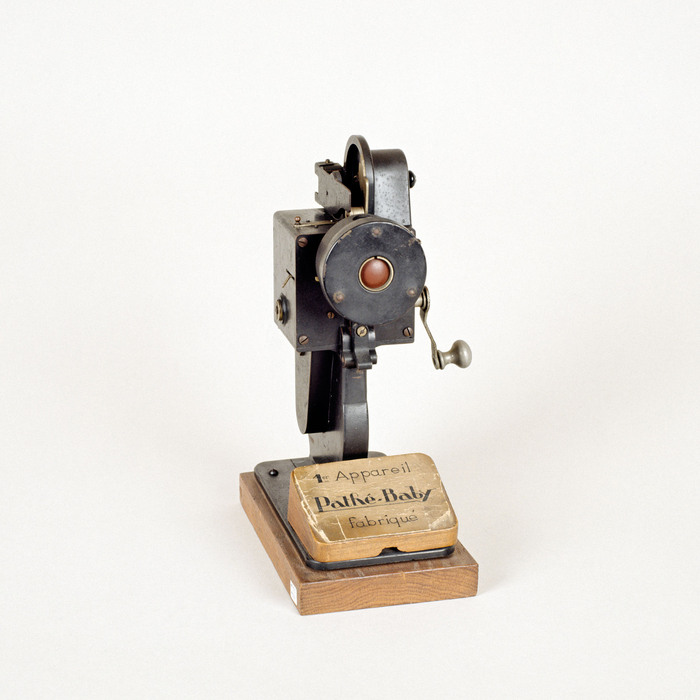
The prototype pictured here measures 19 centimetres long, 12 wide, and 28.5 high. La Cinémathèque française identifies a built-in lamp, a claw that advances the film, and a housing for a ten-metre reel. It also cautions that this particular object's casing and access to the mechanism differ from the model eventually sold.[1]
That qualification matters. An attractive surviving machine can easily become an illustration of every machine in a product's history. This one is evidence of a design being worked out. Its compact arrangement brings illumination, film transport, and storage together in an object a household could accommodate. The wooden display base presents it as an object to preserve.
Pathé had already offered a larger, 28mm home system in 1912. The Baby therefore belongs to a continuing attempt to domesticate cinema, rather than a sudden invention of private viewing. Gallo places its early audience among prosperous families familiar with magic-lantern entertainment.[2] A smaller apparatus widened the possibilities without making ownership universal.
A pause can save film
The 9.5mm strip has its perforations along the centre, between successive pictures. The Pathé Foundation still uses that feature to help people recognize old family reels.[5] Those holes belong to the transport system; a separate notch cut into the edge could control a pause.
As Tim van der Heijden and Mirco Santi explain, that notch triggered a mechanism which temporarily disengaged the advancing claw. The operator continued cranking while a title remained on screen. Instead of spending a length of film on repeated photographs of the same words, the system could hold a single image long enough to read. Their experiments also registered the change through the hand: cranking felt lighter during the pause.[3]
Here economy becomes visible as timing. Film length and viewing time no longer correspond in quite the same way when an image can be held. Reading is accommodated by a mechanical interruption. The person showing the picture participates in its rhythm, even when the picture itself stands still.
The small reel imposed another kind of economy. Van der Heijden and Santi note that commercial releases were often heavily shortened to fit.[3] A home copy could therefore differ in both physical size and editorial shape from the film shown in a cinema.
A household becomes a venue
The commercial achievement required a catalogue as well as a projector. The Pathé Foundation's centenary account describes the coordinated introduction of a film format and published titles, followed by the camera and an expanding range of accessories. Reversal film allowed the camera stock, once processed, to become the viewable image.[4] Buying into the system could lead from collecting other people's pictures to making one's own.
For a viewer now, the distinction between those activities is useful. A surviving 9.5mm reel might hold a family record or a distributed edition. Its smallness alone cannot tell us which. Nor should a familiar film title make us assume that a home edition preserves every scene or the original pacing.
The Foundation's 2022–23 centenary exhibition paired equipment and promotional material with screenings through original apparatus; it also invited people to bring reels for viewing.[5] That approach restores an essential relationship. A cartridge makes sense beside the machine that can turn it into an event.
Pathé Baby's promise depended on several things becoming smaller together: the projector, the strip, sometimes the film itself. Its surviving objects let us see the bargains that made a private screening possible. The handle still tells the most immediate part of the story. Someone in the room had to turn it.
Sources
- La Cinémathèque française, “Projecteur de film 9,5 mm,” inventory AP-95-1587 — prototype identification, dimensions, mechanism, and photograph credited to Stéphane Dabrowski.
- Rubén Gallo, “Princeton's Pathé-Baby: A Relic of the Belle Époque,” Princeton University Library Chronicle 70, no. 2, 2009, reproduced in the library's Pathé Baby Collection — acquisition account, earlier home projection, and social setting.
- Tim van der Heijden and Mirco Santi, “Thinkering with the Pathé Baby: Materiality, Histories and (Re)use of 9.5mm Film,” NECSUS 11, no. 2, 2022, especially pp. 99, 101–102, and 106 — abridged editions, the notch mechanism, and experimental operation.
- Fondation Jérôme Seydoux-Pathé and partners, “Du Pathé-Baby au 9,5 mm, l'invention du cinéma chez soi,” symposium programme, December 5–6, 2022 — projector and camera chronology, catalogue, reversal film, and accessories; in French.
- Fondation Jérôme Seydoux-Pathé, “PATHÉ-BABY: Le Cinéma chez soi,” exhibition, September 6, 2022–March 4, 2023 — central perforations, equipment displays, and screenings using original projectors; in French.