Spoiler note: this essay discusses the ending of Il Posto (1961).
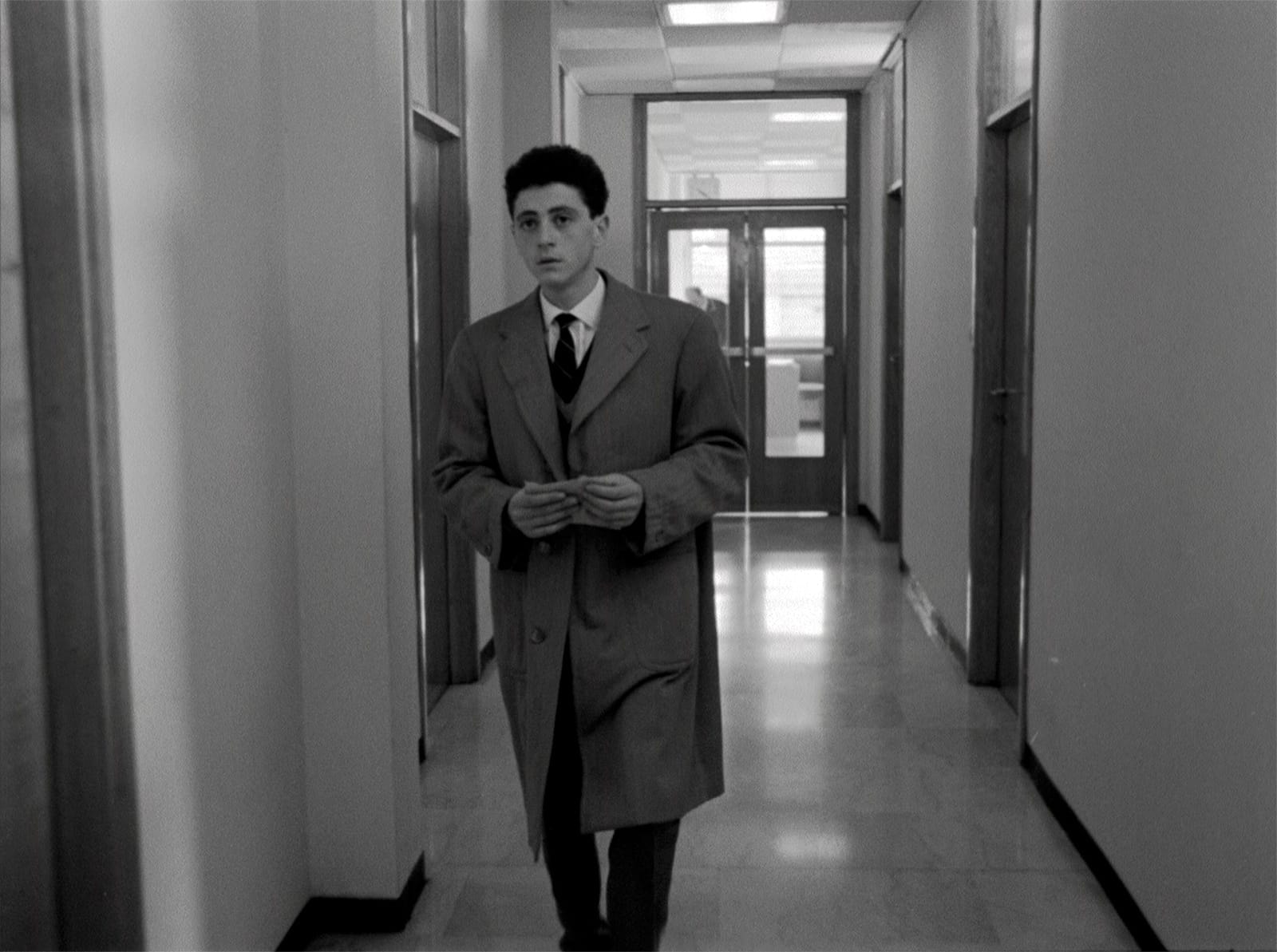
The job is supposed to end the uncertainty. In Ermanno Olmi's Il Posto, Domenico travels from Meda to Milan to apply to a large company. Sandro Panseri plays him with a watchfulness that makes even an ordinary introduction feel consequential. There is employment to secure, a city to navigate, and a fellow applicant, Antonietta, whose company suddenly makes the expedition more inviting.[1]
But getting hired does not give the story its reassuring conclusion. It gives Domenico new things to wait for: an assignment, a meeting, a vacant desk. Olmi turns the promise of permanence into a question about time. How much of a life can someone spend preparing to begin it?
What security promises
Domenico's father understands the attraction of a large employer. The family does not expect the company to make the boy rich; dependable employment is reward enough. Giampiero Frasca's account of the film for Italy's national childhood documentation center emphasizes this parental hope for economic and social stability.[2] The aspiration deserves to be taken seriously. A regular wage can make tomorrow manageable.
Olmi knew the attraction from inside. Before becoming a feature filmmaker, he worked for the energy company Edison in Milan. The company lent him a camera to record employees' leisure activities; he subsequently filmed industrial projects. His experience of entering that workplace informed Il Posto, his second feature.[3]
That background helps explain the film's unusual double vision. The company can offer something valuable while arranging a life too narrowly. Domenico does not have to be foolish to want admission, and his parents do not have to be villains for wanting it on his behalf. The more reasonable the promise sounds, the more troubling it becomes to watch the boy discovering its terms.
A person between appointments
The selection process submits applicants to arithmetic, a medical examination, and personal questions. During the break, Domenico and Antonietta share a tentative flirtation in the city. Once employed, he becomes a messenger's apprentice and she a typist; their separate departments and incompatible breaks make contact difficult.[4]
The contrast gives waiting two different meanings. Before the tests, it means being available to an institution that will decide whether to admit him. With Antonietta, it holds the possibility that someone might choose to spend time with him. One kind of attention assesses his suitability; the other might discover something that no examination has asked about.
It would be too neat, though, to blame every disappointment on the timetable. Stefano Todini's Treccani entry stresses the young people's uneven confidence and uncertain communication as well as their working hours.[5] Antonietta is a person with her own inclinations, not a reward the company has withheld. The workplace limits opportunity without explaining everything that happens inside it. Domenico still has to learn how to approach another person.
The lives a desk cannot describe
Olmi briefly leaves his young protagonist to show employees away from work. These glimpses include singing, domestic routines, and the ambition to write.[2] They interrupt the apparent simplicity of the office: people who occupy comparable positions carry very different private lives.
Kent Jones reads these passages as possible futures for Domenico.[6] They can also change how we look at the older workers in the present. A colleague who initially seems to belong to the furniture acquires an existence beyond the room. The company has a use for that person, but its use is an incomplete description.
This is where the film's tenderness becomes essential to its argument. If every employee were merely an emptied-out version of Domenico, his future would already be settled. The excursions outside work preserve differences. They leave room for pleasure, frustration, vanity, and ambitions that have no place in a personnel file. Some of those hopes may be modest or unrealized; they still belong to someone.
An evening that gets going
At the New Year's Eve party, Antonietta does not arrive. Domenico waits, then gradually joins the celebration. Todini finds an unexpected possibility of happiness in the scene's gathering energy.[5] The evening produces enjoyment even though it fails to deliver the encounter Domenico came for.
That makes it a necessary complication of the office story. The social world around the job can sustain people as well as disappoint them. Colleagues are capable of making an evening worth having. A person may find company while the institution still leaves him lonely at other times.
The party also gives time a different shape. Waiting can end because the expected person arrives. Here, it ends when Domenico becomes involved in what is already happening. For a while, the present stops being an anteroom to a better occasion.
The vacancy and the queue
A clerk's death finally opens a position. Domenico will join the office, but the dead man's desk goes to a colleague with seniority. The newcomer takes the place at the back, with poorer light.[5] The advancement is real and immediately qualified: admission to the room is admission to another order of precedence.
Olmi later described desk placement as a hierarchy, with proximity to the manager carrying importance.[3] The furniture makes waiting visible. Years of service can be expressed as a claim to move a short distance across a room. For someone just arriving, the arrangement quietly supplies a picture of the time ahead.
The ending holds on Domenico while office machinery clatters.[4] Yet a forecast is not a completed biography. Jones sees the possibility that the boy's alert curiosity might eventually take him elsewhere.[6] The film need not guarantee that escape for his attention to matter. We have spent too long noticing what he notices to accept a desk as his full measure.
Domenico has achieved the security his family wanted. The unease comes from seeing how little that achievement tells us about the life he will lead. The office can assign him a place. Olmi leaves us watching the person who has to inhabit it.
Sources
- The Criterion Collection, “Il posto” — 1961 film, cast, setting, and release information.
- Giampiero Frasca, “Il posto,” Centro nazionale di documentazione e analisi per l'infanzia e l'adolescenza, May 14, 2010 — family expectations, hiring, and employees' private lives; in Italian.
- Pasquale Iannone, “Ermanno Olmi obituary: a maestro of Italian post-neorealist cinema,” Sight and Sound / BFI, May 21, 2018 — Edison employment and Olmi's comments to Aldo Tassone on office hierarchy.
- Fernando F. Croce, “Now on DVD: ‘Il posto’ (Ermanno Olmi, 1961),” MUBI Notebook, February 20, 2010 — recruitment tests, working schedules, and the final image and sound.
- Stefano Todini, “Il posto,” Treccani, Enciclopedia del Cinema, 2004 — the uncertain courtship, New Year's party, and desk allocation; in Italian.
- Kent Jones, “Il posto: Handcrafted Cinema,” The Criterion Collection, June 23, 2003 — private lives, Domenico's attentiveness, an alternative reading of his future, and the accompanying film still reproduced here.