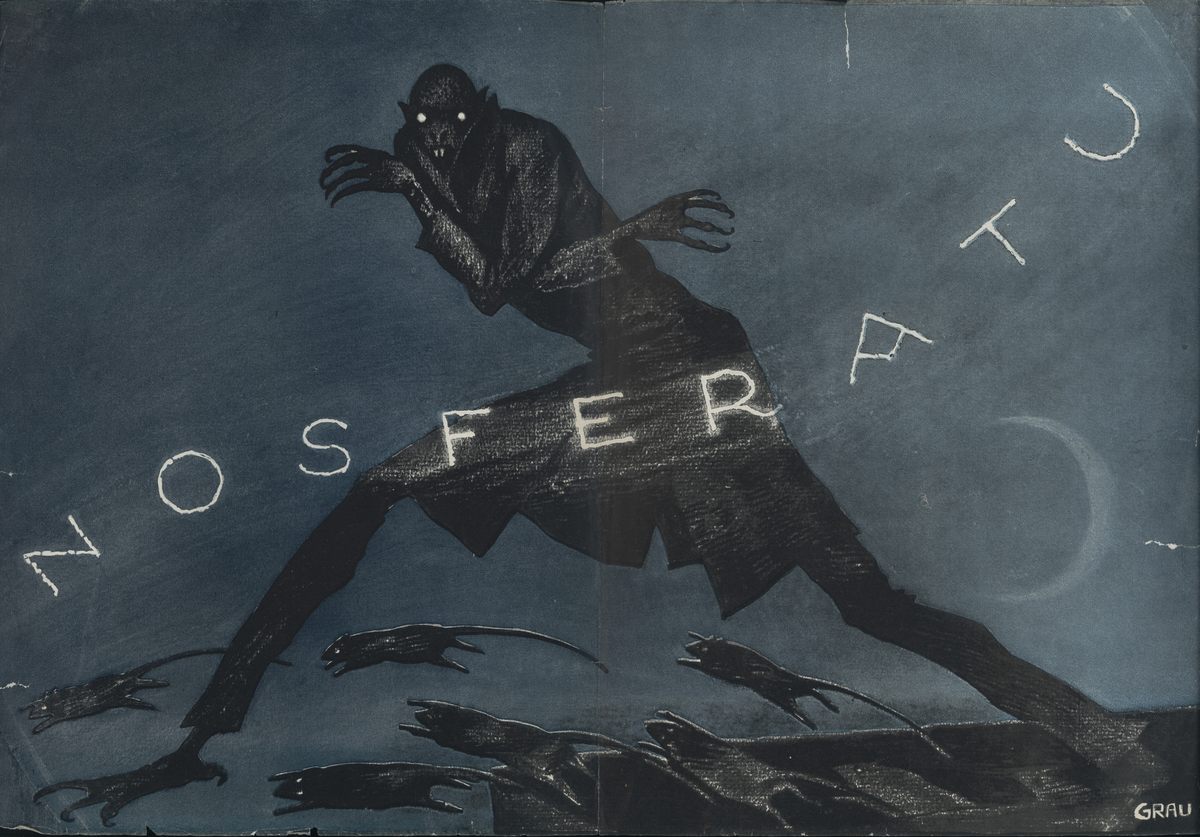
F. W. Murnau’s Nosferatu: Eine Symphonie des Grauens (1922) is often remembered through isolated icons: Count Orlok rising from the ship hold, Orlok’s hand-shadow climbing Ellen’s staircase, the rigid body silhouette and clawed fingers that became a century of vampire design language.[1][2] But those icons hold because the film is structurally exact. Its terror is not only creature design; it is spatial governance. Murnau keeps teaching the viewer that ordinary civic space — houses, streets, ports, stairwells, cargo routes — can become a transmission network.
That spatial logic still feels modern because the movie was never only “about a monster.” It is also about movement systems, delayed recognition, and threshold failure. When critics say the film “haunts” rather than startles, they are naming this architecture of dread.[5]
Image context: the hero image uses the 1922 Albin Grau poster design (via the English Wikipedia file page) as an official period visual anchor for the film’s original release identity.[6]
Spoiler note: this close reading discusses major formal moments from the carriage approach, castle stay, ship passage, staircase sequence, and ending.
1) Shadow choreography: when violence stops needing a body
The famous staircase shadow is easy to reduce to a single expressionist flourish. In the film, it works as a wider rule: Orlok’s danger is increasingly detached from full bodily presence. The shadow moves first, arrives first, and normalizes the idea that force can circulate without direct contact. This is why the shot still lands; it is not just stylization, it is operational displacement.
Murnau strengthens that displacement by grounding much of the movie in actual locations rather than wholly studio-built distortion. Sight and Sound’s classic BFI reading emphasizes this tension: naturalistic settings and clear depth do not soften the uncanny, they intensify it, because the supernatural intrudes into a world that otherwise reads as physically coherent.[2] In practical terms, the viewer loses the comfort of saying “this is a dream-space.” The space is legible, and still unsafe.
The result is a durable horror grammar: fear no longer requires jump timing. Fear can be staged as occupancy — who has already entered your space before you can verify it.
2) Threshold design: doors, windows, and contracts that fail too late
The film’s central dramatic problem is not ignorance but timing. Hutter repeatedly crosses thresholds after warning signals are already visible: inn reactions, vampire folklore text, uncanny carriage transit, Orlok’s courtly but predatory attention to Ellen’s portrait. Each threshold crossing looks administratively normal in the moment — business trip, property contract, signed transfer — and only later reveals itself as irreversible.
That is where Nosferatu diverges from many later Dracula adaptations centered on aristocratic seduction. Murnau’s emphasis is procedural. By the time characters recognize what system they are in, they are already downstream. Britannica’s production history note on the unauthorized adaptation and ensuing lawsuit mirrors that irony at the meta level: surface substitutions (renamed characters, altered details) did not change structural dependency on Stoker’s narrative engine, so legal consequences still arrived.[1]
Inside the film, this procedural dread appears in how frames are built around portals and corridors. Thresholds are not neutral transitions; they are decision points with asymmetrical information. The audience, like the characters, can see enough to worry and not enough to intervene.
3) Plague logistics: Orlok as transport event, not only gothic villain
One of the film’s deepest inventions is to treat vampirism and epidemic imagery as linked infrastructures. Orlok’s movement by ship, the rats, and the panic in Wisborg convert private horror into municipal crisis. Senses of Cinema’s centennial essay underlines this by noting how the film’s plague imagery resonated with postwar and post-influenza anxiety and how the “under-nature” motif spreads beneath ordinary life before erupting into public disorder.[3]
What makes the sequence powerful is logistical pacing. The ship does not arrive as one spectacular reveal; it arrives as a chain of signals — missing crew, contaminated cargo association, civic confusion, then mass fear. Murnau stages contagion as an urban process, not a single supernatural attack. The vampire is therefore both character and freight.
Seen this way, the ending’s dawn resolution is less a tidy moral closure than a system reset purchased at high private cost. The now-canonical sunlight vulnerability, later absorbed across vampire cinema, emerges here as a strict temporal boundary condition: night grants mobility, dawn collapses it.[3] The rule is mechanical, which is precisely why it survives in genre memory.
Why this still matters in 2026
A century later, Nosferatu remains a high-value viewing object because it teaches an analytical skill that extends beyond film history: track how risk moves through structures that appear routine. In Murnau’s design, dread accumulates through ordinary channels — paperwork, housing transfer, travel lanes, bedroom architecture, municipal rumor flow. The supernatural enters through administration.
That is also why restoration history matters for modern viewing. The Murnau Stiftung’s centennial note documents the 2005/2006 restoration led by Luciano Berriatúa and the reconstruction of the original score tradition by Berndt Heller after Hans Erdmann, giving contemporary audiences a materially sharper encounter with the film’s rhythm and tonal control.[4] The movie’s afterlife is not accidental nostalgia; it is sustained by technical stewardship.
If you revisit Nosferatu now, one practical method changes the experience: watch each sequence by asking which threshold has just been crossed and which system (domestic, legal, transport, civic) will absorb the consequence next. Once you do that, the film’s “haunting” quality becomes legible as design discipline.
Sources
- Encyclopaedia Britannica, Nosferatu (1922 film)
- BFI Sight and Sound, “Shadow and substance: F. W. Murnau’s Nosferatu”
- Senses of Cinema, “Nosferatu: Eine Symphonie des Grauens (F. W. Murnau, 1922)”
- Friedrich-Wilhelm-Murnau-Stiftung, “100. Geburtstag Nosferatu”
- San Francisco Silent Film Festival essay page for Nosferatu
- English Wikipedia file page (hero image provenance)