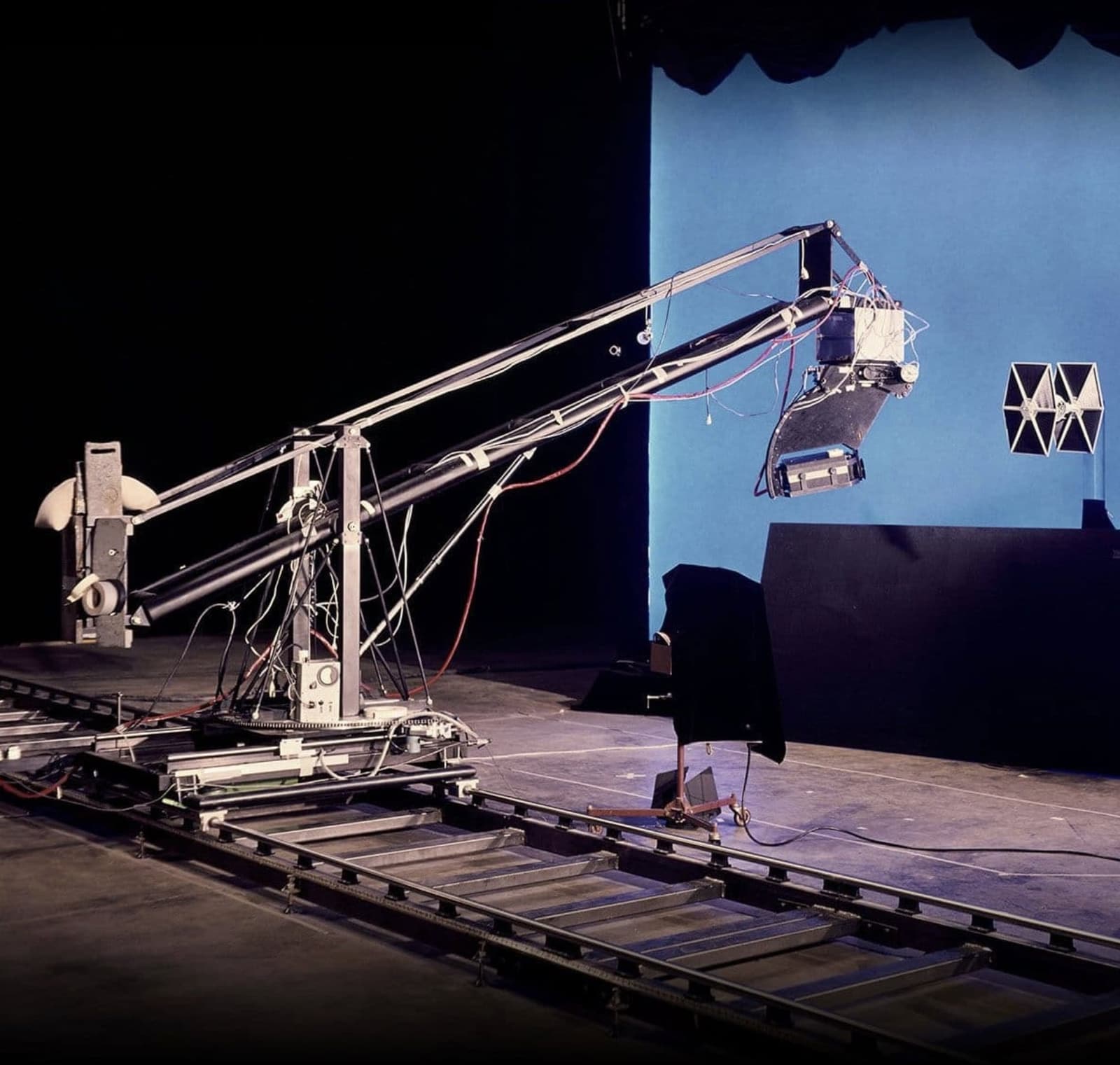
The Dykstraflex looks ungainly in still photographs: rails, boom arm, dangling cables, camera housing, blue backing, a model suspended in the middle distance. Its importance is easier to miss if the machine is treated as a relic of Star Wars nostalgia. The real breakthrough was not that Industrial Light & Magic built a clever rig. It was that the rig made miniature photography behave like moving cinematography instead of a locked-off special-effects insert.[1][2]
Before that shift, effects shots could advertise themselves by changing the grammar of the movie. Live-action scenes might dolly, pan, crane, and jolt with ordinary camera life; then a model shot would arrive fixed in place because multiple photographed elements had to line up later. The Dykstraflex attacked that boundary. If the camera could move along the same path again and again, then separate passes for ships, surface details, star fields, lighting, and mattes could be optically combined while preserving the feeling of a camera moving through space.[2][4]
The problem was movement with memory
The ordinary compositing problem is unforgiving. A single final shot might require one pass for an X-wing, another for a TIE fighter, another for the Death Star surface, another for a star field, and still more for lasers, glows, or mattes. If the camera is locked, alignment is difficult but conceptually stable. If the camera moves, every layer has to remember the same movement. A spaceship cannot bank through one camera path while its background belongs to another.[2]
Lucasfilm's account of the Dykstraflex frames the problem plainly: George Lucas wanted space battles with the swing and urgency of World War II aerial footage, but traditional visual-effects photography was constrained by the need to align separately photographed layers. Motion control supplied the missing memory. A mechanical system operated by a computer could travel a path specified precisely enough to repeat it for duplicate passes, letting the elements be combined later.[2]
That is why the Dykstraflex matters as industry technology rather than just a Star Wars footnote. It made the camera path into data. The operator could design a move, test it, refine it, and then ask the machine to perform that move again for a different element. The shot stopped being a single exposure event and became a sequence of repeatable performances.
The machine joined brute force to delicate timing
American Cinematographer's technical account describes the Dykstraflex as a system of stepping motors controlling the camera-and-subject relationship. The rig used a track and boom system with multiple axes; the camera movement could be viewed through the taking lens and controlled by joystick or by individual potentiometers for single-axis moves.[1] That mechanical vocabulary matters because it explains the look of the resulting shots. Banking, diving, curving, and accelerating were not abstract effects. They were controlled relationships among track movement, boom movement, pan, tilt, roll, frame count, and focus.
VFX Voice adds the industrial scale: the system weighed about 1,500 pounds, used stepper motors, carried a VistaVision camera, and often worked on a roughly 40-foot track. Operators could record and repeat moves while controlling axes such as roll, pan, tilt, swing, boom, traverse, and track.[3] The use of VistaVision was not incidental. A larger negative helped preserve detail through optical compositing, where every generation could punish the image.
The paradox is that the system made shots feel freer by becoming more disciplined. A dogfight could look loose, fast, and dangerous because the underlying camera action was repeatable. The handmade roughness of the rig and the precision of its output belonged together. The machine was not replacing cinematography with automation; it was making a kind of miniature cinematography possible under compositing conditions that normally punished movement.
Berkeley supplied a rehearsal for believability
The Dykstraflex did not appear from nowhere. The National Science Foundation traces one important prehistory to UC Berkeley's Environmental Simulation Laboratory, where researchers used computer-controlled camera movement through detailed urban models to test whether simulated environments could produce responses comparable to real-world experience. A PDP-11 computer let a camera route be repeated precisely, and John Dykstra later connected that repeatability to visual effects: multiple elements could be photographed separately and combined as though captured together.[4]
That origin is revealing. The question was not only "Can a camera repeat a move?" It was "What makes an artificial environment feel real enough to persuade a viewer?" The laboratory model and the Death Star trench share a deeper problem. Both depend on scale, motion, depth, and repeatability. Static model photography can show detail, but it struggles to make the viewer feel physically implicated. A moving camera gives the model a body relation. It turns distance into approach, angle into danger, surface into route.
This is the underappreciated link between psychology and spectacle. The Dykstraflex was built for entertainment, but its power came from perceptual cues: acceleration, parallax, motion blur, depth of field, and the sensation that the camera is not merely observing a model but traveling through a space. Once those cues became programmable, miniature effects could stop apologizing for being miniatures.
The shot became a layered performance
The Dykstraflex also changed labor. It required designers, model makers, camera operators, electronics builders, optical compositors, and supervisors to think of the shot as a system. One pass could not be judged only in isolation because its usefulness depended on how it would combine with other passes. The machine forced a conversation between physical fabrication and postproduction before "pipeline" became the ordinary word for this kind of coordination.
VFX Voice's reconstruction of the process makes this clear. Separate passes might be viewed in black and white on a Moviola and then optically composited; additional passes could add lighting or star fields. John Knoll later described the Dykstraflex as breaking a stylistic boundary because shots were no longer restricted to simple moves or locked-off effects inserts.[3] That claim is stronger than a celebration of machinery. It says the device altered the grammar of what audiences accepted as continuous screen space.
The Academy Museum's 2024 presentation of the restored Dykstraflex made the same point historically, describing the system's precisely controlled shots of miniature models as central to the original trilogy's space battles and as a technology that changed how movies are made.[5] Museum display can sometimes flatten machines into icons. Here the icon is useful because the physical object explains the method. You can see why a camera needed track, boom, motors, and repeatability before computer graphics could simulate the same problem inside software.
Its legacy is not only digital
It is tempting to treat the Dykstraflex as a stepping stone toward computer-generated imagery, and in one sense it was. Motion-control operators learned to think in curves, repeatable paths, axes, and compositing layers. Those habits transferred naturally into later digital visual effects. VFX Voice notes that artists who worked with D-Flex carried motion-control skills into the CG era, where smoothing curves and designing motion remained central problems.[3]
But reducing the Dykstraflex to a pre-CG ancestor misses its continuing lesson. The machine showed that spectacle depends on believable camera behavior as much as on detailed objects. A model can be beautifully built and still feel dead if the camera relationship is wrong. A digital ship can be perfectly rendered and still feel weightless if its movement has no physical conviction. The old rig is obsolete in many workflows, but the problem it solved has not disappeared.
That is why the Dykstraflex remains more than a famous behind-the-scenes contraption. It turned miniature photography into choreographed repeatability. It let separate passes share one camera memory. It made optical compositing accept movement without losing alignment. Most of all, it taught visual effects that the camera path itself could be engineered. The result was not just better space battles. It was a new contract between machinery and movie motion.
Sources
- American Cinematographer, "Star Wars: Miniature and Mechanical Special Effects" - technical account of the Dykstraflex, stepping motors, axes of motion, VistaVision setup, and production photography used for this article's image.
- Lucasfilm, "Lucasfilm Originals: The ILM Dykstraflex" - Lucasfilm historical overview of motion control, repeatable passes, optical compositing, and the Dykstraflex's long ILM afterlife.
- VFX Voice, "Pivotal Technology: How the Dykstraflex Transformed the VFX Industry - and Movies" - industry retrospective with system weight, track scale, axes, workflow, John Knoll comments, and later motion-control legacy.
- U.S. National Science Foundation, "The 1970s psychology experiment behind 'Star Wars' special effects" - account of the UC Berkeley Environmental Simulation Laboratory, PDP-11-controlled repeatable camera routes, and Dykstra's link between simulation and visual effects.
- Academy Museum of Motion Pictures, "Dykstraflex - Spielberg Family Gallery" - exhibition page for the restored Dykstraflex, its 2024 display, and its role in the original Star Wars trilogy's miniature effects.