
The Janus trailer for the 4K restoration of The Wages of Fear is only about a hundred seconds long, but it understands that Henri-Georges Clouzot's film should not be sold as an ordinary adventure plot.[1][2] Yes, the premise is clean enough: four broke expatriates in a South American oil town agree to drive trucks loaded with nitroglycerin across a lethal mountain route in order to earn enough money to escape.[2][4] But the movie's real force does not come from the bare fact of the mission. It comes from a harsher question: how much vibration can a road, a truck, a friendship, and a body absorb before something gives way.
That is why the trailer feels so exact. It does not spend much time on backstory, and it does not pretend the film is mainly about identifying a villain or solving a puzzle.[1] Instead it builds suspense out of surfaces and pressures: wheels in darkness, men gathered around the trucks, the sign on the grille that says EXPLOSIVES, a face inside the cab trying not to flinch, a mountain road that looks less like landscape than like a test rig.[1][2] The Criterion essay on the restored film is useful here because it stresses both the movie's politics and its physical ordeal: the four men are disposable labor to the oil company, and the road turns courage into something measurable rather than romantic.[3] The trailer reaches the same conclusion through editing. It sells risk as repeated jolt.
That approach also fits the film's production history. Janus's press notes describe how Clouzot rejected the safety of a soundstage, built the town in the Camargue, and then fought weather, mud, toppled cranes, injuries, and budget overruns while shooting the trucking sequences.[4] That context matters because The Wages of Fear does not merely depict difficulty. It was built by pushing machines, terrain, and performers through actual difficulty. The trailer never pauses to explain all of that, but it does preserve the feeling of a production in which danger has weight, friction, and duration.
So the preview is worth treating as a serious object in its own right. In miniature, it teaches you how to watch the film. Do not look first for heroism. Look for calibration. Look for hesitation inside motion. Look for the way Clouzot makes a road seem already loaded with consequence before the first disaster fully arrives.[1][2][3][4]
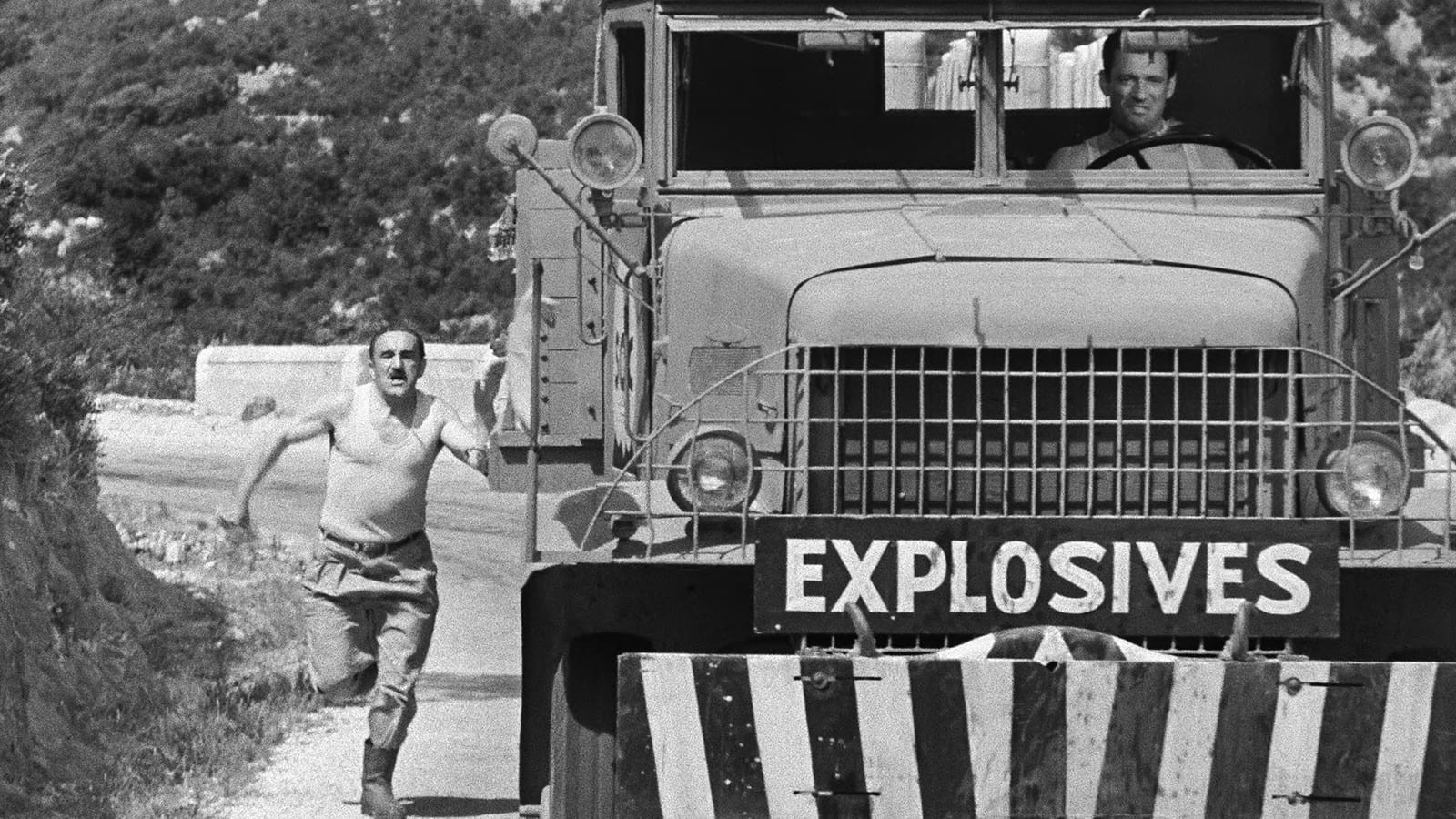
Image context: the lead image uses an official Janus still from the film's promotional materials. It fits this article because the trailer keeps returning to the same hard relation between body and machine: a man can run, brace, and gesture, but the truck's forward movement sets the terms, and terror begins the moment human timing falls even slightly behind mechanical timing.[5]
At 0:00, the trailer opens on machinery and night before it gives us psychology
The first image is not a dramatic introduction to one of the drivers. It is a truck wheel and undercarriage in darkness, with the rest of the vehicle barely legible around it.[1] That choice is the trailer's thesis in visual form. We are not entering a prestige thriller through character biography or through explanatory voice-over. We are entering through hardware. The film's fear begins in suspension, axle weight, tire contact, and the possibility that one bad vibration will travel farther than the men inside the cab can control.
That matters because Clouzot's suspense is famously physical.[2][3][4] Danny Peary's Criterion essay emphasizes the road ordeal itself and the terrible clarity with which each obstacle is staged.[3] The trailer understands that the mission becomes frightening long before an explosion. The truck is already frightening as an instrument: large, unstable, blunt, and asked to carry something too volatile for ordinary motion. By starting there, the preview quietly tells the viewer that mechanical facts will govern emotional facts, not the other way around.
This is also why the darkness is so important. The opening does not make the trucks look glamorous. It makes them look like objects whose full danger has not yet been switched on.[1] Suspense enters as latent force. The viewer is invited to imagine what the machine will do under pressure before the film has even fully laid out the contract that sent it on the road.
Around 0:18, the trailer compresses the whole town into a labor bargain built on expendability
Once the men are gathered around the trucks at night, the preview becomes socially sharper.[1][2] It gives us only a few fast glimpses of the staging, but the meaning is clear enough: these are not triumphant specialists chosen for noble work. They are men at the edge of options, being drawn toward a job because ordinary survival has stopped offering them any other route out.[2][3][4] The film's politics are present precisely because the trailer does not sentimentalize the setup. The bodies look recruited, not exalted.
That compression matters because the restored film is more political than many short descriptions allow.[3] Peary notes that the original cut's early material makes the company's exploitation of expendable men much clearer, and the Janus press notes tie the story back to Georges Arnaud's experience in South America and to Clouzot's interest in the continent's "lower depths."[3][4] The trailer cannot reproduce the whole social world of Las Piedras, yet it finds the key pressure point. It shows that the job is born from hierarchy. Somebody owns the oil fire. Somebody else must carry the nitroglycerin. The suspense therefore starts as a labor relation before it becomes a stunt relation.
That is one reason the truck shots land so hard. They are not just genre props.[1][2] They are the company's answer to human desperation. The men look at the vehicles and, for a moment, the whole film condenses into a brutal equation: enough money to leave, in exchange for agreeing to become part of a delivery system that can obliterate them.
Around 0:35, the mountain road turns space itself into a measurement problem
The trailer's middle stretch is where it becomes unmistakably Clouzotian.[1] We get the truck marked EXPLOSIVES moving through mountain terrain, the cab framed from the front, and the road presented less as scenic adventure than as a sequence of tolerances.[1][2] The question is no longer whether the men are brave in the abstract. The question is whether the vehicle can clear the bend, whether the grade will hold, whether a rock, plank, rut, or edge will transmit one shock too many.
This is why the preview feels closer to a seismograph than a conventional thriller ad. It keeps translating suspense into micro-variation: the twitch of a face in the cab, the slight instability of the truck's path, the exposed emptiness around the road, the knowledge that every correction has to remain smaller than the explosive force being carried.[1][3] Even the endorsement cards help because they do not interrupt the action with a new idea; they intensify the same one. The trailer keeps insisting that this is a movie where scale and precision are inseparable.
The front-facing cab shot is especially revealing.[1] In many action trailers, that angle would flatter the driver into command. Here it does something harsher. The windshield frames the men like specimens under observation. They do not seem masterful. They seem trapped inside the requirement to appear masterful. The road outside them is immense, but their operational margin is tiny. Clouzot turns the open landscape into an enclosure by making error mathematically intolerable.
Around 1:00, the oil-pool passage turns masculine control into helpless procedure
The trailer's final movement is the smartest because it shifts from general danger to a particular kind of disgrace.[1][3] We see the famous oil sequence in fragments: black liquid spreading across the road, one man in the cab, the other out in the pool, chest and face slick with oil, trying to clear a path while the truck waits for movement to become possible again.[1][3] The sequence is suspenseful, but it is also humiliating. Bodies are reduced to labor inside a mess the machine cannot solve for them.
That is crucial to the film's larger vision. The Wages of Fear is often remembered as a masterpiece of nerve, and it is. But the trailer reminds us that the movie is just as interested in the collapse of masculine style under material conditions.[1][3][4] Sweaty faces, terse exchanges in the cab, and the panicked logic of the oil pool all strip swagger down to its residue. The men are not asked to look heroic. They are asked to keep the mechanism from ending them.
The oil passage is also where the trailer reveals how physical Clouzot's morality is. Character is not established through speeches. It is revealed by how long someone can keep functioning once the body is frightened, filthy, tired, and aware that one stalled wheel can turn the whole job into a funeral.[1][3] That is why the preview closes so effectively. It leaves us not with a clean resolution, but with the feeling that suspense here is the name for a system in which human nerves are always one vibration behind the machine they are trying to manage.
That is the trailer's real achievement. It does not simply advertise a famous thriller; it teaches the viewer the film's governing unit of meaning.[1][2][3][4] In The Wages of Fear, danger is not an abstract cloud hovering over the story. Danger is transmitted through matter: tires, boards, grade, cargo, oil, and the slight delay between what the body wants to do and what the road will allow. The preview makes all of that legible in under two minutes. It understands that Clouzot's masterpiece is not finally about action, but about calibration under the threat of annihilation.
Sources
- JANUS, "WAGES OF FEAR - Official 4K Restoration Trailer," YouTube video.
- Janus Films, The Wages of Fear film page.
- Danny Peary, "The Wages of Fear," The Criterion Collection.
- Janus Films, The Wages of Fear press notes PDF, including restoration and production history.
- Janus Films, The Wages of Fear stills package ZIP.