Dolby Stereo is usually remembered through sensation: the star destroyer crossing overhead in Star Wars, the five-note summons of Close Encounters of the Third Kind, the low-frequency theatrical punch that made late-1970s science fiction feel physically larger than ordinary screen space. That memory is fair, but incomplete. The important industrial change was not that a few films sounded big. It was that cinema sound became an upgrade path theater owners could understand, buy, advertise, and keep using after the first novelty wore off.[1][2]
That is why Dolby Stereo belongs in film history as infrastructure, not just as a logo before the feature. It connected three problems that had been treated separately: noisy optical sound, uneven theater playback, and the desire for multichannel scale without making every 35mm release depend on expensive magnetic prints. The system's breakthrough was practical. It made better sound compatible with existing exhibition habits while giving prestige titles a reason to push audiences toward equipped houses.[2][4]
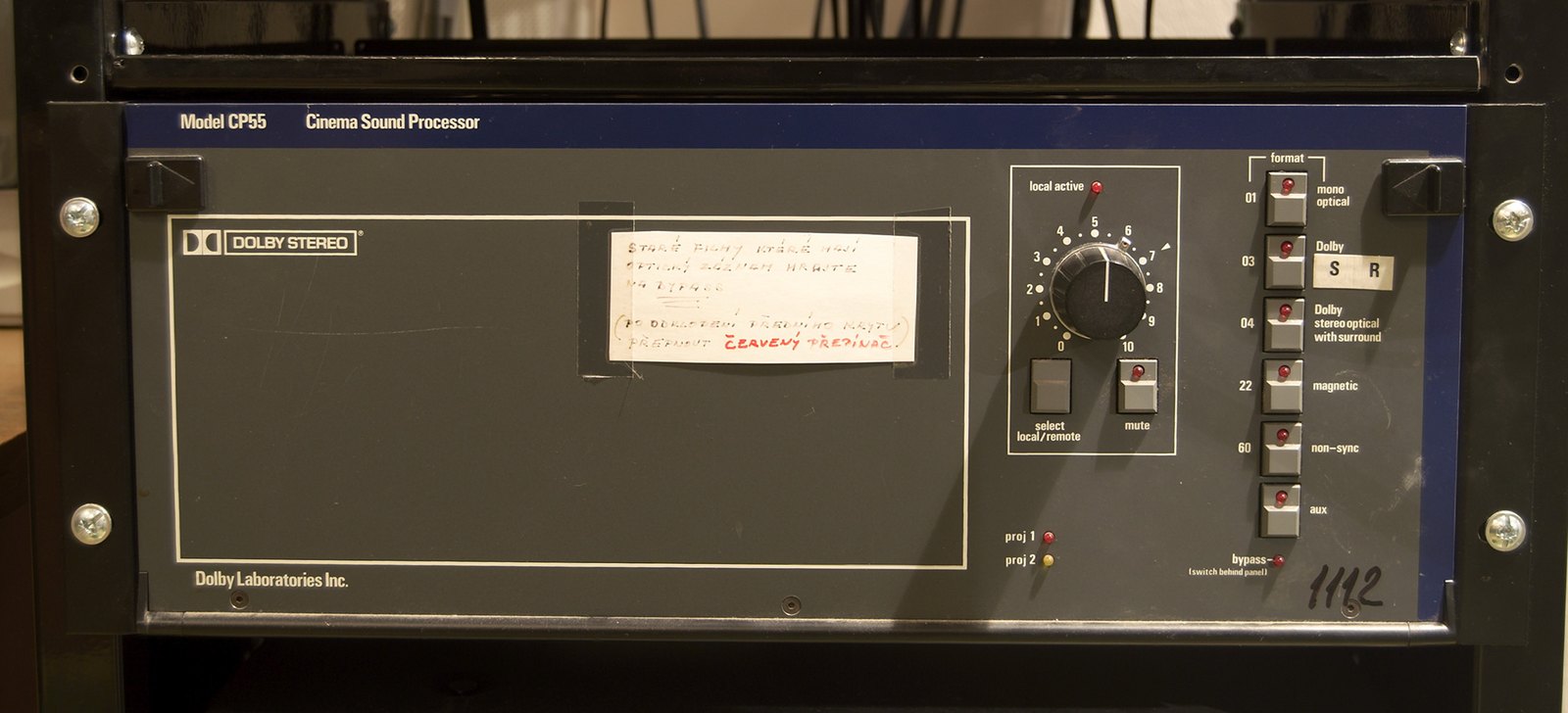
The image of a real Dolby cinema sound processor matters here. A blockbuster sound revolution can look weightless if it is described only as artistry. In practice it sat in projection booths, in processors, cards, faders, equalization circuits, speaker arrays, calibration habits, print formats, and booking decisions.[6][7] The audience heard a spaceship. The industry saw a reproducible theater standard.
The problem was not silence; it was bad everyday sound
Movies had been synchronized with sound since the late 1920s, and large-format experiments had produced spectacular multichannel exceptions long before the 1970s. Disney's Fantasia had shown one early version of the dream: spatialized sound as event cinema. The problem was that event systems did not automatically become ordinary exhibition.[4] Most theaters needed a system that could fit the economics and physical limits of commercial release.
By the early 1970s, the gap between domestic hi-fi expectations and many cinema presentations was becoming embarrassing. Dolby's own history of the Star Wars collaboration frames the period as one in which audio innovation had moved strongly in music, while cinema sound lagged behind.[1] That claim is partly corporate memory, but it names a real exhibition pressure. A movie could be visually expensive and still arrive through a playback chain that made dialogue dull, music compressed, and effects narrower than the image promised.
Dolby entered cinema from noise reduction rather than spectacle. Type A noise reduction had already been used in recording and postproduction, and its extension into film work attacked a basic weakness of optical sound: hiss and limited dynamic range.[2][4] This is the crucial first step. Dolby Stereo did not begin by asking how to make every theater futuristic. It began by making ordinary film sound cleaner and more controllable.
That order of operations explains the system's durability. A format that only produced special effects might have remained a roadshow flourish. A format that improved dialogue, music, quiet passages, and dynamic range could become an operations decision. It helped the whole movie, not just the trailer moment.
Compatibility was the business model
The elegant part of Dolby Stereo was not simply that it offered multiple channels. It was that the theatrical system could encode more spatial information onto a 35mm optical track in a way that remained useful across different theaters.[4][5] In equipped houses, the processor could decode a matrixed presentation with left, center, right, and surround information. In less-equipped houses, the same general release ecosystem did not collapse into unusable incompatibility.
Mix magazine's retrospective stresses this compatibility point: Dolby Stereo could travel in the existing 35mm world while rewarding cinemas that installed decoders and appropriate playback systems.[4] That mattered more than any single technical boast. Theater owners are cautious because projection-booth investments must survive more than one film. A system that made one blockbuster impressive but stranded later bookings would be a bad capital decision. Dolby's advantage was that it turned the upgrade into a continuing exhibition asset.
The CP50 and CP100 processor stories sharpen the point. In70mm's technical history describes the CP50 as a simpler optical sound processor for Dolby Stereo optical films, while the CP100 sat in the more comprehensive processor lineage that could support prestige presentations and broader booth control.[2][6] The hardware was not glamorous to audiences, but it converted format promise into repeatable playback. It gave projectionists a way to run the promise every night.
This compatibility also changed marketing. Once a film could be advertised as Dolby Stereo or 70mm six-track Dolby Stereo, the sound system became part of the ticket proposition.[2][3] The label told audiences that the theater itself mattered. That was a subtle but powerful shift. Exhibition quality moved from backstage assumption to consumer-facing claim.
1977 made the upgrade audible
The system needed a mass-cultural demonstration, and 1977 supplied it twice. In70mm's account identifies Star Wars and Close Encounters of the Third Kind as the watershed titles that made the public and the industry notice Dolby Stereo at scale.[2][3] Dolby's own legacy page likewise treats Star Wars as the point at which the company's cinema work became widely legible to moviegoers and filmmakers.[1]
The reason was not just volume. Star Wars used sound as world-building. Engines, lasers, droids, voices, and orchestral force had to occupy a screen universe that seemed to extend beyond the frame. Dolby's 2019 account emphasizes that George Lucas wanted the opening star destroyer sound to feel huge, and that Dolby's work helped translate that ambition into theatrical force.[1] The claim is promotional, but the historical pattern supports it: the film turned improved sound from an engineering topic into audience demand.
In70mm's chronology gives the adoption story useful numbers. It places the opening of Star Wars in 46 U.S. theaters equipped for Dolby Stereo and describes later growth in Dolby-equipped cinemas as the format gained traction.[3] The exact count matters less than the mechanism. A limited equipped footprint can become a demand signal if audiences believe the equipped version is the proper one. The theater without the upgrade then has to explain why its presentation is lesser.
That is the industrial importance of the Star Wars moment. The film did not merely exploit Dolby Stereo. It helped sell the idea that cinema sound was a reason to choose one auditorium over another. Once that habit formed, the format was no longer just a production tool. It was part of theatrical competition.
The 70mm prestige lane and the 35mm workhorse lane reinforced each other
Dolby Stereo's history is easy to flatten into a 35mm optical story, but the 70mm lane mattered because it gave the technology a prestige aura. In70mm's 70mm history notes that 70mm prints could deliver magnetic six-track Dolby Stereo presentations, while 35mm optical Dolby Stereo made improved sound available through a more scalable release path.[2][3] The two lanes were not enemies. They gave the same brand two different jobs.
The 70mm version said: this is the best possible event presentation. The 35mm optical version said: this can become normal. That combination is powerful. A format that lives only in premium rooms can become rarefied. A format that lives only in everyday rooms may struggle to define aspiration. Dolby benefited from having both: the special-event glow of 70mm and the practical spread of optical Dolby Stereo.
This also helped blockbuster form. Late-1970s and early-1980s popular cinema increasingly depended on worlds that could be felt as environments: space, disaster, war, fantasy, urban pursuit, supernatural threat. Visual effects and production design supplied scale, but sound supplied continuity. A surround effect could make the offscreen field active. A center channel could stabilize dialogue amid spectacle. Bass extension could make a large object feel large before the viewer had time to analyze the image.[1][2][5]
None of that means every Dolby Stereo film used the system imaginatively. New formats always produce cliches. Surround can become empty whoosh; bass can become blunt force; spatial separation can become demonstration. But the best uses changed the grammar of mainstream films. They made offscreen space more narratively available.
The processor changed the director's contract with the room
Film sound is made in studios, but theatrical meaning is completed in rooms. That is why the processor is central to the story. A sound designer can create spatial intention, and a mixer can shape it, but an audience only receives that intention if the theater can reproduce it with reasonable consistency.[5][6] Dolby Stereo tightened that contract.
Stephen Bottomore's academic history of the Dolby era argues that the period from the 1970s onward reshaped Hollywood sound not as an isolated technical footnote, but as part of a broader industrial and aesthetic transition.[5] That framing is useful because it prevents a simplistic invention story. Dolby Stereo did not single-handedly create the modern blockbuster. It joined new filmmaking ambitions, theater upgrades, marketing language, and audience expectation into one feedback loop.
The practical result was a new assumption: a film could be mixed for a theatrical environment in which sound moved with greater precision and stronger dynamic contrast. That assumption feeds back into writing, staging, editing, and effects design. If offscreen sound can be trusted, the image can withhold more. If music and effects can expand without burying speech, spectacle can become denser. If theaters compete on playback quality, studios can justify sound work as part of the film's commercial identity.
This is why Dolby Stereo's legacy is larger than nostalgia for analog film sound. The system helped train audiences to expect cinema as an enveloping environment. Later formats, including Dolby SR, Dolby Digital, DTS, SDDS, and Dolby Atmos, would redraw the technical map.[2][3] But they inherited an audience and industry that had already been taught the basic lesson: movie sound is not a background service. It is part of the reason to go to a theater.
The lasting change was ordinary expectation
The great success of Dolby Stereo is that its revolution became mundane. A viewer today may not think much about center-channel dialogue, surround ambience, clean dynamic range, or low-frequency energy unless something goes wrong. That ordinary expectation is the historical victory. Dolby Stereo helped move multichannel cinema sound from roadshow exception toward default exhibition grammar.[2][4][5]
The irony is that the famous moments remain the easiest way to remember the change. The opening of Star Wars still works as myth because it compresses the whole transition into one sensory event: image scale, sound scale, audience shock, theater hardware, and industry adoption all arriving at once.[1][3] But the deeper story is quieter and more mechanical. It is the story of optical tracks, matrix decoding, processors, speakers, calibration, booking, and a logo that told audiences which room had been prepared for the film.
Dolby Stereo made the blockbuster audible before surround became ordinary. Its achievement was not just to make movies louder or wider. It made better theatrical sound operational.
Sources
- Dolby Professional, "Dolby and Star Wars Legacy," corporate history page on Dolby's collaboration with the Star Wars films and early Dolby Stereo impact.
- Thomas Hauerslev, ""In 70mm and 6-track Dolby Stereo."" in70mm.com, history of Dolby Stereo, 70mm presentations, and format milestones.
- Thomas Hauerslev, "Mixing Dolby Stereo Film Sound." in70mm.com, historical article on Dolby Stereo mixing, Star Wars, CP50, and early release growth.
- George Petersen, "1976: Dolby Laboratories Dolby Stereo Theater Sound." Mix, retrospective on the system's compatibility and theater-sound significance.
- Stephen Bottomore, The Dolby Era: Sound in Hollywood Cinema 1970-1995. Sheffield Hallam University Research Archive.
- in70mm.com, "Dolby CP100 Cinema Processor," technical page on the cinema processor lineage behind Dolby Stereo theater playback.
- Kirk979, "Kino Scala - detailní pohled na zvukový procesor Dolby Stereo SR." Wikimedia Commons, photograph of a Dolby Stereo sound processor in Brno's Kino Scala.