Somewhere just outside the picture in Night Mail, somebody is jiggling a piece of string. The men on camera have two jobs. They have to sort the envelopes in their hands, something they do for a living. They also have to watch the string. Its swing tells them when to shift their weight, so that everyone in the sorting van feels the same lurch at the same instant. The floor beneath their feet is perfectly steady. This stretch of the overnight run to Scotland took place in the General Post Office film studio in Blackheath. [1]
Harry Watt and Basil Wright faced a curious problem in making their 1936 documentary for the GPO. A locomotive going past a camera gives a wonderful impression of speed. A letter going past at the same speed gives you very little to look at. To see what happens to the letter, you have to get aboard and stand still beside the man sorting it. Then the most obvious evidence of the journey disappears. The filmmakers found ways to put that missing movement into a shoulder, a sound effect and, eventually, the breath of a man reading a poem. [1][2]
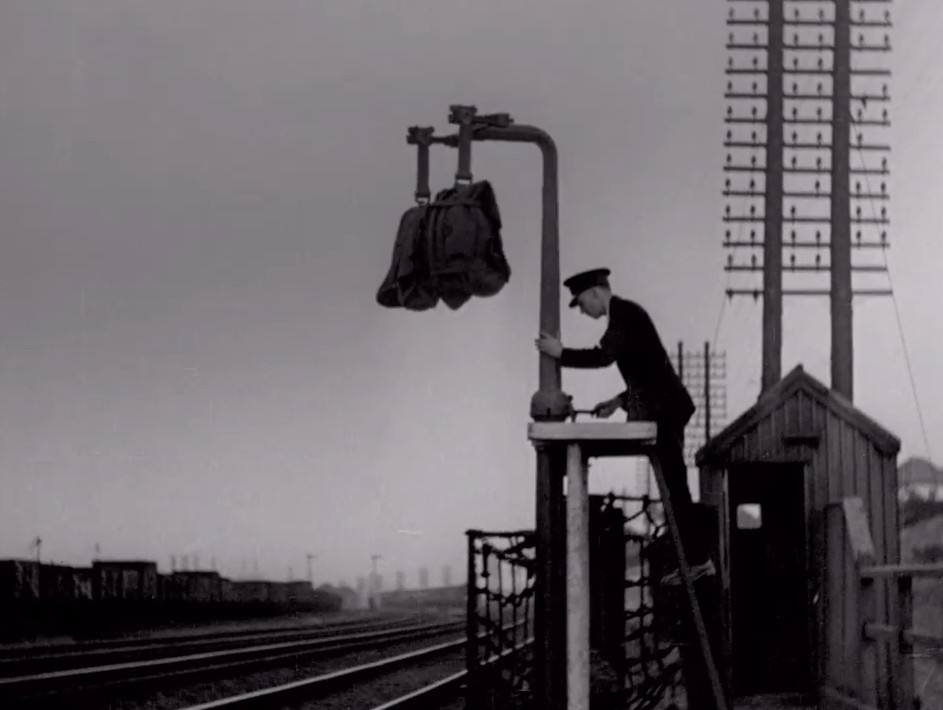
Out on the line, the mailbag makes an excellent demonstration of speed. A worker hangs the pouch on a trackside hook. The train snatches it up on the run. For a moment you can measure the force of an entire express by what happens to one bag. Inside the sorting van, the problem is almost the reverse. An envelope has to find its way into a narrow pigeonhole regardless of what the carriage is doing. Watch the men’s hands with that in mind. The steadiness of a hand at the end of a swaying arm is a small piece of professional skill, and quite difficult to see until the film gives you both movements together. [1][3]
The string matters because a railway carriage imposes the same sudden movement on everybody in it. Four men swaying at their own idea of a plausible interval would give four separate performances. A shared cue makes it possible to infer a single floor beneath them. And because the men are postal workers, the filmmakers can leave the much less conspicuous business of reading, reaching and releasing an envelope to people who already know the sequence in their fingers. The most elaborate piece of pretending in the scene buys us a good look at an ordinary piece of work. [1]
The sound crew had its own stationary railway. In an oral history, GPO cameraman Norman Fisher remembered an iron bedstead among the equipment used to make the noise of the rails. It is a lovely object to keep in mind while listening. In a room, a strike on that frame might send you looking for a loose joint. Heard against pictures of a train, repeated at intervals, the ring of the metal tells you the wheels have covered another length of track. Fisher’s recollection gives that seemingly automatic pulse a human source. Someone had to keep time. [4]
W. H. Auden’s verse and Benjamin Britten’s score arrive together late in the film. By then the audience has spent most of the journey considering the post from the sorter's side of the pigeonholes. One envelope is distinguishable from the next chiefly by where it has to go. In the poem, an invitation, a bill and a love letter go rattling along in much the same metre. Try saying the list aloud and it takes some effort to give each item its due before the next one comes up. For the sorter that pressure belongs to the timetable. For the person waiting at home, any one of those envelopes could be the whole point of the train. [1][2]
At the end of the poem the people who will receive the post are still asleep. Their one extravagance is being able to lie quite still while all this goes on for them. Back in the studio, it took a roomful of men moving on cue to earn them that privilege. [1]
Sources
- Blake Morrison on the making of Night Mail, the Blackheath set and Auden’s verse, The Guardian.
- International Documentary Film Festival Amsterdam, Night Mail film record and credits.
- British Railway Movie Database, Night Mail, with annotated frames of the trackside collection sequence.
- British Entertainment History Project, interview with Norman Fisher on the GPO studio and recording rail sounds.