This essay discusses the ending.
Mikey has to ask his oldest friend whether he knew his brother. It seems an odd thing to have forgotten. Then Nicky starts talking, and the dead boy acquires a head of hair that fell out when he got sick, a nickname the boys gave him, and an apology the boy never heard. For a few seconds in Elaine May’s Mikey and Nicky (1976), the person you would most like to hear more about is a ten-year-old who never appears on screen. [1][2][3]
Earlier that night, Nicky needed someone who would come to a Philadelphia hotel room in the middle of the night. He called Mikey. Now, in a cemetery, we begin to understand the more particular qualification that got Mikey the call. These two have apologized at a grave together before. [2][3]
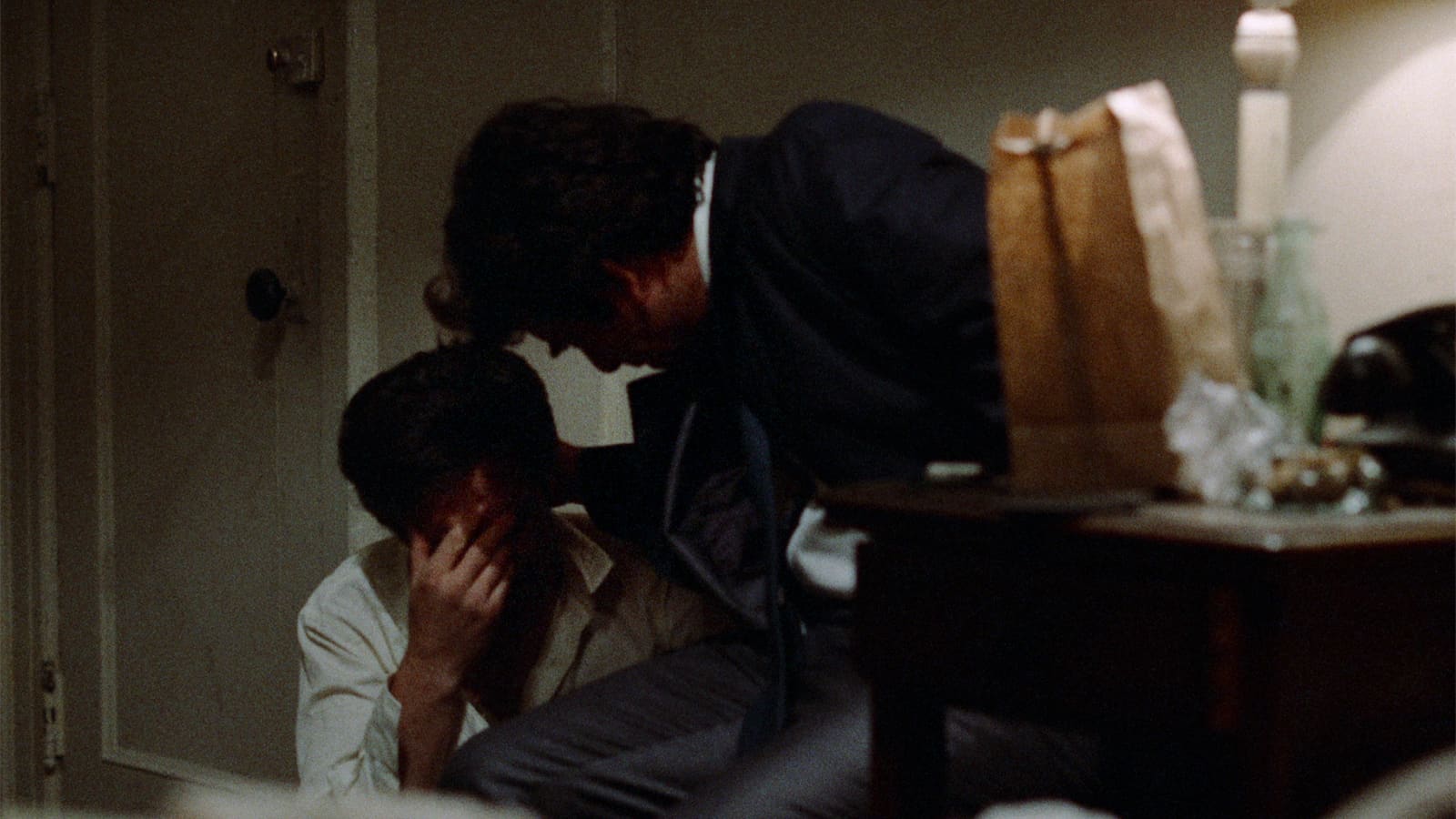
They have come to see Nicky’s mother. The visit is his idea, though once they get there he could use some instruction. In the dark the men have trouble picking out her grave. Mikey, who professes disbelief in an afterlife, keeps excusing himself for stepping on the dead. Peter Falk gives him the manners of a man edging along an occupied row at the movies. He can debate what happens after death and still feel that he owes somebody an apology for his shoe. When he tries to say Kaddish, Nicky laughs and appeals to his mother over Mikey’s head. Surely she knows her own son well enough to let him laugh. [2][4]
John Cassavetes gives Nicky an extraordinary privilege here. He can bring a third person into a conversation simply by speaking as though she can answer. He does something like it for Izzy. Mikey supplies the relationship, my brother. Nicky remembers an ugly little piece of conduct the boys shared. They called the sick child Baldy. After he died they went to his grave to tell him they were sorry. The hurt in the story comes partly from the grammar. As long as Nicky is alive, either man can say we and the other can tell him what happened next. [2][3]
May has a sharp ear for the less lovable uses of that familiarity. Nicky has nicknamed Mikey “The Echo” for repeating himself. It gets a laugh at Mikey’s expense in the world where both men earn their living, and Mikey has carried the embarrassment home. Late that night he asks his wife Annie whether she has noticed him doing it. She hasn’t. It ought to be a relief to get a second opinion from someone who hears him talk every day. Yet Mikey stays up with her and proceeds to repeat a story we have already heard. [2][4]
This time he has to introduce Izzy. Annie has to work out how long ago the boy died and what one says to a husband who brings up a death from childhood shortly before dawn. In May’s screenplay, Mikey even pauses to check that Annie likes hearing about his boyhood. The question gives her two jobs at once. She has to listen to the story and reassure its teller that he has picked the right person to tell. Rose Arrick, playing Annie, has very little room to maneuver. Sympathy is within her gift. A childhood with Izzy is beyond it. [1][2][3]
Then the man who remembers Izzy comes to the front door. Nicky calls out to be let in. Annie does the answering while Mikey uses the furniture to hold the door shut. All night Mikey has been helping a hired killer find his friend. May lets him feel exactly what he stands to lose while there is still time to open the door. When the shots come, Mikey tells Annie she can go to bed. In the morning he will still be able to tell her about his brother. He will have to supply both boys’ parts himself. [2]
Sources
- The Criterion Collection, Mikey and Nicky. Cast, director-supervised restoration and still gallery.
- American Film Institute, Mikey and Nicky. AFI Catalog film record and scene synopsis.
- Elaine May, Mikey and Nicky. Screenplay, including the cemetery and Annie’s conversation with Mikey.
- “Elaine May: Dispassionate,” Screening the Past. On laughter at the grave and Mikey’s habit of repetition.