This essay discusses the ending.
When Taeko objects to the way her husband eats, Mokichi puts a question to Fumi, their housemaid. Surely people back home eat rice the way he does? She is an odd choice of referee. She knows the custom, which makes her an excellent witness. She also works for both parties to the dispute. What answer could she possibly give that would settle it? By the time Taeko and Mokichi sit down to eat together near the end of Yasujirō Ozu’s The Flavor of Green Tea over Rice (1952), Fumi has gone to bed. For once, the couple will have to manage without a third opinion or a third pair of hands. [1][2]
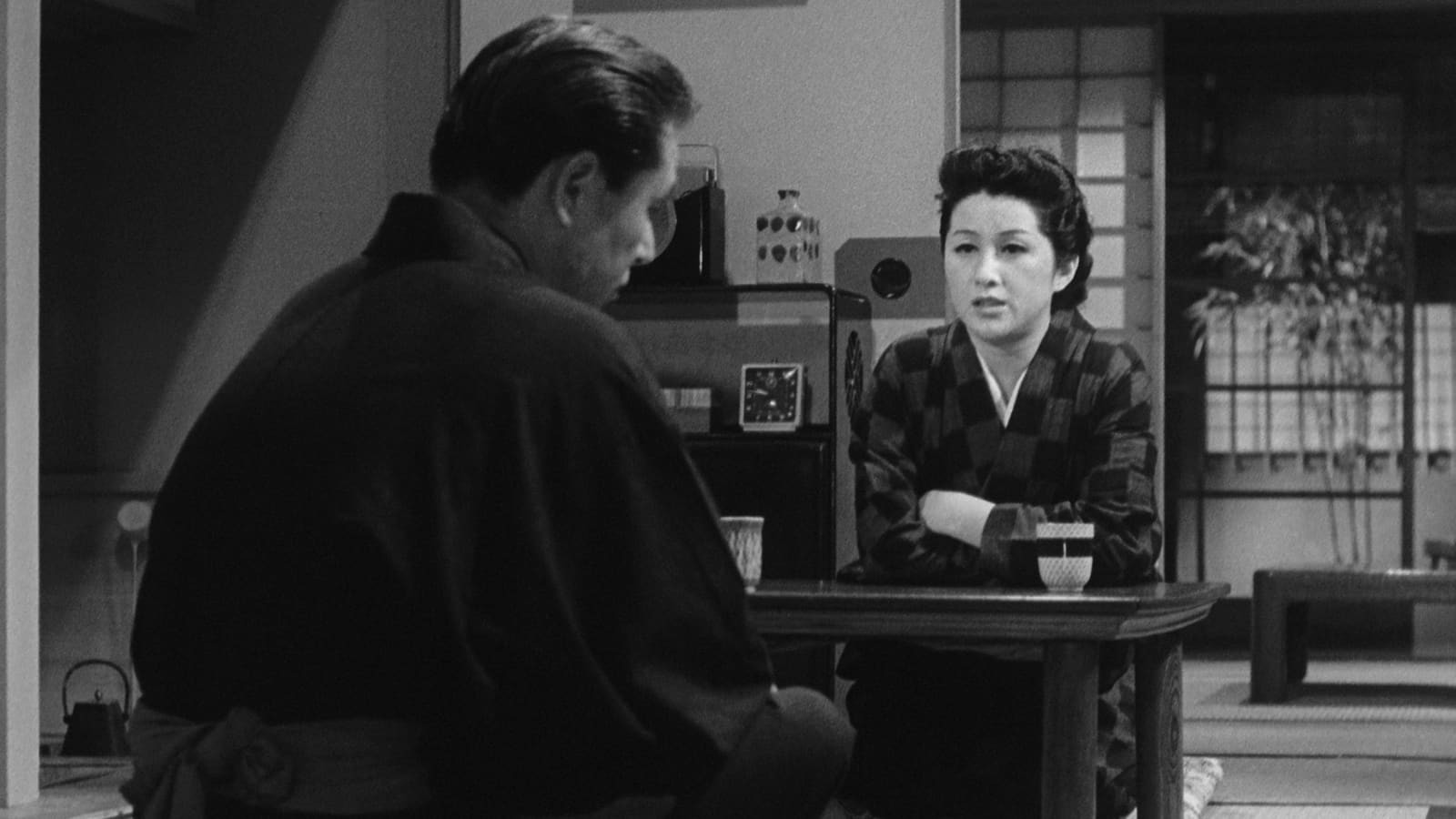
There are two different things in those bowls. At the earlier meal Mokichi pours miso soup over his rice. The dish that gives the film its title, ochazuke, is rice with tea poured over it. The distinction matters because it would be easy to remember the second meal as an exact replay, with Taeko finally giving her approval. The trouble at the first meal outlasts the pouring. Mokichi apologizes, takes another mouthful, and makes a noise eating it. Taeko walks out. He can agree with his wife in words and offend her again in the time it takes to swallow. [2]
Shin Saburi plays Mokichi as a man quite at ease with his pleasures. He has gone up in the world and can afford better cigarettes. He still buys the cheap ones because he likes the taste. Michiyo Kogure gives Taeko an equally persuasive pleasure in getting a laugh. On a trip to a hot spring with other women, she spots a carp moving slowly through the pond and gives it her nickname for Mokichi. You can see the appeal of the joke even as you wince for him. A fish supplies the movement, her friends supply the laughter, and the one person who might have something to say about the resemblance is safely at home. At dinner, Mokichi tries a milder version of the same maneuver when he appeals to Fumi. Each spouse knows where to find an audience. [2][3][4]
The kitchen is a room in which their usual advantages are worth very little. Late at night, hungry, they decide to let Fumi sleep. Now two grown people who have eaten any number of meals under this roof have to work out how to put one together. Ozu gives their uncertainty time to be funny. There is something especially endearing about seeing Taeko on unfamiliar ground in a house where she has felt qualified to correct the proper way to eat a bowl of rice. Mokichi may know exactly how he wants his supper to taste, but that knowledge takes him only part of the way to getting it on the table. For a few minutes each has an excellent reason to keep the other in the room. [2]
Ozu could have made the shared dish do all the work here. Two bowls of the same food would make a tidy picture of a reconciled couple. Listen, though, to what happens when he cuts from Mokichi eating to Taeko’s face. As the critic Junji Yoshida observes, the sound of his eating goes on over the cut. For an instant it might belong to her. Then we see how quietly she eats. Earlier, a noise like that could drive Taeko from the room. Here the camera can move from one spouse to the other on the strength of it. The pleasure of the cut is that we get to hear Mokichi quite distinctly even while looking at the person who once wished he would stop. [2]
In the BFI’s programme notes, Ozu recalls an earlier version of the script in which the husband was leaving for war. He had doubts about changing the reason for the departure to a business trip abroad. The smaller occasion has one advantage. Almost any married couple might find themselves hungry at an odd hour. What makes this night unusual in the Satake house is that the people who want the meal do the work. Come morning, Fumi will still be their employee. Yet for the length of a supper, she owes them nothing. One hopes she slept through the slurping. [2][3]
Sources
- Janus Films, The Flavor of Green Tea over Rice. Film credits and distributor’s still gallery.
- Junji Yoshida, “The Flavor of Green Tea over Rice: Acquired Tastes,” The Criterion Collection.
- BFI Southbank, The Flavour of Green Tea over Rice. Programme notes, credits, and Ozu’s account of rewriting the departure.
- Eye Filmmuseum, The Flavor of Green Tea over Rice. Shochiku retrospective screening notes on Mokichi’s background and tastes.