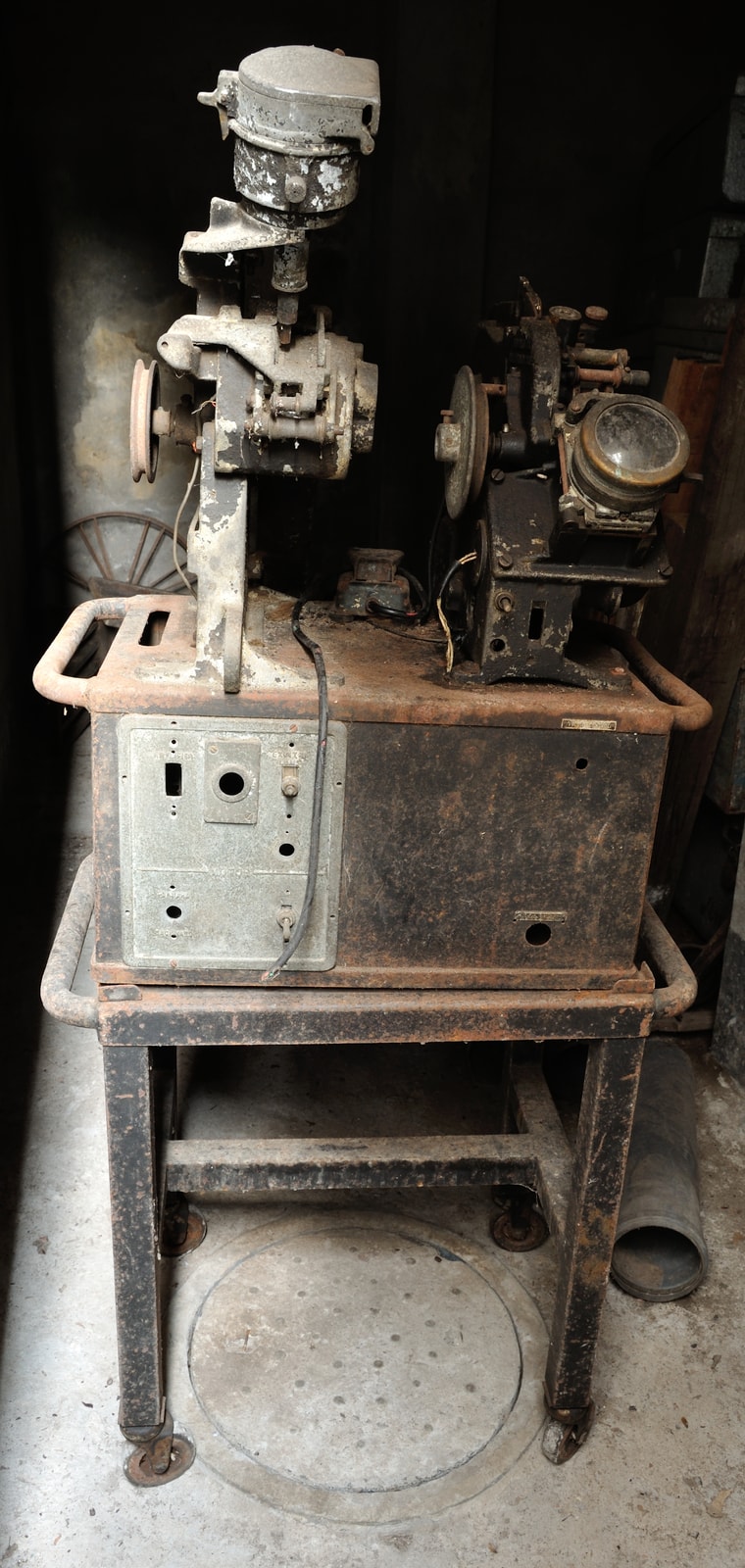
The Moviola looks strange now because it makes editing visible as furniture. It is not a floating timeline, a software panel, or a cloud workspace. It is a vertical machine with a viewer, reels, sound heads, pedals or hand controls, and enough physical presence to make the editor's body part of the workflow. That physicality is the point. The Moviola did not merely help editors see film while cutting it. It turned editing into a repeatable bench discipline: load, watch, stop, mark, rewind, compare, trim, splice, and decide.[1][2]
That is why the machine deserves a technology report rather than a nostalgia note. It changed the film industry by giving the cutting room a practical interface. Before editing became a non-linear software metaphor, it was already a non-linear thought process constrained by linear material. The editor could jump backward, examine a performance, listen for rhythm, search for a better entrance, or test a transition, but every action passed through reels, sprockets, leader, grease pencil, splices, and assistant labor. The machine made that negotiation efficient enough to become an industrial standard.
The first achievement was proximity
La Cinematheque francaise's apparatus catalogue preserves the origin story as a product pivot. Iwan Serrurier had been pursuing a convenient home movie projector, but the decisive meeting came in September 1924 at Douglas Fairbanks Studio, where the mechanism was seen as potentially useful for the editing table. Over a weekend, one mechanism was modified with a board, lamp, and magnifying glass; Fairbanks bought the first Moviola editing machine, and the surplus mechanisms were converted and sold.[1] In other words, the Moviola became important when it stopped trying to bring movies to the living room and started solving a professional cutting-room problem.
The problem was not abstract. Editors needed proximity to film. They had to inspect performance, judge motion, locate exact frames, and make decisions without waiting for a full projection-room event. The Moviola gave the editor a small, controllable viewing station. That sounds modest until one remembers how much of cinema depends on tiny timing decisions: whether a glance starts too early, whether a reaction breathes too long, whether an entrance has force, whether a line should land over a face or a door.
The machine's authority came from making those decisions repeatable. A 1935 International Photographer feature on Serrurier's Hollywood factory describes the Moviola line as designed from actual experience to fill a need, with pictures viewed on a 9-by-12-inch screen and film passing through the table into a basket.[2] The details are modest, but that modesty is revealing. A useful editing machine did not need to theatricalize the image. It needed to put moving film close enough to inspect and controllable enough to stop at the instant judgment arrived.
Editing became a room, not just a cut
The apparatus records also show how editing expanded from a viewer into a room system. La Cinematheque's Moviola PH 97 D catalogue entry identifies a 35mm film viewer made in Hollywood between 1943 and 1945, with a Geneva-drive film movement, toothed feed, supply and take-up arms, magnifying lenses, electric motor, and speed control.[1] That inventory matters. Editing was not a light desktop abstraction. It was a standing or seated routine around a machine, with film moving through a controlled path and assistants managing rolls, trims, bins, sync, and paperwork.
That physical setup shaped taste. A film editor could experiment, but not without friction. Material had to be handled. Choices had to be prepared. Comparing two alternatives meant finding the pieces, threading or positioning them, and living with the consequences long enough to know whether the cut had a pulse. The machine therefore encouraged a particular kind of attention: close, tactile, sequential, and decisive.
The Los Angeles Times' Hollywood Star Walk profile of Mark Serrurier helps explain how deeply the device entered industry infrastructure. Mark, Iwan's son, became president of Moviola Manufacturing Co. in 1946, redesigned the device in 1948, and received a 1979 Academy Award of Merit for that development line.[3] The significance was not a one-off novelty. It was continuity. The Moviola had become a platform: modified, refined, and kept current across decades of changing production practice.
That platform logic separates the Moviola from simpler "old equipment" sentiment. Cameras, lenses, sound recorders, labs, and projectors all changed around it. Yet the editing room still needed a reliable way to bring image and sound under an editor's hand. The Moviola's industrial value was that it made revision possible without making decision feel casual.
The machine was slow only in the wrong comparison
Against digital editing, the Moviola seems slow. That comparison is partly fair and partly misleading. Digital systems can duplicate versions instantly, search bins, stack tracks, undo decisions, and let multiple alternatives coexist without physical cost. But the older machine was not simply a brake on creativity. It was a device for concentration.
Michael Kahn's 2006 CineMontage interview is valuable because it catches the Moviola at the end of its long professional life, not at the start. Kahn was already familiar with Avid from other projects, yet he and Steven Spielberg still used film tools, including a Moviola and a KEM, on Munich. For that production, assistant Pat Crane rigged mobile editing rooms in trucks so Kahn could cut near Spielberg while the shoot moved through Malta, Budapest, Paris, and New York.[4] The anecdote overturns the lazy assumption that analog editing meant immobility. In this case, the old system was made portable enough to keep pace with a demanding production schedule.
Kahn's explanation also makes the workflow philosophy clear. He argued that film editing forced a point of view because decisions moved one way at a time.[4] That does not mean digital editors lack judgment. It means the Moviola foregrounded commitment. Each choice had physical cost, so the editor learned to discriminate before multiplying options. The constraint could be frustrating, but it could also be clarifying.
This is the hidden continuity between analog and digital editing. The best software timeline still requires an editor to decide what matters: performance, rhythm, information, causality, suspense, silence, breath, sound overlap, and the moral weight of when to leave a face. The Moviola did not invent those questions. It made them local and bodily. The editor sat with the film until the answer was not merely available but chosen.
Digital timelines inherited more than they replaced
Digital editing did not erase the Moviola's central problem. It changed the price of reaching possible answers. Kahn's comparison between film and electronic editing is useful because he does not treat the machine as magic. His point is about decision pressure: when choices have to be made in a more linear physical process, the editor's point of view is tested earlier.[4] A software timeline removes much of that handling cost, but the same underlying problem remains: how to let editors find structure inside footage.
The word "non-linear" can make digital editing sound like an absolute break. In practice, the editor's mind was already non-linear. Editors had always compared possible beginnings, endings, reactions, and bridges. What changed was the cost of accessing alternatives. The Moviola made one piece of film available to the hand and eye with precision. Avid made many pieces available to the screen and database with speed. The leap was enormous, but the problem remained recognizable.
That is why the 2024 documentary Her Name Was Moviola could matter to viewers long after analog editing had ceased to be normal production infrastructure. The Guardian's review describes Walter Murch and assistant Dan Farrell reconstructing a Moviola cutting room and editing a scene from Mr. Turner on 35mm film, treating the machine not as a museum prop but as a way to demonstrate the labor of editing before digital abstraction.[5] The exercise matters because it restores the work's physical grammar. Film has to be handled. Sound has to be synchronized. A cut is an operation, not just a cursor gesture.
The lesson is not that the old way was purer. That would flatten history into taste. The better lesson is that interfaces teach habits. The Moviola taught editors to think through touch, tempo, and commitment. Digital timelines teach editors to think through availability, versioning, layering, and speed. Each system produces freedoms and risks. One can make decision too heavy; the other can make revision so easy that decision arrives late.
The bench still haunts the screen
The Moviola's lasting importance is not that editors should go back to upright machines. Its importance is that it reveals what editing technology is always trying to organize. Editing is not only the joining of shots. It is the management of attention under constraint. Someone must decide where a viewer looks, when information arrives, how a performance breathes, when sound leads image, and when a scene has said enough.
The machine made those decisions visible as a workplace. The editor had to occupy a room, handle material, coordinate with assistants, and commit labor to each experiment. That workplace shaped Hollywood craft for decades, from studio features to independent productions and late analog holdouts. It gave editing a reliable body before software gave it an expandable screen.
So the Moviola should be remembered less as a quaint ancestor of Avid, Premiere, or Resolve than as the first great ergonomics of film thought. It put moving images close enough to touch and slow enough to judge. Before editing became a timeline, it was a bench where time had to be pulled through a machine.
Sources
- La Cinematheque francaise and CNC, "Visionneuse de film 35 mm" - apparatus catalogue entry for a Moviola PH 97 D, with manufacturing details, patents, mechanism notes, and Mark Serrurier origin-history excerpt.
- Earl Theisen, "The Story of the Moviola," International Photographer, November 1935, via DIX Project - factory-era feature on Iwan Serrurier, machine design, screen size, and practical editing-tool development.
- Los Angeles Times Hollywood Star Walk, "Mark Serrurier" - profile noting Mark Serrurier's presidency of Moviola Manufacturing Co., 1948 redesign, and 1979 Academy Award of Merit.
- Michael Kunkes, "'Munich,' Mentoring & Moviolas: The Michael Kahn Interview," CineMontage, January 1, 2006 - interview on Kahn's film-editing workflow, mobile editing rooms, Moviola/KEM use, and analog decision-making.
- Peter Bradshaw, "Her Name Was Moviola review - ode to editing machine a geekgasm for analogue fans," The Guardian, June 14, 2024 - review of Walter Murch and Howard Berry's reconstruction of a Moviola cutting-room process.
- Wikimedia Commons, "Moviola - 35mm Film Editing Machine - Kolkata 2012-10-09 1577.JPG" - source page for the real photographed Moviola image used in this article.