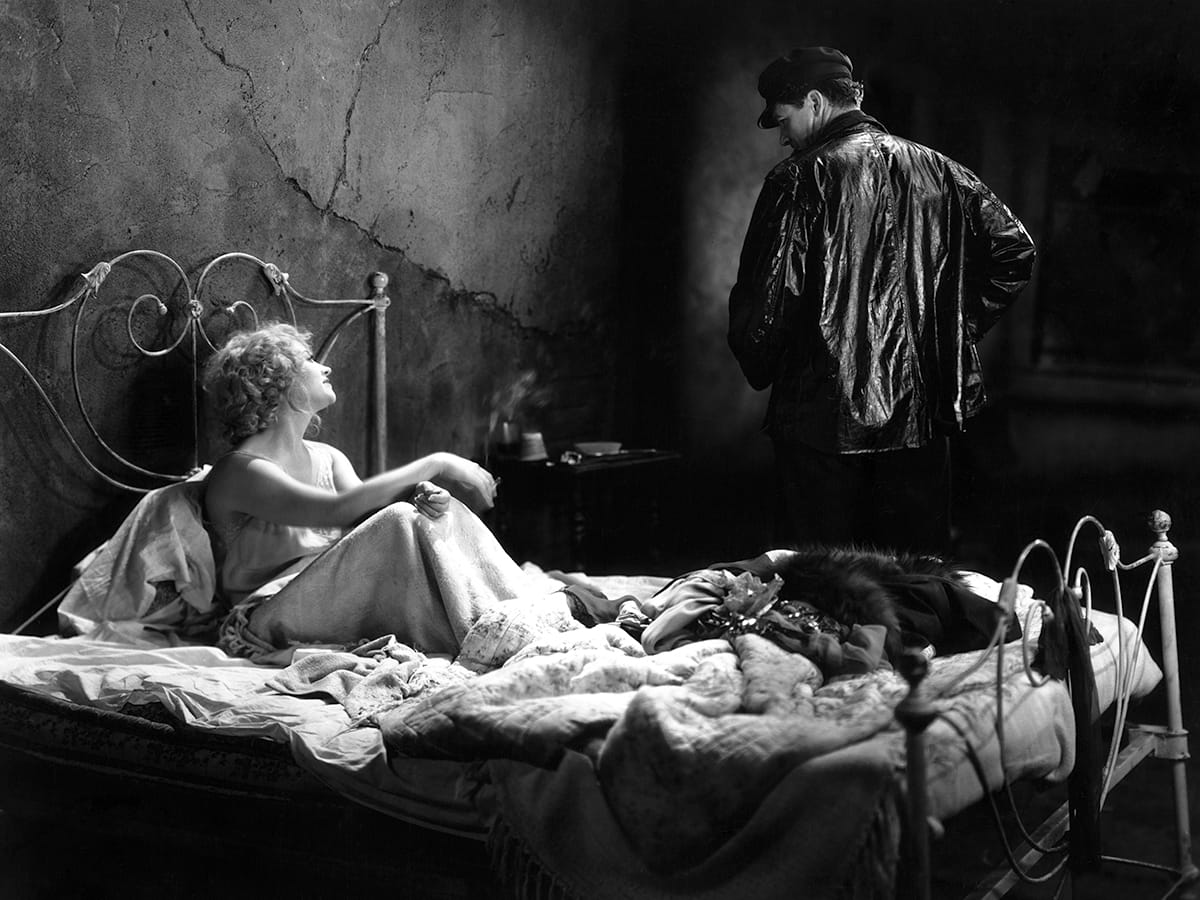
Josef von Sternberg's The Docks of New York looks at first like a small story: a ship stoker goes ashore for one night, rescues a woman from the water, marries her as a barroom stunt, then has to decide whether the gesture means anything when morning arrives. The plot could have hardened into rough-man sentiment or fallen-woman pity. Instead, Sternberg turns it into a study of atmosphere under pressure. Fog, smoke, lamps, dock machinery, stairs, wet boards, cheap rooms, and tired faces do as much moral work as the dialogue cards.[1][3]
That is why the film still feels unusually alive for a late silent. Criterion's film page identifies the core materials plainly: George Bancroft as Bill Roberts, Betty Compson as the woman he rescues, Harold Rosson's photography, Hans Dreier's expressionist set design, and a silent black-and-white frame that makes the waterfront less a place than a climate.[1] The surprise is that the climate does not smother the characters. It gives them a temporary shelter in which a brutal man and a bruised woman can test whether tenderness is only another form of performance.
The Dock Is A Threshold
The opening force of The Docks of New York is physical labor. Bill is a stoker, a man whose body belongs first to the ship's furnace before it belongs to romance. AFI's catalog record places the film in Paramount's 1928 production context, with von Sternberg directing, Jules Furthman writing from John Monk Saunders's "The Dock Walloper," Harold Rosson photographing, and the picture released in September 1928.[2] Those credits matter because the film is built from a collaboration between industrial setting and studio artifice. The docks were not documentary waterfront footage; they were a designed world made to feel damp, heavy, and half-visible.
That half-visibility is the point. The dock is neither freedom nor home. It is the interval between ship and city, work and leisure, anonymity and exposure. Bill climbs out of a furnace world into shore leave, but he does not become clean. The same muscular confidence that makes him useful below deck makes him dangerous in the Sandbar saloon. He strides as if the night has already agreed to him.
Mae enters from another threshold: the water. The rescue sequence might have made Bill noble at once. Sternberg refuses that simplification. Pulling a woman from the harbor is an act, but not yet a transformation. Bill's first relation to Mae is still partly boast, partly appetite, partly curiosity. The film's close reading starts there, in the gap between saving someone and seeing her.
The Barroom Turns Cruelty Into Ceremony
The Sandbar is the film's great social machine. Eddie Muller's San Francisco Silent Film Festival essay stresses that Docks is not really a crime thriller, despite the assumptions that followed von Sternberg's Underworld; it is an elegiac love story about damaged people at the waterfront's bottom edge.[3] That distinction changes how the bar should be read. Its roughness is not just local color. It is a ceremony for converting loneliness into noise.
Sternberg's camera does not treat the saloon as a neutral room. It moves through smoke, railings, hanging walkways, bodies, and drink as if every object were part of the same tide. The wedding scene matters because it is both joke and sacrament. The room encourages Bill to treat marriage as one more drunken flourish, a stunt performed before witnesses who expect nothing permanent from anyone. Yet Mae hears the gesture differently. She knows the joke, but she also knows that the joke briefly gives form to a desire she has been taught not to trust.
This is where the film's moral weather thickens. A conventional melodrama would separate sincerity and mockery so the viewer can sort the couple cleanly. The Docks of New York keeps them in the same room. Bill can be ridiculous and moved. Mae can be wary and hopeful. The bar can be vulgar and solemn. The atmosphere does not blur meaning because Sternberg is vague; it blurs meaning because the characters themselves do not yet know which version of the night will survive morning.
Fog Makes Class Visible
Senses of Cinema's essay is useful because it treats the waterfront as an active milieu, a world of docks, flophouses, gin mills, and back alleys through which Sternberg studies working-class life and desire.[4] The film's New York is not a map. It is a compression chamber. People arrive already used up by work, sex, drink, and repetition, then try to squeeze one more feeling out of the night.
Fog and shadow make that compression visible. They do not simply beautify poverty. They keep the city from becoming a clean moral diagram. Bill's labor is real, but it does not make him automatically virtuous. Mae's exhaustion is real, but it does not make her only a victim. Lou, played by Olga Baclanova, carries another version of female knowledge: glamorous, wounded, and sharper than the men around her expect. The film's class world is full of people who know the terms are bad and still have to keep bargaining.
Rosson's photography and Dreier's sets, highlighted by Criterion and the Internet Archive item description, make that bargaining tactile: fog-enshrouded docks, expressionist waterfront spaces, and bodies staged against damp darkness.[1][6] The style is not a decorative shell placed over a simple story. It is the story's method. If the harbor were clear, the film would be less truthful. These people live in partial light.
Close-Ups Slow The Night Down
The most moving scenes in The Docks of New York are not the biggest ones. They are the pauses in which Mae and Bill seem surprised by the possibility of being looked at without immediate use. Bancroft's Bill is built as a large force: blunt face, working body, comic arrogance, a sailor's entitlement to the night. Compson's Mae is built out of guarded stillness. She does not need to overplay suffering because the room has already done part of the work for her.
Sternberg's genius is to let these two scales meet without making either one win too soon. Bill has to become smaller without becoming false. Mae has to become visible without becoming conquered. In their room, the film leaves the saloon's public ceremony and studies a private uncertainty. The marriage may have begun as a joke, but privacy makes jokes harder to maintain. A rented room can become a court of appeal.
That is the film's strongest emotional movement: not redemption as instant moral upgrade, but attention as a change in tempo. The noisy room says people are types: stoker, prostitute, drunk, wife, crimp, judge. The close-up says a type can hesitate. In a silent film, hesitation is not absence. It is action.
Morning Is The Real Test
The film's ending depends on a simple question: what does a night promise after the night is over? AFI's production history notes the September 1928 release and the contemporary trade praise for von Sternberg's direction and the film's photography.[2] That timing matters. The Docks of New York arrived as synchronized sound was changing the industry, but its power comes from a silent cinema that had become exquisitely good at showing thought before speech could settle it.
Morning strips away the fog's temporary mercy. Bill has to return to the ship; Mae has to decide whether the marriage was only another humiliation; the court has to translate one night of feeling into the public grammar of judgment. The film does not pretend that love erases the waterfront. The ship still sails. Work still commands bodies. The law still reduces lives to cases. But something has shifted because Bill's earlier swagger can no longer explain him to himself.
That is why The Docks of New York is more than a beautiful late silent. It is a film about whether a gesture performed in bad faith can become binding because another person believed it. Fog, smoke, alcohol, labor, and fatigue all make sincerity suspect. Yet Sternberg's answer is not cynicism. He lets the night remain morally dirty and still lets a fragile form of responsibility emerge from it.
The film's beauty is inseparable from that dirt. Its shadows do not hide a pure romance waiting underneath. They show how hard it is for tenderness to appear in a world arranged to turn people into functions. Bill begins as a furnace worker spending his body. Mae begins as a woman who expects every rescue to carry a price. For one night, the docks give them no clean future, only a pause. Sternberg makes that pause luminous enough to count.
Sources
- The Criterion Collection, "The Docks of New York (1928)" - film page for synopsis, format, cast, credits, Rosson photography, Dreier set design, and collection context.
- AFI Catalog, "The Docks of New York (1928)" - release date, production history, credits, trade-review notes, and source-story context.
- Eddie Muller, "The Docks of New York," San Francisco Silent Film Festival - essay on the film's tone, collaborators, studio waterfront, and emotional structure.
- William "Bill" Blick, "The Docks of New York," Senses of Cinema, March 2012 - close reading of the waterfront milieu, class setting, and visual style.
- Wikimedia Commons, "File:The Docks of New York, 1928 silent film. Directed by Josef von Sternberg.jpg" - Paramount Pictures publicity photograph, source for the article image.
- Internet Archive, "The Docks of New York" - streaming copy and item description noting the film's waterfront plot, Rosson cinematography, Dreier design, and silent-era craft.