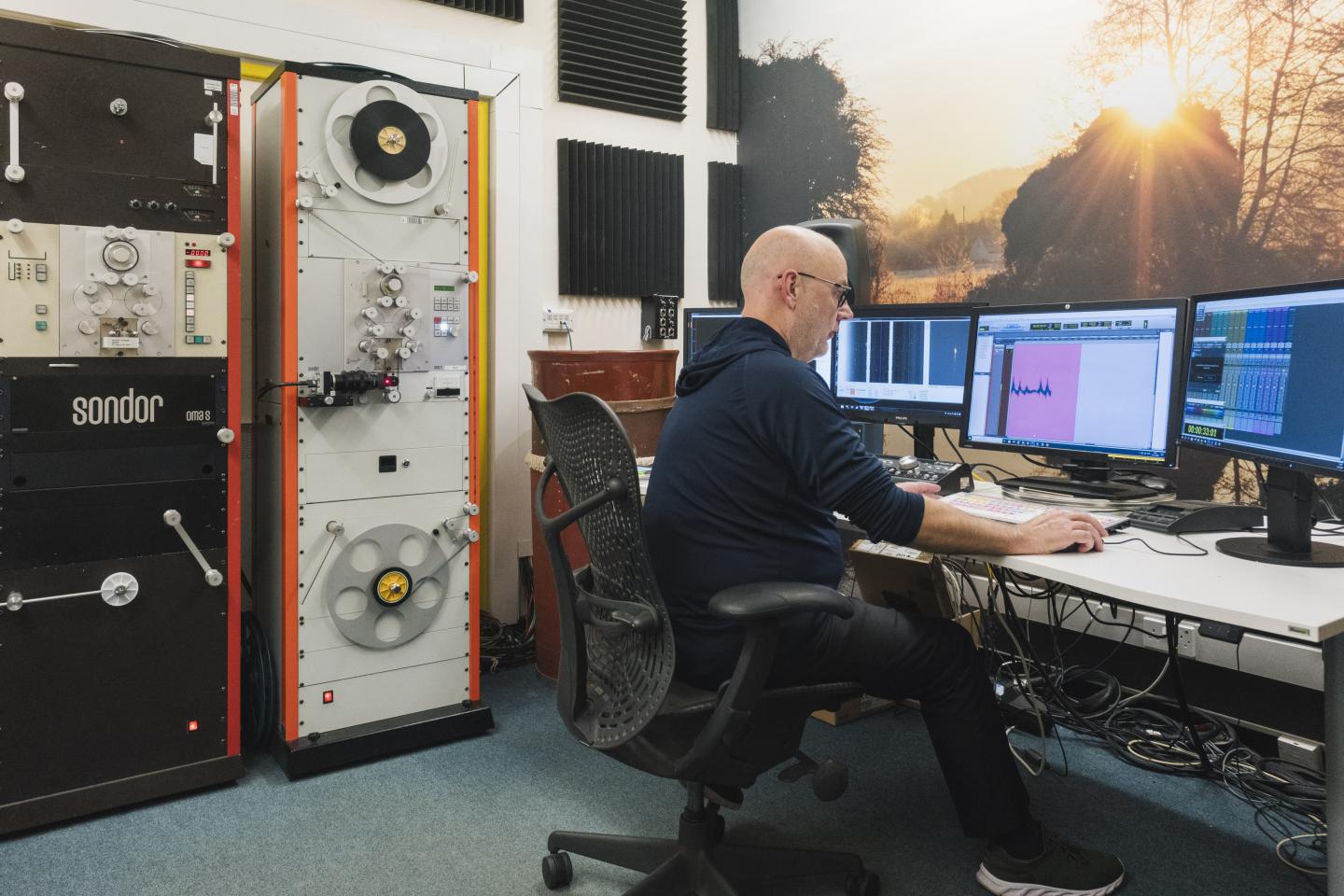


A film restoration can betray its subject by looking too innocent. When every tick, fluctuation, splice, and trace of wear disappears, technical polish can masquerade as historical truth. Yet keeping all damage would be another kind of falsification: scratches acquired in circulation are not automatically part of a filmmaker's design, and a soundtrack's hiss can obstruct rather than preserve a performance.
The archive therefore works inside a productive tension. It must protect the surviving object, recover an intelligible presentation, and leave enough evidence for future conservators to question today's decisions. The National Film Preservation Foundation usefully separates conservation, duplication, restoration, and access. They belong to one preservation continuum, but they are not synonyms: the original artifact, a preservation master, a reconstructed version, and a screening copy do different jobs.[5]
The two short BFI National Archive videos below make that distinction visible. The first moves an optical soundtrack from film into a digital preservation system; the second combines picture and sound negatives in a photochemical printer to create a new positive print. Watched together, they show that restoration is not a beauty filter. It is a chain of translations in which source, intervention, and access copy must remain legible.
1. Sound restoration begins by refusing to guess
The first video is only two minutes and forty-seven seconds long, but its sequence is exact. An item is selected, its condition is reported, the film is cleaned, and only then does audio transfer begin. That order matters: the software does not meet an anonymous waveform. It meets a physical element that has already been identified and examined.[1][3]
Around 0:48, the video reaches the Sondor OMA-E. A red-light emitter, camera, and software read an optical soundtrack as an image. That simple fact changes how one listens: the track beside the picture is both sound and a photographed pattern whose dirt, mould, splices, and damage can become audible. The scanner's first duty is not to make that pattern pleasant. It is to reproduce what the element contains faithfully enough that later work remains separable from capture.[1]
The most revealing moment is less automated. At roughly 1:14, the conservator synchronizes a spoken word by watching the performer's mouth close between its two syllables. A restoration workstation can display the sound with extraordinary precision, but a person still has to understand speech, gesture, frame rate, and the history of the carrier. The work is technical because it is interpretive, not because interpretation has been removed.
Only after capture does the video introduce tools for reducing pops, ticks, mould noise, and hiss. It then draws a crucial boundary. Restoration aims toward the soundtrack as audiences would have heard it at original release, including the equalization associated with cinemas of that period. Remastering may make tonal adjustments for contemporary reproduction. Those goals can overlap, but they are not interchangeable.[1][3] A mix optimized for a modern auditorium may offer excellent access while being a poor substitute for an unprocessed archival record.
That is why the workflow ends with layers rather than one victorious file. The BFI preserves 24-bit, 96 kHz WAV files, without compression or equalization, one file for each reel; separate copies can then enter restoration, remastering, synchronization, or release workflows.[1][3] The raw transfer does not have to carry every future presentation choice. It remains available when better tools, new evidence, or different access needs arrive.
The revised FIAF Code of Ethics gives this architecture a principle: restoration and copying should be reversible, decisions and interventions should be documented, and new preservation elements should respect the characteristics of original materials.[6] In the sound video, that principle is not an abstract warning. It is the practical distance between scan and cleanup.
2. A new print is an access object, not a replacement
The second video returns to the laboratory a year later and follows a different direction of travel. Instead of moving film sound into data, it uses picture and sound negatives to expose a new positive print. The purpose is double: reduce projection wear on vulnerable source materials and keep historical works available in the medium for which they were made.[2][4]
At about 0:32, the video supplies a compact lesson in why a print is engineered rather than merely copied. On a 35 mm projector, the sound head sits twenty frames ahead of the picture gate, so the soundtrack must be printed twenty frames in advance for voice and image to meet on screen. The offset looks wrong on the strip because it is correct in the machine. A film element cannot be interpreted apart from the apparatus that will play it.[2]
Timing, or grading, introduces another judgment. Exposure is adjusted scene by scene so that the finished print holds a coherent density and appearance. Consistency here does not mean forcing every shot into one contemporary ideal. It means making the source elements perform as a continuous film. Historical reference, the properties of the stock, laboratory records, and the surviving negatives constrain what a timer can responsibly do.[2][5][6]
The video's second half makes the physical stakes unusually clear. Negative and fresh positive stock travel across a light source; exposed silver-halide crystals form a latent image; developer converts that image to metallic silver. Speed, temperature, and agitation have to be controlled before a stop bath halts development, fixer removes unexposed crystals, and washing clears chemical residue. Drying must happen without introducing dust or scratches. A two-minute explainer compresses the procedure, but it does not make the outcome look automatic. Every stable projected image depends on chemical reactions being bounded at the right moment.[2]
Finally, the print is screened for quality control and enters the collection as something that can be booked and projected. That last step is not secondary to preservation. Access is why the surrogate exists. The National Film Preservation Foundation's guide explains the bargain plainly: a viewing copy can carry a film's visual and aural content while the original receives safer storage and less handling.[5] A new print spends itself gradually on behalf of a more vulnerable element.
This also explains why “film versus digital” is the wrong contest for these two videos. The BFI uses high-resolution digital audio files to preserve a source signal and photochemical printing to maintain an exhibition form. One workflow can support the other. The relevant question is not which medium wins; it is whether each object has a defined role and whether a future archivist can trace how it was made.
The archive's best result is accountable
Together, the videos replace the fantasy of a definitive restoration with a more durable model. There may be a surviving negative, an optical or magnetic soundtrack, an unprocessed digital transfer, a restored master, a remastered release, and a new projection print. None is simply “the film” in isolation. Each preserves or presents a different relationship among work, carrier, technology, and audience.
That plurality does not mean anything goes. FIAF's current code asks archives to safeguard multiple versions, resist deliberate modification, document interventions, respect original technical characteristics, and distinguish restoration from new creation.[6] Restraint is not passivity. It requires research, calibrated equipment, critical listening, comparison, and the willingness to keep a conspicuous flaw when removing it would erase evidence rather than repair damage.
For viewers, the most useful question is therefore not “Does this look and sound new?” It is “What version am I seeing, which elements were used, what was changed, and what record of those changes survives?” A clean image can be historically responsible; a rough one can be careless. Authenticity lives in the evidence and the process, not in a preset amount of grain or hiss.
The human scale of the BFI videos is their strongest argument. One conservator watches a mouth to find sync. Another laboratory team controls exposure, chemistry, washing, and projection. Their machines are sophisticated, but the work remains answerable to a source and open to later review. A good restoration lets a film meet another audience. A responsible one also remembers what the film survived on the way there.
Sources
- BFI, “Inside the Archive: how we restore sound,” YouTube video, June 24, 2024 — optical-sound scanning, synchronization, restoration, remastering, and preservation-file workflow.
- BFI, “Inside the Archive: how we create new film prints,” YouTube video, June 17, 2025 — picture-and-sound printing, timing, photochemical processing, and quality control.
- Mike Kohler, “All about... film sound and how we restore it,” BFI, June 20, 2024 — detailed history and practice of soundtrack transfer, restoration, and remastering; source of the Adam Bronkhorst photograph.
- Kristina Tarasova and Alex Prideaux, “Inside the Archive #30: Seoul-searching and print-making,” BFI, June 19, 2025 — institutional context for the BFI film-printing video and Conservation Centre laboratory team.
- National Film Preservation Foundation, The Film Preservation Guide: The Basics for Archives, Libraries, and Museums — definitions and practical guidance for conservation, duplication, restoration, storage, and access.
- International Federation of Film Archives, “FIAF Code of Ethics,” revised April 2025 and adopted May 1, 2025 — reversibility, documentation, source integrity, access, and original-format principles.