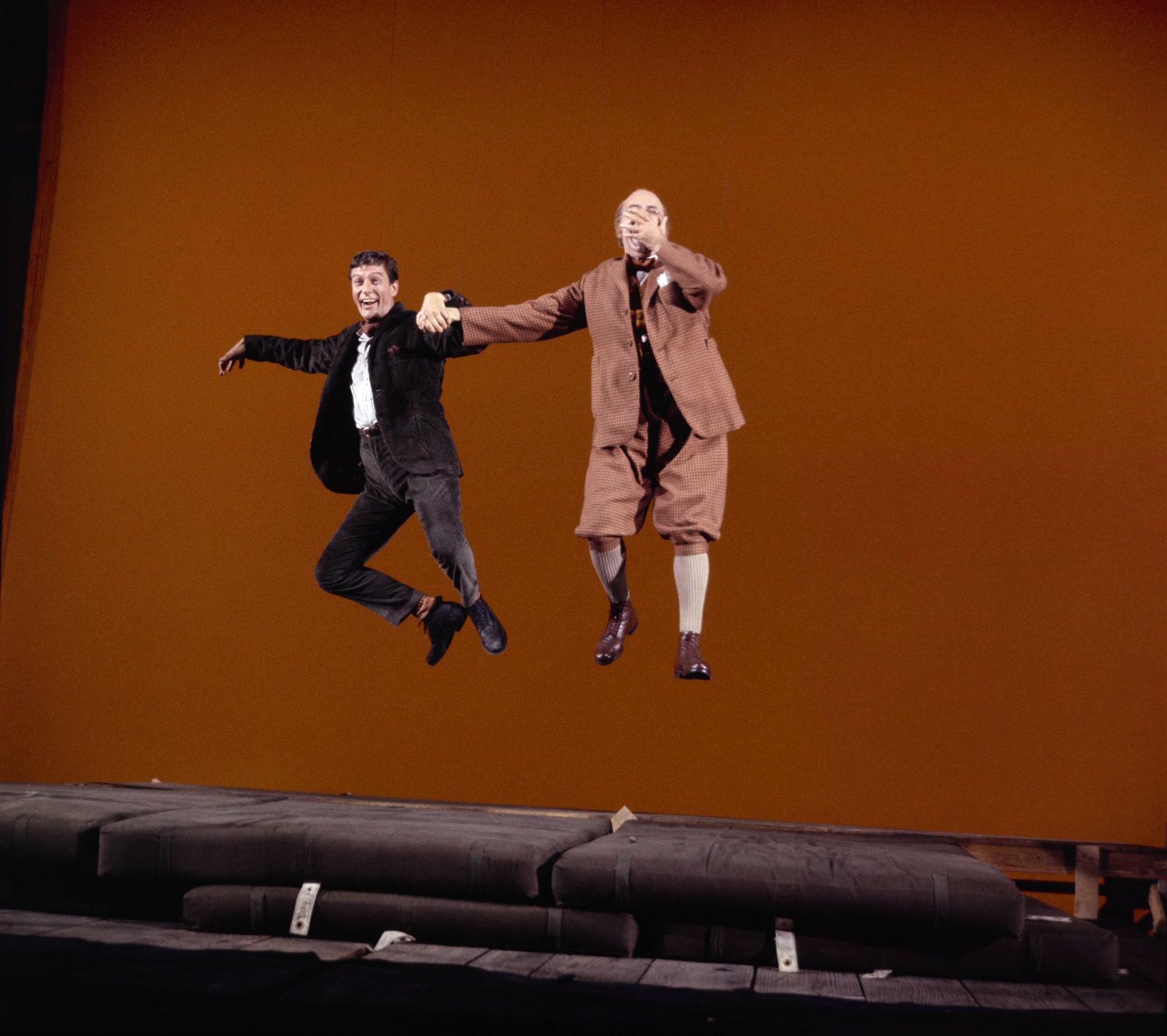
In the production photograph, Dick Van Dyke and Ed Wynn are already airborne but not yet anywhere. They hang against an amber void; crash mats fill the bottom of the frame. The furnished room, ceiling, and laughter that make the finished “I Love to Laugh” sequence feel buoyant are still missing. What exists is the difficult half of an illusion: two moving bodies whose outlines must survive the arrival of another image.
That edge problem was the industrial heart of Mary Poppins. Robert Stevenson's 1964 musical combined live performers, painted environments, hand-drawn characters, wires, props, and optical printing on a scale that could easily have made every layer announce itself. Instead, veils remain delicate, limbs blur as they move, and Bert can dance beside animated penguins without acquiring a hard cutout border. The film's sodium-vapor process—often called yellow screen—did not achieve this by finding the actor in a color image after the shoot. It recorded a separate silhouette at the same instant as the performance.[1][2]
That distinction is the whole machine. Ordinary color keying asks one photographed image to provide both the foreground's color and its degree of opacity. Sodium-vapor photography gave those jobs to two pieces of film. One kept the performance; the other measured where the glowing backing reached the lens. Mary Poppins did not merely replace yellow with a new world. It captured, frame by frame, how much of that world should show through.
A composite needs more than a cutout
A traveling matte is a moving permission map. In one region it says that the foreground is opaque; in another, that the background may pass through; along hair, gauze, glass, smoke, or a motion-blurred hand, it may need to preserve partial transparency. Its complementary holdout protects the opposite region while separate image elements are printed onto a final strip of film.[3]
A binary silhouette is easy to imagine and often ugly to watch. It can separate a still hat from a flat background, but it turns a translucent veil into cardboard and a fast gesture into a jagged blade. Convincing compositing depends on gray values at the boundary: not simply actor or background, but a precise mixture of both.
Alvy Ray Smith and James Blinn later formalized why extracting that mixture from a single color image is troublesome. A foreground photographed against one constant color does not, in the general case, contain enough information to recover both its uncontaminated color and its opacity uniquely. Practical blue- and green-screen systems work by imposing assumptions and adding human judgment, but the underlying problem is underdetermined. Their paper makes a crucial exception for multi-film methods such as sodium-vapor photography: those systems record the foreground on one strip and its matte simultaneously on another, so the matte does not have to be inferred from the color record.[3]
The sodium process therefore solved an information problem with capture hardware. It spent complexity on the stage and inside the camera so that the laboratory would receive an explicit edge record.
The yellow screen was a narrow signal
Petro Vlahos's 1958 patent application describes a pale, translucent backing illuminated from behind by low-pressure sodium lamps. Those lamps concentrate their output in a very narrow yellow band around 589.6 nanometers. The actors in front of the backing receive ordinary broad-spectrum production light.[2]
After both actor and backing pass through one lens, a selectively coated optical unit divides their light by wavelength. The patent specifies an interference-layer assembly designed to reflect roughly 80 to 90 percent of the narrow sodium band toward a black-and-white matte negative while transmitting about 90 percent of the remaining visible light toward the action negative. The first strip sees the backing as strong exposure and the actor as a silhouette. The second keeps the actor's color while losing most of the backing signal.[2]
This is not the same operation as photographing a yellow wall and deleting yellow later. The backing is useful because its light is spectrally narrow, and the prism is useful because it peels off that narrow signal before the two records reach film. The color negative never has to surrender a whole broad color channel just to describe the edge.
The two records also share a decisive geometry. They are exposed through the same lens, at the same moment, from the same performance. A separate matte derived through later duplication can grow, shrink, soften, or drift relative to the action. Here, a fluttering piece of fabric and the matte made by light passing through it are born together. Vlahos's patent explicitly notes that transparent or semitransparent foreground objects carry backing light into the matte record; Disney's archival account emphasizes the resulting preservation of motion blur, soft contours, and translucent material.[1][2]
The process did not abolish optical work. Foreground, matte, holdout, animation, painted background, and other elements still had to be developed, aligned, and printed into a final image. What it changed was the quality of the evidence entering that chain. The laboratory began with a first-generation measurement of coverage rather than a best reconstruction of it.
On set, precision felt like heat
Clean edges did not make the stage effortless. Julie Andrews remembered the “Jolly Holiday” material being performed before an enormous yellow screen under lights so bright and hot that they made the actors squint; wigs and layered costumes intensified the discomfort. Because the animation would be added later, a cardboard penguin established her eyeline for the tea-party scene and was then removed before the camera rolled. She had to sustain her focus on an absent partner.[6]
Her account restores the bodies that a technical diagram leaves out. The process could record the boundary around a parasol or dress, but it could not give an actor an animated character to play against. It could preserve the blur of a gesture, but the gesture still had to land in empty space at the correct height. It could separate the performer from the backing, but it required a large controlled stage, specialized lighting, and enough cooling and stamina to keep the performance alive.
The lead photograph holds that bargain in one frame. Van Dyke and Wynn appear weightless because wires and timing have lifted them; they remain extractable because the background is deliberately vacant. Below, the mats confess gravity. Behind, the amber field confesses compositing. The finished film removes both confessions.
That concealment is particularly effective in the animated countryside. “Jolly Holiday” is not persuasive because every live-action edge is perfectly invisible in isolation. It works because edge, choreography, drawn motion, color, and eyeline agree on a common world. Sodium-vapor capture protected the most fragile junction, then allowed the scene's other crafts to attract attention.
A superb image came with a narrow pipeline
The system's advantage was also its industrial limit. It required sodium illumination, a large controlled backing, a light-splitting camera, two synchronized film paths, specially coated optics, and a laboratory prepared to use the paired records. Disney's archival feature says that only three of the crucial prisms were produced.[1] A conventional color-screen workflow could keep improving through new stocks, better color-difference methods, electronic keyers, and eventually software; the sodium system bound its special information to scarce capture hardware.
It also moved commitment earlier. Because the matte was recorded with the action, the set had to establish the conditions that made the matte good. That produced unusually faithful fractional edges, but it left less room to treat separation as a flexible postproduction decision. The system was powerful wherever a studio could design the shot around it, and awkward as a universal production platform.
This is why “better than green screen” is the wrong verdict. Better at which boundary, and at what operational cost? Sodium-vapor photography captured opacity directly and beautifully. A modern digital key can be used with ordinary cameras, inspected immediately, revised by artists, combined with tracking data, and adapted shot by shot. One method makes a strong measurement by specializing the camera; the other accepts an inference problem in exchange for a broad, revisable workflow.
The historical credit is similarly collective. Vlahos is the named inventor on the sodium-illumination patent. Disney's archive foregrounds Ub Iwerks's work in bringing the process into studio production. The Academy's official database awarded a Class I scientific or technical honor to Vlahos, Wadsworth E. Pohl, and Iwerks for the conception and perfection of color traveling-matte composite cinematography.[1][2][4] The process was not a miraculous prism dropped into a finished film. It was an engineering lineage made usable by optics, camera modification, stage practice, laboratory control, and effects artists.
At the 37th Academy Awards, Mary Poppins also won Special Visual Effects for Peter Ellenshaw, Eustace Lycett, and Hamilton Luske.[5] Keeping the two recognitions distinct is useful. One honored a general technical advance and its developers; the other honored what a production team made that advance do inside this particular film.
The matte became a channel
Digital compositing changed the material but retained the conceptual split. An alpha channel is the electronic descendant of the matte: a value stored beside color that says how opaque each pixel should be. Smith and Blinn describe it as the digital equivalent of a holdout matte, including fractional values for partial transparency.[3]
The sodium-vapor camera can therefore be read as a machine for photographing color and alpha onto separate strips. That is an analogy, not a claim that the photochemical system was secretly digital. Its larger lesson is that color alone is an incomplete description of an image element. If a production wants a foreground to travel cleanly into another world, it must preserve not only what the foreground looks like but also how it meets what lies behind it.
Disney now places the surviving prism in a lineage that reaches toward real-time virtual production.[1] The technologies are not equivalent: an LED volume puts a responsive background in the photographed scene, while sodium-vapor photography creates a matte for a background to be added later. What joins them is an industrial instinct to move a difficult part of compositing closer to the camera, where performers, lenses, light, and perspective can share one production decision.
The amber emptiness in the archival photograph is thus not the absence of the movie. It is a carefully prepared place for the movie to arrive. Two strips turn through the camera: one holds the people, the other holds the exact shape of everything that is not yet there. The finished image feels effortless because the production photographed that relationship before it photographed a world.
Sources
- The Walt Disney Company, “Disney's Legacy of Innovation: From the Sodium Vapor Process to ILM StageCraft,” August 18, 2025 — archive photographs, prism history, production applications, edge-quality claims, and the article's lead-image source.
- Petro Vlahos, “Composite Photography Utilizing Sodium Vapor Illumination,” U.S. Patent 3,095,304, filed May 15, 1958 and published June 25, 1963 — the two-film capture method, sodium wavelength, selective beam splitter, complementary mattes, and treatment of semitransparent objects.
- Alvy Ray Smith and James F. Blinn, “Blue Screen Matting,” Microsoft Research / ACM SIGGRAPH, 1996 — definitions of mattes and alpha, the underdetermined single-backing problem, and the distinction between single-film keying and simultaneous multi-film matte capture.
- Academy of Motion Picture Arts and Sciences, official awards database results for Ub Iwerks — the 1964 Class I scientific or technical citation shared by Petro Vlahos, Wadsworth E. Pohl, and Ub Iwerks.
- Academy of Motion Picture Arts and Sciences, “The 37th Academy Awards | 1965” — official record of the film's nominations and five wins, including Special Visual Effects.
- Julie Andrews, “Julie Andrews Remembers Becoming Mary Poppins.” Vanity Fair, October 7, 2019 — memoir excerpt on the yellow-screen stage, heat, lighting, absent animated partners, and physical effects work.