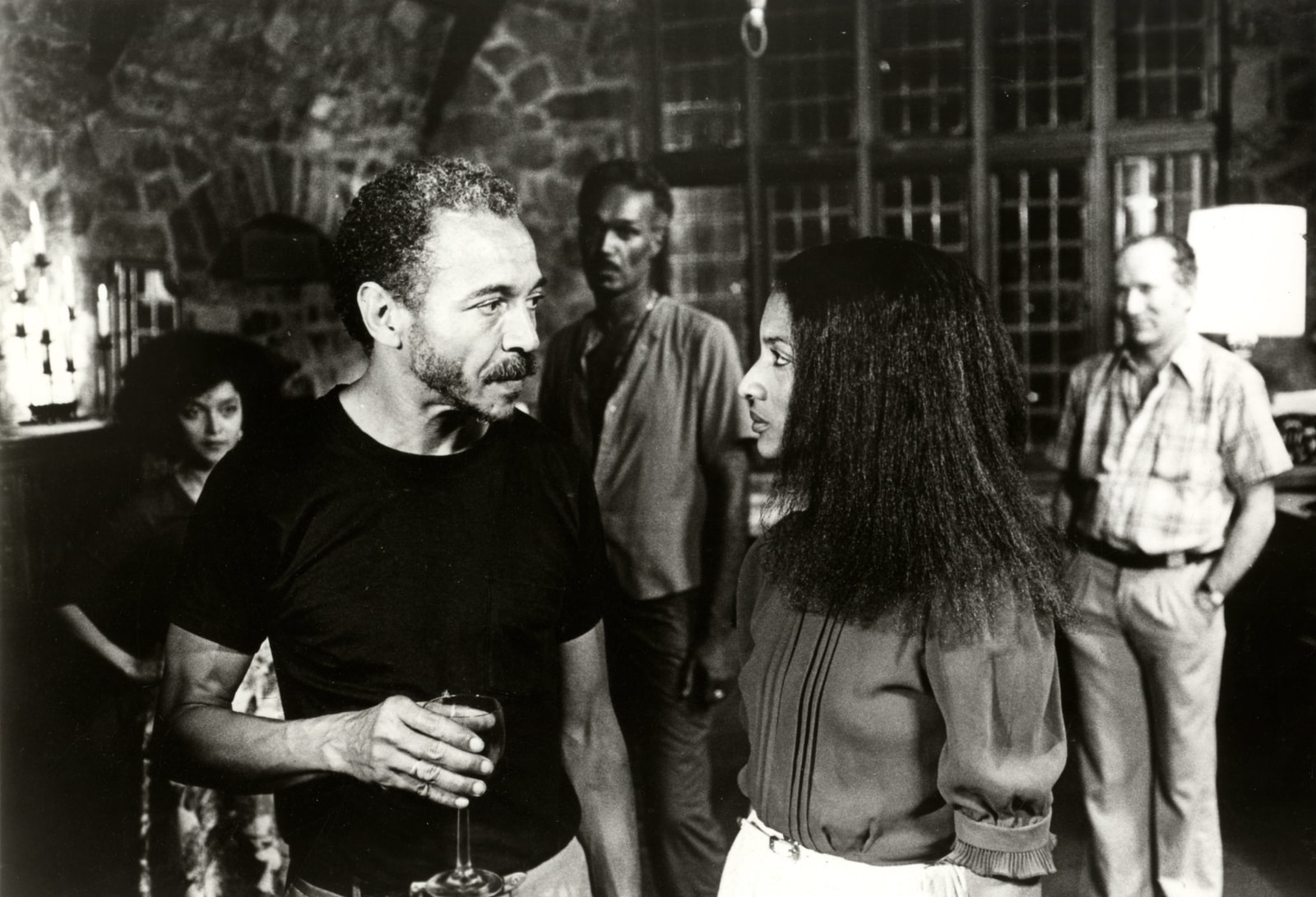
Near the end of Losing Ground, philosophy professor Sara Rogers steps into somebody else’s movie. A student director has cast her as Frankie in a stylized version of “Frankie and Johnny”; Duke, played by Duane Jones, is her partner. Instructions interrupt the dance. Costumes and gestures make the old ballad visible. Then Sara raises a prop gun and performs the anger that her marriage has trained her to contain. Her husband Victor arrives not as the artist in charge, but as a spectator.[1][4][6]
This passage is sometimes reduced to a neat conversion: an intellectual woman stops analyzing experience and finally feels it. Kathleen Collins directs something more exacting. Sara has never lacked feeling. Her pleasure in thought is intense from the opening lecture, and her search for “ecstatic experience” is already an attempt to widen what reason can hold. Acting does not cure her of intellect. It gives thought another location—in costume, in rhythm, opposite another body, before a camera.[2][6]
That distinction runs through Collins’s two completed narrative films, The Cruz Brothers and Miss Malloy (1980) and Losing Ground (1982). Both are verbally agile, but neither treats talk as a substitute for cinema. Rooms, lawns, ladders, work, dance, and performance disclose what a character cannot deliver as a thesis. Collins made interior life visible by making it move.
Spoiler note: this profile discusses the ending of Losing Ground.
The room comes before the emblem
Collins knew what it meant to be introduced by milestones. Born in Jersey City in 1942, she studied philosophy and religion at Skidmore, worked on voter registration with the Student Nonviolent Coordinating Committee in 1963, studied literature and cinema at the Sorbonne, became a professional film editor in New York, and taught film history and screenwriting at City College. She was a playwright, fiction writer, professor, editor, producer, and director in an industry that offered Black women almost no room to combine those roles.[1][3][7]
Yet her own theory warns against turning a person into the sum of exemplary facts. In a 1984 Howard University master class, Collins rejected characters made to represent either racial depravity or racial virtue. Both sinner and saint, she argued, erase the private and idiosyncratic life between them. Her practical alternative began with environment: what is in a character’s room, where the window and door are, how the person eats, studies, sleeps, and gets stuck. She called film, at its barest, “space and light,” then described directing as the freedom to move people through both so that placement itself says who they are.[2]
This is the useful key to her work. The fact that Losing Ground was among the earliest fictional features directed by a Black American woman matters historically. Collins’s cinema becomes smaller, however, if that pioneering status is allowed to explain its characters. When distributors claimed they did not recognize Black people like Sara and Victor, Collins answered that ordinary Black love, work, vanity, intelligence, and error were themselves full of racial meaning. She would not make her people saintly enough to deserve the screen.[1][2][3]
A ruined house teaches the Cruz brothers to move
For her first film, Collins chose some distance from autobiography. With writer Henry H. Roth, she adapted a story about Victor, José, and Felipe Cruz, three Puerto Rican brothers living in an isolated New York town, and Miss Malloy, an elderly Irish woman who hires them to restore her decaying house before she dies. Ronald K. Gray, then Collins’s student and soon her central cinematographic collaborator, photographed the film’s lawns, woods, rooms, and wandering bodies in soft, gauzy color.[1][3]
The premise sounds like a meeting of social types. Collins quickly makes it stranger. The brothers’ dead father, Poppa, speaks off-screen; only Victor can perceive him. Victor records the family history on tape, becoming an archivist who is also teased by the voices he wants to preserve. Miss Malloy is employer, survivor, would-be actress, and director of her own last pageant. José wants to perform and to make images of his own. No one remains the single meaning that age, ethnicity, class, or family role first appears to provide.[6]
Renovation supplies the film’s grammar. The brothers chop, carry, clean, run, tumble through grass, and animate a landscape that initially seems to belong to someone else. At tea time, Miss Malloy enters their work space carrying a silver tray and goblets as though stepping onto a stage; the brothers receive ginger ale. Later, dancing briefly makes her remembered world share the clearing with theirs. The house is not merely a symbol for a recoverable past. It is a set of tasks through which four people try on relations that their separate histories did not prepare them to have.[6]
Collins therefore lets character emerge as a difference in motion. Felipe can interrupt the spell; José can lean toward play and performance; Victor can alternate between participant and recorder. The film does not solve them by assigning a lesson. Work changes the space, and changed space gives each brother another way to stand inside his life. This is interiority without confession: a self becomes legible in the route a body takes across a lawn.
Sara is never a mind without a body
Losing Ground opens in a lecture hall, with Sara teaching students about Sartre, existentialism, and absurdity. The seating places her below them, but the exchange gives her authority; she thinks with an audience rather than delivering wisdom from a pedestal. Victor first appears above her on a ladder in their apartment, newly elated because a museum has bought one of his paintings. Before their argument is fully stated, the rooms have established its pressure: his art expands into the household, while her work is expected to fit around his summer plans.[6]
Victor speaks the sensual vocabulary of form, color, and light. He paints, flirts, dances, and treats appetite as proof that he is more alive than his wife. Sara researches ecstasy in theology, philosophy, Gnostic thought, and Haitian writing on possession. The apparent opposition—his body against her books—is also Victor’s preferred account of the marriage. Collins keeps exposing its fraudulence. Sara is passionate when an idea becomes clear. Victor can make “freedom” look remarkably like entitlement. Thought and sensation are not gendered substances; they are practices that each person can use honestly or selfishly.[2][6]
Sara’s movement through the film is therefore not a flight from abstraction. She takes her question from classroom to library, from conversation with her actor mother to an encounter with a psychic, and finally onto the student set. Each place changes the terms of inquiry. In the film-within-the-film, she learns choreography, waits for cues, responds to Duke, and repeats action for a lens. Her body is not suddenly more authentic than her mind. Performance gives the mind resistance: timing, another person’s weight, the difference between imagining anger and carrying it through a gesture.[1][6]
The crucial dance also changes who gets to look. Victor has made women into extensions of his painterly appetite; now he stands outside Sara’s performance. The ballad permits Frankie to shoot Johnny, while Sara does not shoot Victor. That boundary matters. Art neither excuses violence nor supplies a magical marital cure. It creates a protected double through whom Sara can discover a capacity, then return to her own unfinished life with that knowledge.[6]
The ending grants Victor recognition, not control. He sees his wife command an image that he did not compose. Sara’s expression survives the role, and the marriage remains too complicated for one astonished look to repair. Collins has moved an intellectual problem through space and light until it becomes an encounter: one artist watching another arrive.
Independence was a condition of the form
Collins’s cinema was collaborative as well as independent. Gray shot both films and co-edited Losing Ground with her. Seret Scott, Collins’s friend, made Sara’s intelligence active rather than decorative; Bill Gunn gave Victor charm inseparable from injury; Duane Jones made Duke’s courtliness feel both material and faintly otherworldly. Collins wrote, produced, directed, and edited because conventional routes would not protect the odd tonal balance those collaborators built.[1][3][7][8]
That autonomy cost the films an audience. Losing Ground premiered in 1982 but received no regular theatrical release. Its only publicly programmed New York City screening during Collins’s lifetime was a January 24, 1983 Cineprobe presentation at MoMA. Collins herself also recalled a small community showing for roughly twenty residents of an old-folks home in Harlem. They talked back delightedly to Sara and Victor, immediately grasping the marriage beneath the philosophy. The people presumed not to want this ordinary complexity had scarcely been allowed to encounter it.[1][2][5]
Collins died in 1988 at forty-six. Her daughter Nina later recovered the films’ elements and worked to return them to circulation. Restored versions of both films screened at Indiana University in 2013; Losing Ground began a wider Milestone theatrical release in 2015, entered the National Film Registry in 2020, and was preserved again by the Yale Film Archive and The Film Foundation in 2022: a 4K scan of the original 16 mm negative, color correction supervised by Gray, restored sound, and new 35 mm picture and track negatives used to strike its first 35 mm screening print.[3][7][8][9] Yale preserved The Cruz Brothers and Miss Malloy at FotoKem in 2024.[10]
Rediscovery is an important part of this history, but it should not become the final myth attached to Collins: the lost pioneer whom later institutions benevolently made visible. Her films had viewers, collaborators, arguments, humor, and a rigorous theory of form before the canon caught up. Their achievement is not only that Kathleen Collins reached the director’s chair. It is what she did once people were inside the room.
She placed them. Then she let them move.
Sources
- Kathleen Collins’s official estate site, “Films” — film synopses, credits, production history, circulation, and the recovery of the original elements.
- Kathleen Collins, “I refuse to create mythological characters” — edited transcript of her 1984 Howard University master class, published by Sabzian.
- Ashley Clark, “Making ground: remembering Kathleen Collins,” Sight and Sound / BFI — career profile, production context, collaborators, and restoration history.
- Museum of Modern Art, “Losing Ground. 1982. Directed by Kathleen Collins” — film record, credits, and source page for the still used above.
- Museum of Modern Art, “Cineprobe: 15th Season Begins November 22” (1982) — contemporary program recording the January 24, 1983 New York premiere of Losing Ground.
- Geetha Ramanathan, Kathleen Collins: The Black Essai Film. Edinburgh University Press, 2020 — open-access study of space, performance, authorship, dance, and doubling across both films.
- Indiana University Black Film Center & Archive, “The Lost Films of Kathleen Collins” — archival holdings, Collins’s independent-production rationale, and the films’ 2013 restored theatrical premiere.
- Yale Film Archive, “Film Notes: Losing Ground” — the completed 4K scan, color correction supervised by Ronald K. Gray, restored sound, and new 35 mm preservation elements.
- Library of Congress, “National Film Registry Spotlights Diverse Filmmakers in New Selections” — the 2020 selection of Losing Ground for the National Film Registry.
- Yale Film Archive, “Preserved Films” — the completed 2024 preservation of The Cruz Brothers and Miss Malloy at FotoKem through a National Film Preservation Foundation grant.