Discusses the premises of Big Deal on Madonna Street (1958), The Great War (1959), and The Organizer (1963), with limited plot spoilers.
A photographer without a camera makes an unpromising criminal recruit. In Big Deal on Madonna Street, Marcello Mastroianni's Tiberio also has childcare duties: his wife is in prison for selling contraband cigarettes.[1] Mario Monicelli finds comedy where an imagined adventure meets the life someone must bring along.
Across these three films, the director gives famous actors a demanding assignment: remain recognizable, funny individuals while belonging to a group that cannot simply arrange itself around them. A burglary needs accomplices; military service imposes comrades; a strike requires agreement. Each situation tests whether people can act together while wanting different things. The star's charisma helps us enter the crowd. It cannot settle the crowd's problems.
A director formed through collaboration
Monicelli's apprenticeship ran through screenwriting and assisting before his partnership with Steno, with whom he co-directed Cops and Robbers (1951), starring Totò and Aldo Fabrizi. Their collaboration ended amicably in the mid-1950s. Pasquale Iannone's career profile also records Monicelli's admiration for Dickens, whose social observation and comic characterization offered him a model.[2]
A person in these ensembles can be ridiculous without being incidental. An inconvenient obligation gives someone a life beyond the plot's immediate purpose. Every scheme must pass through people who have other concerns.
The authorship was itself collaborative. Big Deal credits Monicelli, Agenore Incrocci, Furio Scarpelli, and Suso Cecchi D'Amico with the screenplay. Gianni Di Venanzo photographed it; Adriana Novelli edited it; Piero Umiliani supplied the music.[3] The coordination we call Monicelli's style was made through other people's writing, images, performances, and timing.
The crew has a life outside the job
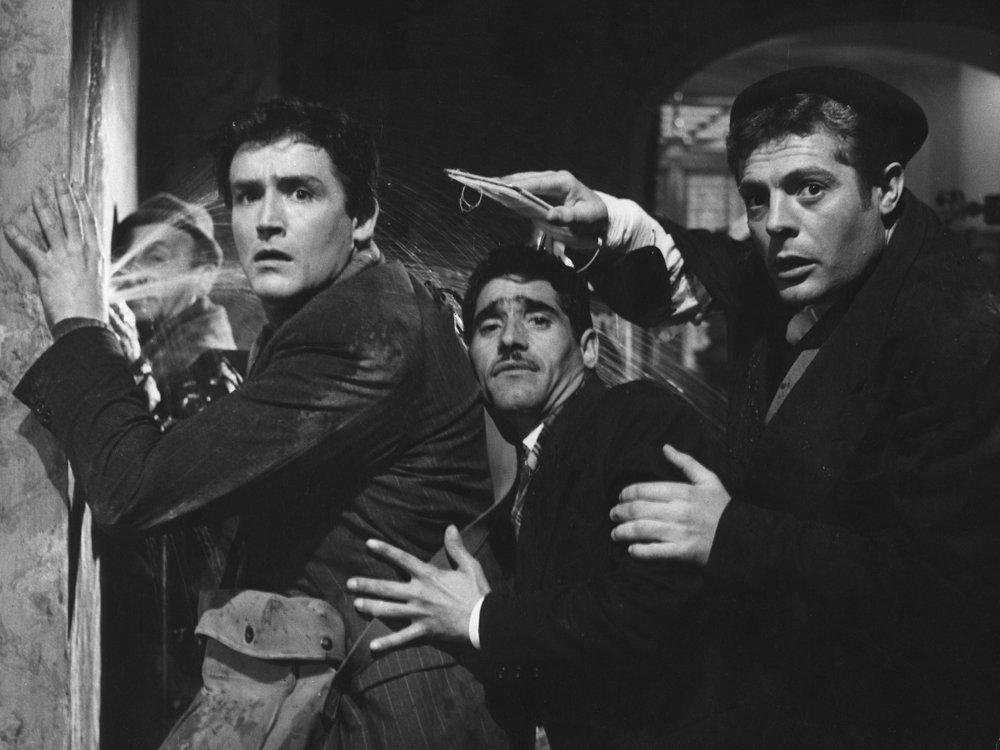
Big Deal assembles the outward ingredients of a caper while making competence scarce. Bruce Eder's Criterion essay identifies its relationship to Rififi and The Asphalt Jungle, then points to the crucial difference: these thieves lack the professional assurance their cinematic predecessors bring to a job. Vittorio Gassman's Peppe is a boxer who cannot take a punch; Tiberio's childcare duties persist alongside his criminal ambitions.[1]
Calling someone a specialist does not furnish him with a skill. Assigning him a task does not suspend his responsibilities. A caper plan promises that everyone will become useful at the appointed moment. Here, usefulness remains in doubt. The effort of making a team is already a comedy.
Carry the comedy into history
In The Great War, Monicelli puts Gassman alongside Alberto Sordi as reluctant soldiers near the Austrian front.[2][4] Matthew Thrift's BFI account draws attention to the officers' empty efforts to raise morale and to the individuality of even minor characters. The war has scale, but so do the people caught in it.[4]
That distribution of attention matters. A minor character can interrupt the importance a protagonist assumes for himself. An official speech can sound quite different when measured against the people expected to take heart from it. The audience has more than one person to listen to, and more than one reason to doubt.
The method also makes affection less comfortable. Enjoying someone's resourcefulness can mean enjoying his ability to avoid an obligation that another person will inherit. The shared predicament holds the pair together, but it cannot make every act of self-preservation generous. Monicelli's ensemble gives the joke a social cost.
The organizer must join the others
The Organizer moves to textile workers in nineteenth-century Turin. Mastroianni plays Professor Sinigaglia, a fugitive agitator whose scruffy appearance complicates the authority implied by his title.[6] MoMA's programme note stresses the way the actor and director combine fellowship with the severity of the workers' circumstances.[5]
The American title singles out his role. The Italian title, I compagni—the comrades—directs attention toward the group. As J. Hoberman observes, the workers' story is already underway before Sinigaglia arrives. He enters a struggle with its own history, rather than bringing the film's world into existence.[6]
One small incident exposes his position beautifully. Hungry, he takes a worker's unattended sandwich, then gives it back when its owner returns.[6] The intellectual who can explain a collective interest still has an appetite of his own. The embarrassment brings him close to the people he wants to lead without pretending that they have identical roles.
I read that moment as a useful limit on the star's authority. Mastroianni can attract our attention, but attention does not confer ownership: even the sandwich belongs to somebody else. The film asks us to keep noticing the people around its most recognizable face.
Affection has limits
This strand of Monicelli's work should not become a comforting formula. His later An Average Little Man (1977) takes Sordi into the story of a bereaved father pursuing revenge. Iannone describes a deliberate transformation of the comic tradition into something much darker.[2] Familiarity with an actor, or sympathy for a character's suffering, cannot guarantee where the story will lead.
The earlier ensembles remain compelling because they make togetherness an activity. Someone must listen, wait, contribute, or accept an inconvenience. A gifted leader cannot perform those acts for everyone. Monicelli gives the star plenty to do—and keeps the other people in the room.
Sources
- Bruce Eder, “Big Deal on Madonna Street,” The Criterion Collection, June 4, 2001 — caper conventions, Tiberio's family responsibilities, and Peppe's failed boxing career.
- Pasquale Iannone, “Mario Monicelli: Italy's Dickens?”, Sight and Sound/BFI, originally December 16, 2010; updated January 25, 2016 — collaborations, literary influence, later career, and the Big Deal on Madonna Street still reproduced above.
- The Criterion Collection, Big Deal on Madonna Street — film identification and cast, screenplay, cinematography, editing, and music credits.
- Matthew Thrift, “10 great First World War films,” BFI, May 29, 2014 — the La grande guerra section on its setting, minor characters, morale-building rhetoric, and movement between comedy and tragedy.
- Museum of Modern Art, “I compagni (The Organizer). 1963. Directed by Mario Monicelli,” December 2024 programme — cast, historical setting, and the relationship between fellowship and hardship.
- J. Hoberman, “The Organizer: Description of a Struggle,” The Criterion Collection, April 24, 2012 — the Italian title, ensemble structure, Sinigaglia's arrival, and the sandwich incident.