Spoilers throughout, including the ending. This essay discusses the complete five-story version of the 1945 film.
An architect arrives at a country house to discuss alterations. He recognizes the people inside, although he has never met them. Before Walter Craig can make any changes to the building, the building has begun to change his understanding of where he is. Mervyn Johns plays Craig in Dead of Night (1945), Ealing's anthology of supernatural stories directed by Basil Dearden, Alberto Cavalcanti, Robert Hamer, and Charles Crichton.[1][5]
The professional detail is a good joke with a long fuse. An architect ought to understand how rooms connect. This film spends much of its running time teaching us the same thing: where people gather, where a staircase leads, what lies beyond a door. Its ending then puts those familiar spaces together in an arrangement that nobody could draw as a floor plan. Recognition survives. Orientation does not.
Give the audience somewhere to return
Five separate stories were planned before their linking device had been settled. According to BFI archivist John Oliver's programme notes, writer Angus MacPhail supplied the farmhouse gathering that brought them together. Dearden directed this framing narrative as well as the first episode, about a premonition involving a hearse driver.[2]
That solution gives the production more than an economical place to introduce each tale. The house party becomes an audience within the film. Guests listen and respond; Dr Van Straaten, the psychiatrist played by Frederick Valk, supplies rational explanations. Craig's anxiety is consequently exposed to social pressure. Other people can treat an uncanny experience as an interesting subject for conversation. He fears that he is still inside one.[4][5]
Returning to the gathering initially feels reassuring. A story has ended, and people are available to discuss it. Each return also reminds us of the unfinished business that made the stories necessary. The cut back has two jobs: it releases the tension of one episode while resuming the pressure on Craig. The filmmakers can vary the tales without starting the film's suspense from scratch.
Build a passage worth remembering
Cavalcanti's Christmas-party episode offers a particularly tangible example of how the film prepares its later effects. During a game of sardines, Sally and Jimmy find a dusty storage space at the top of an old house. Michael Relph's surviving production design, held by the BFI National Archive, establishes the narrow room and its small rear window. The finished scene closely follows it.[3]
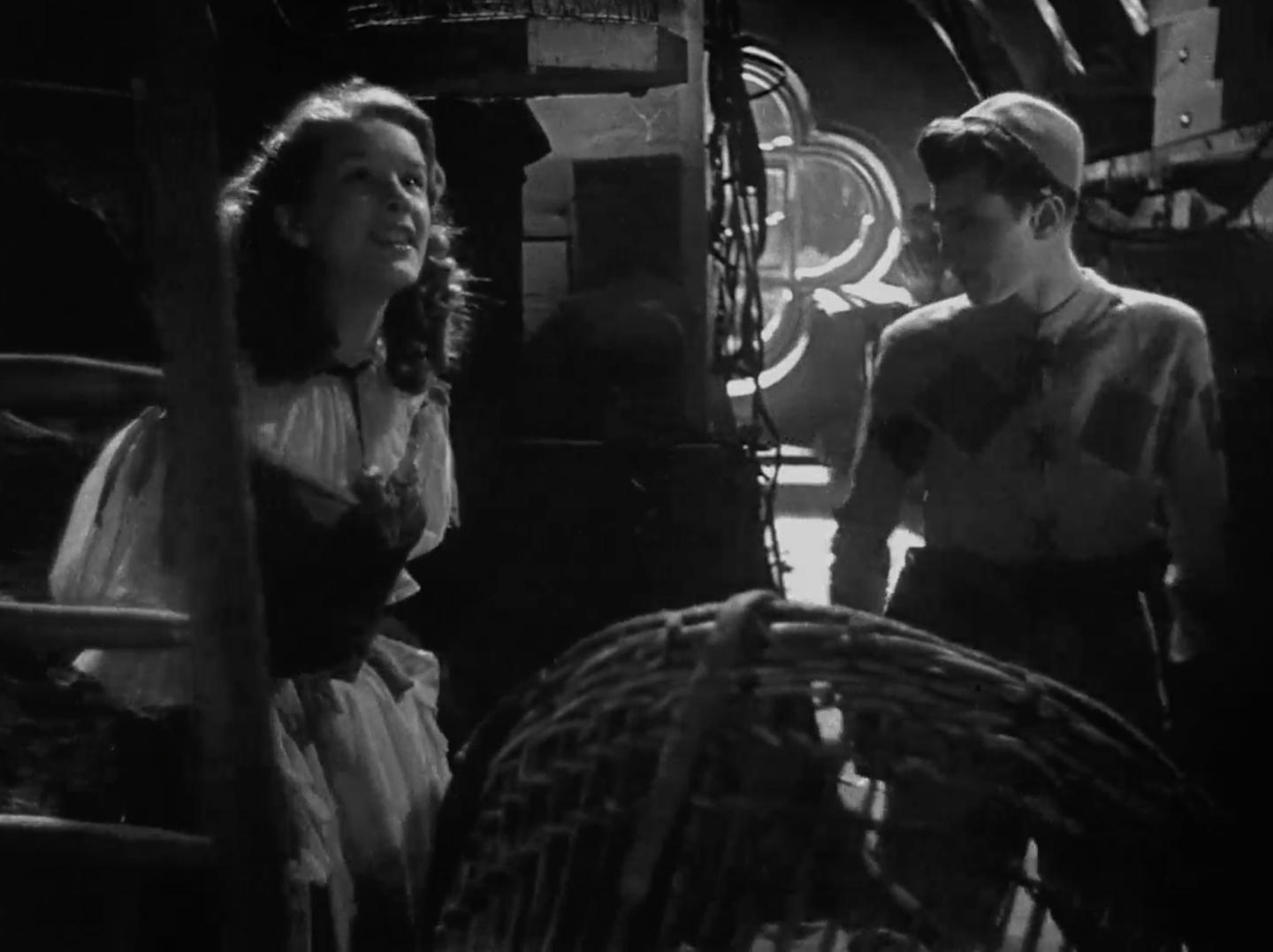
The room contains trunks, old furniture, discarded frames, and hanging objects. Beyond another door, Sally encounters the child she will learn was murdered long ago.[3] The approach matters. Before the supernatural appears, the set offers a practical reason for things to be half visible and for a young person to explore them. A hiding game makes darkness useful; an old house makes accumulated clutter ordinary.
My reading of the design is that it gives the audience a route to remember. A doorway holds more suspense when we have some sense of the space around it. The stored objects also keep the passage from becoming an anonymous corridor. When the film later returns to this part of the house, recognition can happen quickly enough for a cut to carry us straight into danger.
A breather can belong to the rhythm
The golfing episode, directed by Crichton, makes the anthology's changing tone conspicuous. Oliver considers its comedy a serious loss of momentum, but his notes also record that some contemporary reviewers welcomed the relief. The University of Kent's Melodrama Research Group likewise describes its uncertain mixture of comedy and death.[2][4]
There is a useful distinction here between liking an episode and understanding its position. A stretch of comedy can renew an audience's willingness to relax. The next story then has something to disturb besides an already strained nerve. That is a reading of the sequence's function, rather than proof that every joke works. The possibility of a lull is real; so is the value of having somewhere to fall from.
Version matters to this rhythm. The Kent group, citing a contemporary National Board of Review publication, identifies the Christmas-party and golfing stories as the two episodes omitted from the shorter American release.[4] Removing them changes both the tonal range and the stock of places the ending can recall. This is why the complete version is the basis of the argument here.
Let the cuts take away the exits
The final nightmare breaks the arrangement that has kept the tales apart. After Craig strangles Van Straaten, the Christmas-party staircase, the haunted mirror, the ventriloquist's dummy Hugo, and the hearse driver's face enter his own predicament. Edward Parnell's Sight and Sound account traces this succession, including the tilted return to the staircase and Hugo's movement toward Craig in a cell.[5]
Earlier, a storyteller's introduction gave us permission to enter a different world. Now Craig passes among those worlds without anyone explaining the transfer. The editing withdraws the comfortable boundary between hearing about an experience and undergoing it. A face that belonged to somebody else's story can suddenly address him.
That is also why the preceding care over rooms pays off. If every location were unfamiliar, the sequence could feel merely chaotic. Remembered places give each impossible connection a precise shock. We know enough to recognize where Craig has arrived, and enough to understand that he cannot have reached it normally. The audience's memory does work that an explanatory speech would only slow down.
Craig finally wakes in his own bedroom. A telephone call summons him to the country house, and the film repeats his arrival.[5] The apparent escape has delivered him to the start. For the viewer, however, the road is changed: we now know the rooms waiting at its end. Dead of Night closes by making the most ordinary journey in the film the one we least want to take again.
Sources
- BFI Player, Dead of Night — film identification, year, ensemble premise, and all four directing credits.
- John Oliver, “Dead of Night,” BFI Southbank Programme Notes, December 16, 2022 — development of the linking story, allocation of episodes, and contrasting responses to the golfing section.
- Melanie Williams, “The back room from Dead of Night: the production design for a dusty hiding place,” BFI, June 30, 2026 — Michael Relph's archived design, the finished set, and the StudioCanal film still reproduced above.
- University of Kent Melodrama Research Group, “Summary of Discussion on Dead of Night,” December 14, 2016 — narrators, tonal shifts, spatial connections, and the American release's omissions, with a contemporary print reference.
- Edward Parnell, “Dead of Night: 80 years on, Ealing's anthology horror is still a waking nightmare,” Sight and Sound, September 4, 2025; from the January 2020 issue — Craig's arrival, the final nightmare's sequence, and the circular ending.