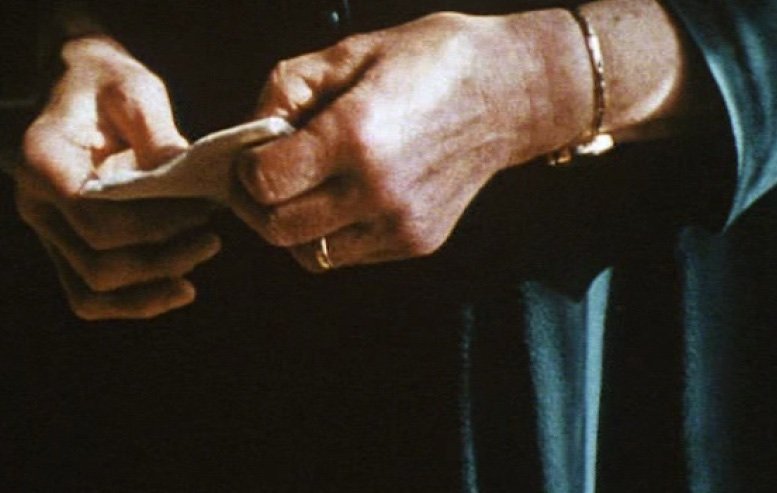
In A Portrait of Ga (1952), Margaret Tait films her mother walking, smoking and unwrapping a sweet. These small actions carry the portrait. A dress, a pace, a familiar gesture give the woman a presence that a list of biographical facts could never supply.[1] Tait's camera makes room for the time a person takes to do something.
That attention runs through a career spent largely outside commercial filmmaking. The familiar was inexhaustible for Tait because familiarity did not settle what a thing might mean. A room could be looked at again. A sound could change its relationship to an image. Home supplied subjects, working space and difficulties; it kept giving her reasons to make another film.
Returning with a camera
Tait was born in Kirkwall, Orkney, in 1918. She studied medicine in Edinburgh, served with the Royal Army Medical Corps during the Second World War, and later trained in filmmaking at Rome's Centro Sperimentale di Cinematografia. Back in Scotland, she established Ancona Films on Edinburgh's Rose Street.[2]
The route matters. Her close attention to Scotland followed experience of other countries and another profession. Returning home was an artistic decision made by someone who had learned to look elsewhere. The intimate scale of the films tells us little about the size of the world she knew.
Medical work also helped pay for that freedom. As Thirza Wakefield recounts in Sight and Sound, Tait financed most of her films herself, working intermittently as a locum doctor. She resisted the prescriptive terms associated with John Grierson and the Films of Scotland Committee.[3] Choosing her own subjects required a way to keep buying the means to film them.
Making a place for an audience
Independence solved only part of the problem. A completed film still needed somewhere to meet its viewers. In 1954, Tait held a free film festival at her Rose Street studio, attracting passersby.[3] Her account, preserved on the Margaret Tait 100 website, recalls local children coming for the free show and some returning repeatedly.[4]
That little exhibition history complicates the image of a solitary experimental artist. Tait wanted contact. The studio could become a temporary cinema, bringing the work back into the street from which some of its subjects came. Control over production did not remove the need for an audience; it left her with the additional work of finding one.
Nor should the arrangement be romanticized. Paying for films through another job and organizing their screenings consume time and energy. The freedom visible in the work had practical costs. It is possible to admire her persistence while recognizing how much labor an established route to funding and exhibition might have spared her.
The house before leaving
Tait's own description of Place of Work (1976), cataloged by LUX as A Place of Work, fixes its scale precisely: a house and garden observed between June and November 1975. This was her childhood home in Orkney, subsequently a place where she lived and worked. She filmed it in the months before leaving.[5]
The interval gives familiar space a particular tension. A building known for years is now available for only a limited number of further visits with the camera. Making a record becomes an opportunity to discover what habit has concealed. Which view matters? How does a room change when it is also the room one is about to lose?
Her diary offers a useful check against an entirely nostalgic reading. Writing about Buttquoy House in May 1975, she emphasized the pleasure of its spaces and their proportions in relation to her body.[4] This was affection expressed through movement and measurement. The house mattered as somewhere she could work, walk and look.
A poem can travel through sound
Tait's methods also resist the assumption that filming nearby things means simply recording whatever happens. Colour Poems (1974) links nine short sections using spoken verse, music, recorded sounds, live-action imagery and marks made directly on film. Merritt Barnwell's account for the Yale Center for British Art describes how memories of the Spanish Civil War enter a work populated by Orcadian town and domestic scenes.[6]
The local image can therefore carry a history that exceeds its visible boundaries. A boat or a moving leaf need not serve as a literal illustration of a sentence. Sound introduces another time, feeling or association; editing asks the viewer to hold them together. Poetry here is a way of making relationships between things.
A revealing parallel appears in Tait's explanation of Orquil Burn (1955). She followed the stream inland toward its source, a direction that puzzled people who expected a journey downstream. For her, the upstream route allowed discovery instead of beginning with a cause already known.[4] The film could learn where it was going.
A feature within a life's work
In 1992, Tait completed her only feature, Blue Black Permanent, becoming the first Scottish woman to direct a feature film.[2] It is a conspicuous landmark, but treating it as the moment her career finally began would leave decades of decisions out of the picture.
The film moves among three generations of women and between Orkney and Edinburgh. Barbara, played by Celia Imrie, tries to understand her past and her mother Greta. As Mitchell Miller's essay in the BFI's programme notes explains, the nested memories resist becoming a neatly resolved account.[7]
The larger production preserves an interest already present in the shorts: proximity can deepen knowledge without making another person fully explainable. A mother can be intensely familiar and still exceed the story her daughter tells about her. The gesture caught by the camera and the life reconstructed through memory offer different kinds of access, each incomplete.
Tait continued making films after the feature; her last was completed in 1998, the year before her death.[2] Seen across that span, her achievement lies in sustaining a practice of discovery. She could return to a face or a place without deciding in advance that she had used it up. Even the unwrapping of a sweet could still deserve its own time on screen.
Sources
- Georgia Korossi, “Remembering Scotland’s film poet Margaret Tait.” BFI, 2018, updated 2021 — A Portrait of Ga, its observed gestures and the film still reproduced here.
- University of Stirling, “Life and work of Scots filmmaker and poet celebrated,” 30 October 2018 — education, wartime service, Ancona Films and career chronology.
- Thirza Wakefield, “Archives online: Margaret Tait’s rooms of her own.” Sight and Sound, 2015, updated 2018 — medical work, independent production and the Rose Street screening.
- Margaret Tait 100, “Map.” LUX Scotland — Tait’s writings on Rose Street screenings, Buttquoy House and the direction of Orquil Burn.
- LUX, “A Place of Work” — film catalog record and Tait’s account of filming her home before departure.
- Merritt Barnwell, “Colour Poems.” Yale Center for British Art — the film’s sections, sound, animation and historical associations.
- BFI Southbank, “Blue Black Permanent,” programme notes, 1 March 2024 — Mitchell Miller’s essay on narrative structure, with production and cast credits.