A screen location is often praised as though somebody simply found it: the perfect tunnel, market counter, freeway, or hotel lobby was waiting for a camera to arrive. Location management begins where that fantasy ends. A candidate place has to satisfy two scripts at once. It must express the story, and it must support a working day of access, contracts, crew movement, equipment, parking, permissions, public contact, cost, and safety. Industry descriptions of the role accordingly place location professionals in conversation with directors, designers, cinematographers, owners, film commissions, and communities from preparation through wrap.[2][3][4]
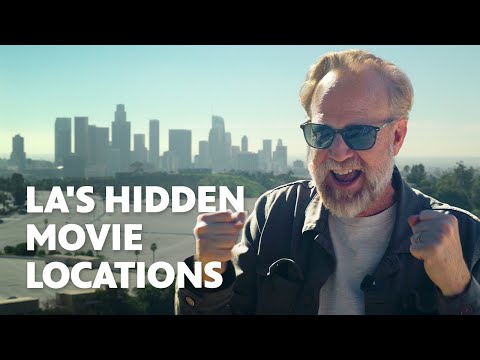
PBS SoCal's Locationland episode with host Harry Medved and veteran location manager Robert Foulkes is a deceptively useful way to see that double test. Foulkes revisits Los Angeles sites connected to La La Land, Terminator 2: Judgment Day, True Lies, and Crime 101. The program looks like a movie-location road trip, but its most revealing moments are not recognitions of famous scenery. They are explanations of why one road could stand in for another, why adjacent sites mattered, how a stunt location was made usable, and how several physical places could become one continuous screen journey.[1]
Watch the tour with the postcard impulse turned down. The key question is not “Where was that shot?” but “What had to be true here for the shot to exist?” Foulkes's answers recast the city as a set of production choices. A location is not merely photographed. It has to perform off camera.
The useful substitute can be truer than the literal road
About ninety seconds in, Foulkes stops at a curved downtown roadway used for Crime 101. The composition carries a sliver of freeway in the background, so the road reads on screen as part of the larger highway system. Crucially, the production did not have to control an operating freeway to get that impression. The bend supplied cinematic depth; the accessible street supplied a workable set.[1]
That choice clarifies what “authentic” means in location work. The literal road is not automatically the most truthful one for a film. A live freeway may be geographically exact but dramatically inert, impossible to hold, or too restrictive for the camera and action. A surface road can be the better screen freeway if it preserves the features the scene actually needs while making time, access, and control possible. FilmLA's planning service treats street closures, base camps, parking, special conditions, effects, and stunts as questions to resolve before a permit application, not as decorative paperwork after a location has been chosen.[4]
La La Land offers the productive opposite. Its opening number needed the exposure and scale of an elevated ramp, so the production accepted the harder location. American Cinematographer reports that the sequence was blocked first in a parking lot, rehearsed on the closed ramp during one weekend, and filmed during another. What appears to be one exuberant take is three segments joined by concealed cuts.[5] The distinction is not “real location” versus “fake location.” It is whether the image justifies the operational burden. Sometimes substitution is the intelligent choice; sometimes the irreplaceable view earns a weekend-sized machine.
Adjacency is invisible production value
Midway through the tour, Medved and Foulkes ride Angels Flight, then walk into nearby Grand Central Market. Both appear briefly in La La Land, and Foulkes confirms that the two pieces were filmed on the same day.[1] Their proximity is a geographical fact, but turning it into a production advantage is a planning decision.
On screen, the locations contribute quick notes to a romantic Los Angeles montage: the funicular provides vertical motion and historical texture; the market provides color, density, and the intimacy of two people at a counter. Off screen, the short distance reduces the friction of moving a company. The video does not show the call sheet, so the exact savings are not stated. The principle is nevertheless clear: when two places work dramatically and can share a practical orbit, less of the day disappears into relocating people and equipment.
Location management therefore performs a kind of edit before the editor receives footage. It arranges the order in which the production can encounter space. The Production Guild of Great Britain's location-manager profile stresses script breakdown, storyboard review, scouting, and collaboration with the director, production designer, and cinematographer.[2] Those tasks join creative geography to calendar geography. A beautiful place that strands the company may cost a shot elsewhere; a cluster of strong locations can return time to performance, light, and camera work.
Every public location is a temporary social contract
In the Lower Grand tunnel, Foulkes jokes that he does not have a permit for the present visit and that the group should leave.[1] It is a light moment, but it points toward the people normally absent from location-tour mythology. Streets, tunnels, shops, homes, and transit systems do not become neutral movie property when a scout likes the view. Owners, authorities, neighbors, businesses, and ordinary users remain part of the place.
The AFCI and Location Managers Guild International describe the profession in terms that include both production departments and members of the public.[3] FilmLA makes the boundary concrete: planning can involve reservations for city property, parking and base-camp arrangements, street-closure approval, special conditions, and advice on effects or stunts.[4] Those negotiations determine not only whether a crew may arrive, but how much disruption the image is allowed to create.
This is why location management is better understood as stewardship than conquest. The department has to translate an imaginative request—night rain, a blocked lane, a crane, a crowd, a vehicle impact—into a finite set of promises about time, footprint, protection, and restoration. The shot begins administratively before the camera rolls and ends only when the place can resume its own life. A production that exhausts local trust may get today's frame while making tomorrow's access harder for everyone.
A stunt site is a safety system, not a backdrop
Late in the episode, Foulkes returns to the channel used for the truck pursuit in Terminator 2: Judgment Day. As an assistant location manager, he watched a pulley system bring the truck toward the bridge edge; one attempt stopped short, while the next produced the usable descent. His memory emphasizes the coordination and uncertainty around the action, not only the famous image that resulted.[1]
An extra story after the apparent ending makes the hidden work even clearer. For the True Lies chase in which a horse crosses a hotel lobby and enters an elevator, Foulkes recalls ensuring that protective rubber matting sat beneath water so the animal would not slip. Other pieces of the pursuit were filmed elsewhere.[1] The polished scene suppresses those mats, just as it suppresses permits, route plans, access windows, reset space, and the many people positioned outside the frame.
Safety is not a separate moral layer pasted onto a finished visual idea. It changes which visual ideas are executable. A floor has traction; a bridge has limits; a vehicle needs a controlled path; an animal needs a surface and exit; emergency personnel need access. FilmLA's decision to group stunt and special-effects advice with closures, parking, and location planning reflects this systems view.[4] The “look” of a location includes everything the audience will never see but the action depends upon.
Screen geography is assembled, not inherited
Foulkes's True Lies anecdote supplies the episode's deepest lesson. A chase that feels like continuous movement through one world was built across two states, several Los Angeles locations, streets, a hotel, and a stage-built elevator.[1] Physical geography did not hand the sequence to the filmmakers. Production and editing manufactured a route.
For that route to hold, locations must rhyme in the right ways. An entrance has to suggest a plausible exit. Architecture, direction of movement, light, scale, and surface have to survive the cut even when the actual addresses are far apart. The location department does not control every element of screen continuity, but it helps give other departments compatible spaces in which continuity can be constructed. The job is partly to find places and partly to identify which differences the camera can hide.
This also explains why location tourism can misdescribe the craft. A visitor asks whether a scene “really happened here.” A filmmaker asks which portion happened here, what this place played, what was added, and where the movement went next. The screen city is neither a lie nor a map. It is an argument made from selected pieces of the physical city.
Look for the seam that is not there
The best way to carry this episode into other films is to notice apparent effortlessness. When a camera sweeps through a market, ask where the company staged. When a dialogue scene catches the last blue light, ask how access and schedule protected that window. When a pursuit flows through a doorway, ask whether the next room was in the same building. When a street seems empty, remember that emptiness may be a negotiated effect.
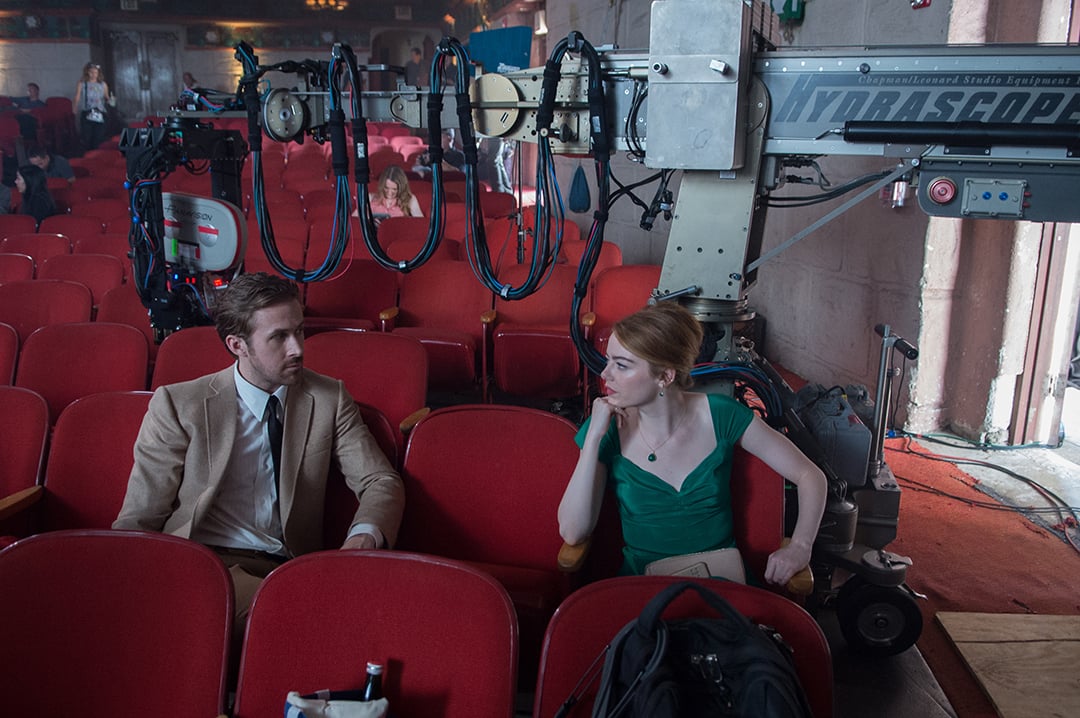
The production photograph above makes those questions visible. Its romantic movie date shares space with a telescopic crane and the working structure needed to move a camera through the scene.[5] That machinery does not diminish the illusion. It is the condition that lets the illusion take form.
Foulkes's tour is valuable because it keeps the finished image and the city's resistant material reality in the same conversation. Roads must close or cleverly substitute for roads that cannot. Sites that look separate in a montage may succeed because they are neighbors. A spectacular stunt begins with surfaces, clearances, and controlled movement. A continuous chase may be a relay among distant places. Location management turns all of those constraints into screen space—and succeeds when geography, permission, safety, and schedule collapse into a shot that feels inevitable.
Sources
- PBS SoCal, “Movie Locations 101 with La La Land Location Manager | Locationland,” YouTube video, February 12, 2026 — Robert Foulkes's tour and firsthand accounts of location substitution, clustering, stunt logistics, and composite screen geography.
- Production Guild of Great Britain, “PGGB Membership Focus: Location Managers,” February 9, 2024 — industry profile of the role from script breakdown and scouting through collaboration and wrap.
- Association of Film Commissioners International and Location Managers Guild International, “Location Management 101” — industry course overview covering location-management duties, departmental coordination, film commissions, and public interaction.
- FilmLA, “Production Planning” — official Los Angeles guidance on location challenges, special conditions, effects, stunts, base camps, parking, and street closures.
- Mark Dillon, “La La Land: City of Stars,” American Cinematographer — production account of the freeway number's rehearsal, access, camera strategy, and concealed cuts; also the source of the Lionsgate production photograph used above.