Spoilers follow, including the ending.
A successful expedition ought to end with something brought home. In Letter Never Sent, finding the diamonds merely changes what the explorers stand to lose. The discovery exists; the people who can explain where to find it are stranded. A map must make the journey that knowledge cannot make by itself.
Mikhail Kalatozov's Soviet adventure follows four members of a geological expedition into the Siberian wilderness, photographed in black and white by Sergei Urusevsky. Innokenti Smoktunovsky plays their leader, Sabinin, alongside Tatiana Samoilova as Tanya, Vasili Livanov as Andrei, and Yevgeny Urbansky as Sergei.[1] My reading turns on the distance between achieving something and being able to communicate it. Across the film, that distance becomes terrifyingly physical.
Leaving the audience in the helicopter
The opening gives us an exit the expedition cannot take. The camera rises and recedes from the four waving figures until the landscape makes them tiny. Brad Weismann describes this withdrawal in his Senses of Cinema essay, along with its return at the film's conclusion.[3]
At first, the movement has the exhilaration of departure: work is beginning, the destination has been reached, everyone can still wave. Yet the shot also separates two freedoms. The camera can leave. The people must stay and cross the ground on foot. Their confidence does nothing to alter the scale that the retreating view reveals.
That separation is useful to remember later. The landscape has not suddenly grown larger because the expedition is in trouble. The opening has already shown how much country surrounds these bodies. Disaster will make that proportion unbearable.
Congratulations that cannot hear an answer
The radio produces an even crueller separation. Once its transmitting function fails, the survivors can hear messages from their base but cannot send their distress calls. Praise for their achievement keeps arriving while they struggle through danger, a mismatch Jaime N. Christley singles out in his review for Slant.[4]
This is a precise way to stage institutional distance. The voice is present, audible, apparently connected. Its cheerfulness belongs to an earlier version of events. The people at the other end know enough to congratulate the expedition and too little to respond to its present condition.
The horror lies in that incomplete connection. Silence would at least announce isolation. The broadcast continually renews the expectation of contact, then denies the exchange that would make contact useful. Listening becomes another form of helplessness.
The scene also changes the meaning of public recognition. To be celebrated is to be described from elsewhere. Here, the description has become dangerously detached from the people it honours.
A forest that occupies the frame
The fire makes communication an immediate problem of bodies, smoke, and obstructed movement. David Blakeslee's CriterionCast review describes the passage from engulfing flames into rain, frost, and snow, as well as early handheld shots in which branches intrude toward the lens.[5] These environments demand different kinds of endurance; surviving one does not prepare the group for the next.
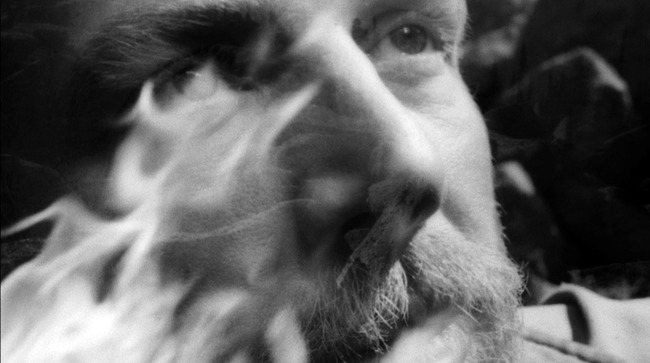
The intrusion matters. A branch in front of a face interrupts our access to an expression. Smoke interferes with the simple pleasure of locating a person clearly within a landscape. The forest occupies the space through which we would ordinarily look at the performers.
Blakeslee finds the personal backstories thin beside the force of these images.[5] That is a fair limit to acknowledge: spectacular suffering does not automatically make a character complex. But it can make an elementary need difficult to dismiss. Here, getting across the next patch of ground becomes absorbing because the image makes passage feel contested at every depth.
The map has a destination
Sabinin's unfinished letter to his wife gives the expedition a private audience. The map has a public one: people who might use the discovery. Iordanova identifies both the letter's connection to home and the survivors' determination to deliver the location of the diamonds.[2]
These documents ask different things of a reader. A letter carries a person's account of being somewhere. A map makes that place available to others. Read together, they raise a question the adventure cannot settle simply by locating its mineral deposit: how much of the discoverers' experience will arrive with the result?
Near death, Sabinin imagines an industrial future on the river. Iordanova places this vision within the film's commitment to collective progress; Weismann reads the devastation around it as undermining that promise.[2][3] The disagreement is productive. The imagined future can sustain Sabinin without requiring the audience to accept it as sufficient compensation.
What comes back
Only Sabinin survives the expedition, and the film grants him a last-minute rescue.[5][3] That ending permits relief, but it cannot restore the group whose waving figures opened the journey.
For me, the map is where the film's admiration and unease meet. Preserving the discovery is an act of responsibility toward people the explorers will never know. It also risks making a terrible loss legible chiefly as a useful achievement. We can want Sabinin to deliver it while resisting the idea that delivery balances the account.
The diamonds have been found. The harder thing to bring home is what finding them cost.
Edition note: Criterion lists its 96-minute edition as 1959; the Senses of Cinema essay places the film under 1960. Both discuss the same Kalatozov film.[1][3]
Sources
- The Criterion Collection, Letter Never Sent — catalogue year, running time, synopsis, cast, and production credits.
- Dina Iordanova, “Letter Never Sent: Refining Fire,” Criterion, March 21, 2012 — the letter, map, industrial vision, ideological tensions, and accompanying film still.
- Brad Weismann, “1960: Letter Never Sent (Mikhail Kalatozov),” Senses of Cinema, December 2017 — opening and closing movements, rescue, and a critical reading of the film's heroic promise.
- Jaime N. Christley, “Review: Mikhail Kalatozov's Letter Never Sent on Criterion Blu-ray,” Slant Magazine, March 19, 2012 — the one-way radio connection and visual treatment of the expedition.
- David Blakeslee, “David Reviews Mikhail Kolotozov's Letter Never Sent,” CriterionCast, May 27, 2012 — obstructed camera movement, changing environments, the survivors' fate, and reservations about characterization.