Spoiler warning: this article discusses the film's ending and several major scene turns throughout.
Max Ophuls's Letter from an Unknown Woman begins with the cruelest possible advantage: one person remembers everything, and the other remembers almost nothing.[1][2][3] Stefan Brand, the celebrated pianist, receives Lisa's letter on the night before a duel, and only then is forced to read his own life as somebody else's continuous wound.[1][3] Ophuls takes Stefan Zweig's novella and turns it into a film about timing rather than confession. Love is not blocked by one decisive prohibition. It is thinned out by entrances, missed recognitions, and returns that always arrive a moment too late.[1][2]
That is why the movie still feels so strange inside Hollywood melodrama.[1][2][4] Joan Fontaine gives Lisa a voice that sounds calm enough to pass for acceptance, but the film around her never stops moving. Ophuls builds Vienna out of thresholds: apartment landings, doorways, stairwells, station platforms, amusement rides, and formal interiors that seem designed less for dwelling than for passage.[2][3] The camera glides as if it were following memory through space, yet memory here is never stable. It keeps circling a man who cannot hold on to faces as firmly as Lisa holds on to moments.
Seen this way, the film's pathos is not simply that Lisa loves more deeply than Stefan deserves.[1][3] The sharper point is structural. Every time she reaches him, the world offers only a temporary version of arrival. The romance keeps generating settings that look like union while quietly preparing separation: the staircase outside his apartment, the fairground carriage that simulates travel, the dining room, the opera exit, the final return of the letter itself. Ophuls makes these spaces beautiful, then lets them reveal how beauty can behave like delay.
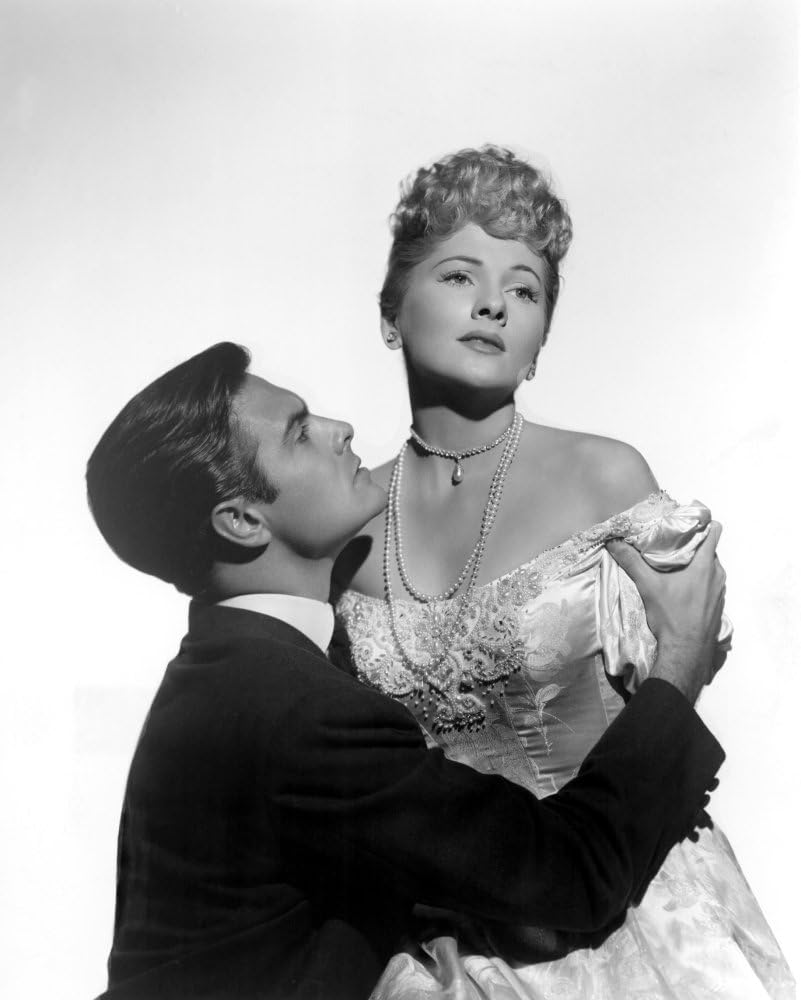
Image context: the cover uses a period publicity still of Joan Fontaine and Louis Jourdan from Wikimedia Commons. It fits this essay because the film's emotional imbalance can be read in one glance: Lisa is physically inside Stefan's embrace, but her expression is already elsewhere, as if the scene had begun turning into memory before he noticed what it meant.[6]
The staircase is where desire learns its rhythm
The film's first great visual idea is vertical.[2][3][4] Lisa does not first know Stefan through conversation or shared social space; she knows him through sound crossing a hallway and through a stairwell that separates childish looking from adult access.[2][3] Senses of Cinema's essay on the film describes Ophuls's Vienna as a landscape of doorways, stairs, streets, and trains, a geography where entrances and departures carry the psychic promise of happiness long before that promise can be fulfilled.[3] That is exactly what the staircase does. It gives Lisa a route upward while making that route feel provisional, overheard, and slightly forbidden.
This motif grows sharper when Lisa returns from the station after deciding she cannot leave Vienna without seeing Stefan again.[4] The music analysis in Senses tracks how voice, movement, and tempo lock together as she runs up the stairs, stops, rings, waits, then knocks again.[4] Ophuls does not shoot the climb as simple urgency. He makes it pulse between determination and hesitation. In narrative terms Lisa is going to a door. In formal terms she is learning the film's law: desire is a movement upward that may still end in suspension.
That law never relaxes. Staircases in Letter from an Unknown Woman are neither decorative Viennese elegance nor generic melodramatic flourish. They are the film's grammar of unequal knowledge.[2][3] Lisa repeatedly ascends with memory, anticipation, or total commitment already inside her, while Stefan occupies the upper rooms as if feeling could remain casual. By the time the film reaches the later encounters, each climb carries earlier climbs inside it. Ophuls lets architecture accumulate emotional time.
The carriage ride is perfect because it is transparently fake
The film's most intoxicating romantic passage is also its most candidly artificial.[1][2][3] When Stefan takes Lisa to the amusement venue and the two sit inside a mock railway compartment, they appear to travel through painted European destinations without leaving the room.[1][3] The scene is often remembered as pure enchantment, and it certainly earns that feeling. Ophuls slows the world into private glamour: velvet, soft light, the illusion of motion, a compartment built for two, and the temporary belief that love can create its own geography.[1][2]
But the sequence wounds because the illusion is never hidden.[1][3][4] The film knows that the carriage ride is a machine. The scenery rolls past because someone is operating it. The compartment simulates departure while keeping the lovers in place. Senses of Cinema's music essay is especially useful here, because it notes how the fairground music makes the scene playful and mechanical at once, easing melodrama even as it underlines the lovers' incompatibility.[4] What Lisa experiences as unforgettable singularity is already staged inside a prebuilt fantasy that can be rented for an evening.
That doubleness gives the scene its afterlife. Ophuls is not mocking Lisa's happiness. He is showing that her happiest memory is inseparable from a form of transport that cannot actually take her anywhere.[1][3] The carriage is cinema in miniature: a darkened enclosure, artificial movement, shared looking, and a world manufactured just long enough to feel absolute. No wonder the ride becomes one of the letter's deepest emotional anchors. It is the point where memory and fabrication enter their most seductive alliance.
Recognition fails because Stefan lives in the present tense
If Lisa's tragedy were only that Stefan abandons her, the film would be sadder and simpler.[1][2][3] Ophuls gives the story a more humiliating pattern. Stefan is not a melodramatic villain of grand declarations; he is a man who keeps meeting the same woman as if meeting her for the first time.[1][2] Each lapse of recognition lands with a different pressure. At first it seems part of his charm, then part of his vanity, and finally part of his moral emptiness. Lisa, meanwhile, becomes the keeper of continuity. She carries earlier scenes intact even when Stefan has already let them dissolve.
This is where Fontaine's performance becomes devastating.[1][2] She plays Lisa not as a fool who learns nothing, but as someone whose inner chronology keeps outrunning the social present. In Cannes's note on the film's 2021 restoration, the movie is described as a quest for an impossible love, and that phrase is exact so long as the impossibility is understood formally rather than sentimentally.[5] Lisa does not merely want the wrong man. She wants duration from a person organized around immediacy, appetite, and elegant forgetting. Her memory has shape; his desire has weather.
By the time Stefan finishes the letter, recognition finally arrives, but it arrives in the only form left to him: retrospective shame.[1][3][5] The letter does not restore the lost romance. It rearranges Stefan's relation to time. Suddenly he can see that what he treated as scattered episodes was, for Lisa, one continuous life. Ophuls therefore withholds moral clarity until the end and then makes it useless. Stefan's awakening is real, but it cannot travel backward. It can only send him outward into the duel, where belated seriousness becomes his last available gesture.
Ophuls turns remembered love into a city of repeated arrivals
What lasts in Letter from an Unknown Woman is not the plot twist of the letter but the pressure of recurrence.[1][2][3] Ophuls keeps sending Lisa through versions of the same action: approach, pause, enter, wait, leave, return. Vienna starts to feel less like a realistic city than like a memory instrument built out of stairs, corridors, conveyances, and formal rooms. The camera's movement matters because it makes recurrence feel both fluid and entrapping. The film glides, but the characters do not escape.
That is one reason the film survives restoration so well.[5] Cannes's restoration note matters not only as preservation news but as a clue to the film's design: Ophuls's delicacy depends on gradations of movement, shadow, and emotional timing that can easily flatten if the image is dulled.[5] Once those motions remain legible, the film's true severity returns. Letter from an Unknown Woman is often remembered as one of cinema's supreme weepies. It is that. It is also a remarkably exact machine for showing how love becomes fate when only one person is allowed to remember continuously.[1][3][4]
Sources
- The Criterion Collection, "Letter from an Unknown Woman" - essay on Ophuls's adaptation, Joan Fontaine's Lisa, and the film's romantic artifice.
- BFI, "Letter from an Unknown Woman" - film page on the 1948 Max Ophuls melodrama starring Joan Fontaine and Louis Jourdan.
- Adrian Danks, "Letter from an Unknown Woman (Max Ophuls, 1948)," Senses of Cinema.
- Catherine Grant, "Mouvements du coeur: Music, Movement and Memory in Letter from an Unknown Woman," Senses of Cinema.
- Festival de Cannes, "Letter from an Unknown Woman, the quest for an impossible love" - Cannes Classics note on the film's 2021 4K restoration.
- Wikimedia Commons, "Louis Jourdan and Joan Fontaine in Letter from an Unknown Woman" - archival publicity still file page.