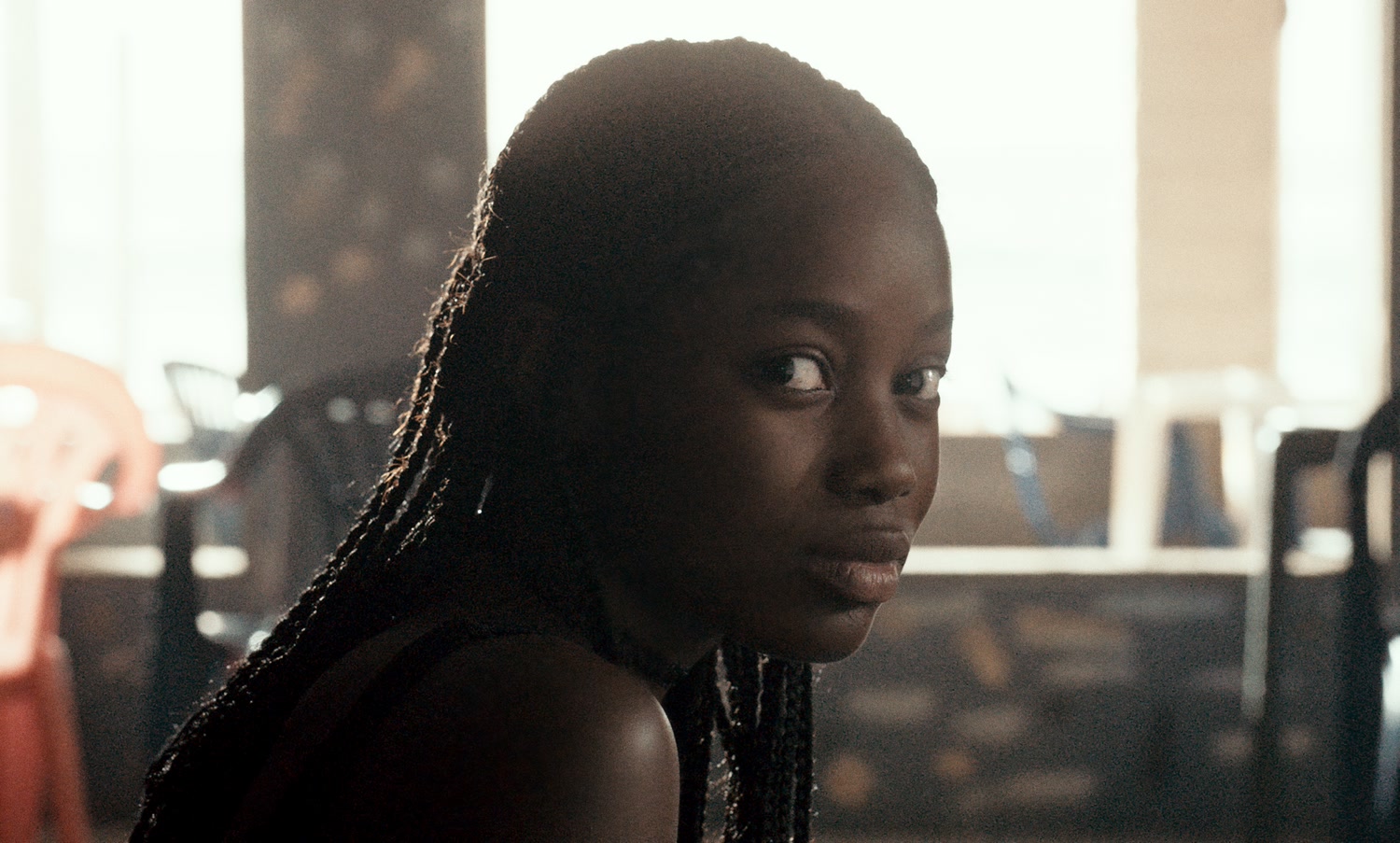
Spoiler note: this essay discusses the full film, including its final scenes.
The men at the beginning of Mati Diop's Atlantics have already built the proof of their own exploitation. A futuristic tower rises above Dakar while, at its base, the construction workers argue for wages they have earned and not received. The building is present. The money is not. Mr. N'Diaye can delay the payroll, but he cannot hide the labor: it has hardened into glass, concrete, height, and a light blinking over the city.[1][2][3][5]
A conventional social drama might keep that dispute at the construction office. Diop lets it change the genre of the entire film. Souleiman and his co-workers leave Senegal by sea; the crossing and their deaths remain offscreen. Then the men return through the bodies of young women who walk at night, confront N'Diaye, and demand what he owes. One return is different: Souleiman inhabits Issa, the police inspector who has been questioning Ada, so that he can reach the woman he loved.[2][4][6][7]
The supernatural is therefore not an escape from economic reality. It completes the causal chain that ordinary language tries to break apart: work is performed, payment is withheld, departure begins to look like an option, people die, and the loss reorganizes every life left on shore. In Atlantics, wage debt comes back in another body because the original bodies have been made to disappear.
The tower keeps the receipt
Diop did not choose a generic skyscraper as shorthand for inequality. The official press kit explains that the film's digital tower was inspired by an unrealized solar-tower project associated with Senegal's former president Abdoulaye Wade and Muammar Gaddafi. She filmed the opening at Diamniadio, the new city outside Dakar, and described the contradiction with exact clarity: an upscale world was being built by men who would have no place in it.[2]
That production history makes the tower stranger, not less real. It is a computer-generated form derived from an actual development fantasy, inserted into a landscape where actual workers face an immediate cash shortage. The structure belongs simultaneously to policy, aspiration, fiction, and labor. Its unreality is the most realistic thing about it: capital can project a skyline before it can meet a payroll.
Diop and cinematographer Claire Mathon usually hold the tower at a distance. At night it barely separates from the sky, except for its vertical outline and the light at its tip. The low city spreads beneath it in scattered lamps. Nothing in the image explains who owns which building or where the money went. Scale supplies the argument. The tower concentrates wealth upward while the people whose work made it possible disperse across the ground.[2][5]
This is why the construction-site quarrel cannot be treated as disposable exposition. The tower is a receipt with the workers' names removed. Every later genre turn remains attached to that first missing payment.
The crossing is withheld from the viewer
The feature grew from Diop's 2009 short Atlantiques, in which a young man named Serigne recounts a sea journey from Senegal toward Spain. Diop has said that the period's departures altered how she saw Dakar and the ocean: young people seemed mentally gone before they boarded, while those who drowned left a palpable absence in the city. Her feature does not restage that testimony as disaster spectacle. It shifts its attention to Ada, her friends, and the social world that must absorb the men's disappearance.[2][3][5]
That choice is both ethical and formal. There is no heroic shot of a boat cutting the horizon, no suspense sequence on rough water, and no image of death offered as proof. The sea keeps returning as a surface—glittering, darkening, breathing against the shore—but it does not surrender the bodies. Viewers know the crossing chiefly through what is missing afterward.
The absence changes the film's center of gravity. Souleiman initially appears to be the protagonist: an unpaid worker, a lover, a young man facing a narrowing future. Once he leaves, Atlantics stays. Ada's arranged marriage, Dior's independence, the friends' arguments, the burned bridal bed, and Issa's investigation become the story. The migrant route is not reduced to the traveler because departure is also an event in the lives of people who never board.[2][5][6]
Film Comment describes the feature as a meeting of romance, investigation, and haunting rather than a continuation of the short's documentary method.[3] That mixture matters. A report can count the missing; a ghost story can make absence exert force. Diop needs both kinds of knowledge, but she refuses to let the first contain the second.
Possession merges two unfinished struggles
The possessed women do not arrive with a sharp special-effects rupture. Dusk comes, bodies grow feverish, eyes turn pale, and an already unsettled world slips into another register. Diop told Film Comment that she was drawn to the way djinn emerge at a charged hour and to the sight of a body responding to an invisible force. The transition feels less like a plot twist than like pressure already in the air becoming visible.[3]
The bodily arrangement is crucial. The dead workers do not return in replicas of themselves. Their voices and demands travel through women who have their own conflicts with money, marriage, family, religion, and sexual expectation. In the press kit, Diop describes this as a merging of bodies and struggles: the men act through those who loved them, while the women are already fighting battles of their own.[2]
That prevents possession from becoming a simple replacement. By day, the young women are talked over, judged, paired off, or warned about the limits of acceptable conduct. By night, moving together, they can enter the boss's house and make a claim he cannot defer. Their solidarity gives the workers' demand a new physical form, but the scene also reveals power that the women themselves were not permitted to exercise alone.
The danger in describing them merely as vessels is that it repeats the film's central theft: treating a body as useful while ignoring the life that inhabits it. Atlantics does something more unstable. The workers' ghosts borrow bodies, yet the encounter enlarges the visible anger of the women rather than erasing it. Masculine labor grievance and feminine social constraint occupy the same nocturnal figures without becoming identical.[2][4]
The pale eyes make that doubleness legible at a glance. They are an unmistakable genre sign, almost archetypal, but they do not tell us where one identity ends and the other begins. Possession is not a costume placed over realism. It is the film's way of asking how one person's dispossession enters another person's life.
The ghosts ask for wages, not treasure
When the group confronts N'Diaye, its demand remains stubbornly specific. The workers want the money they earned. They also compel him to dig graves for bodies the ocean did not return. Cash and burial answer different forms of disappearance: one records labor denied by an employer; the other gives social form to deaths denied a resting place.[2][4]
The distinction between wages and compensation matters. Compensation would suggest that money can balance death. Wages acknowledge a narrower obligation that should have been met while the men were alive. The payment cannot repair the crossing or bring anyone home. It identifies the first breach and refuses to let N'Diaye redescribe exploitation as misfortune.
Diop also denies the confrontation the easy release of physical revenge. She told Bidoun that an earlier version had Fanta seize the boss by the throat, but the gesture felt false when filming began. The completed scene locates violence in the conditions that forced departure—in withheld pay, scarce choices, and a system that made a deadly voyage imaginable—rather than in a cathartic blow.[4]
That restraint gives the haunting an unusual moral shape. The ghosts do not return as an indiscriminate threat to the living. They return with an invoice. N'Diaye's terror comes from being forced to recognize people he had converted into an accounting delay.
Sound makes the invisible continuous
The genre shift works because the film has been haunted before anyone's eyes change. Mathon's lingering faces and wide, hazed landscapes make Dakar feel both materially specific and slightly unmoored. The camera returns to the ocean not as a single symbol but as a changing presence: route, grave, horizon, weather, and the blank surface on which the city projects knowledge it cannot verify.[5]
Fatima Al Qadiri's score carries what the camera cannot photograph. Diop said she wanted music that could seem to have been written by a djinn and could hold the film's spirit world, Muslim setting, female perspective, and geopolitical reality at once. Al Qadiri's electronics do not sit apart from the street, club, bedroom, and shore as a warning that fantasy has begun. They make those spaces porous from the start.[2][4][6]
This continuity protects the film from a common failure of political fantasy, in which social fact occupies the serious first half and supernatural metaphor arrives to decorate it. In Atlantics, sound has already joined them. The score can make a truck ride feel like a farewell before Ada learns through her friends that Souleiman has left, and it can make dusk feel inhabited before the women walk. By the time the dead return, the film has taught us to hear absence as a presence.
Souleiman returns through the law
The collective ghosts come back to settle an account. Souleiman comes back for Ada. His route is telling: he possesses Issa, the investigator assigned to turn the burned wedding bed into a case and Ada into a suspect. The body of official scrutiny becomes the body through which an impossible farewell can occur.[7]
That transformation stops the wage-debt reading from becoming a ledger of its own. Souleiman was a worker, but he was not only labor. He desired, withheld, hesitated, and was loved. British Vogue's interview with Diop describes the supernatural design as giving the lost spirits room to seek justice, receive their money, and meet a lover once more.[6] The last purpose is not less political than the first. Exploitation steals attachments as well as income.
Ada's encounter with Souleiman does not return her to the life they might have shared. It lets her recognize that the life is gone. Earlier, marriage to Omar appears as another economic route planned around a man: security is offered through a phone, a bed, and a household she does not desire. Souleiman's return could have fixed her forever as the woman who waits. Instead, the meeting ends, morning arrives, and the film gives Ada the final act of recognition.[2][4][5]
Looking into a mirror, she claims the name the plot has repeatedly tried to attach to someone else: bride, suspect, abandoned lover. “I am Ada.”[4][8] The statement is small enough to avoid false triumph. She has not defeated the economy that sent the workers to sea or the expectations that narrowed her choices. She has acquired a first-person future.
That is the film's final transfer. The workers use other bodies to make a debt visible; Ada returns fully to her own. Her survival does not settle the account, but it refuses to let the account consume every future it touched.
What cannot stay off the books
Atlantics begins with a familiar managerial maneuver: separate the finished asset from the unpaid people who produced it. The tower is treated as development; the missing wages as a temporary problem; the voyage as a private choice; the drowning as a tragedy. Each label narrows responsibility.
Diop's ghost story reverses that narrowing. It connects tower to paycheck, paycheck to pirogue, pirogue to ocean, ocean to the bodies on shore. Possession is the form that lets causality cross the gaps created by bureaucracy, distance, and death. What was kept off the books walks back into the boss's home.
Yet the film does not end at collection. It passes through the debt toward Ada's reflection because justice cannot mean turning the living into memorial furniture for the dead. Wages must be named. Graves must be dug. Love must say goodbye. Then the person left behind must still be allowed to become someone whose future is not merely an aftereffect of loss.
The tower remains on the skyline, but it no longer owns the last image. Ada does.
Sources
- mk2 Films, “Atlantics” — official film page with synopsis, production details, press-kit access, and the official Ada still used for this article.
- mk2 Films, Atlantics English press kit — Mati Diop interview on the 2009 short, the tower and Diamniadio, unpaid wages, possession, casting, cinematography, music, and Ada's emancipation; full cast and crew credits.
- Eric Hynes, “Mati Diop.” Film Comment, May–June 2019 — interview on the Dakar Spring, the short-to-feature transition, nonprofessional casting, genre changes, djinn, bodily response, and the film's “hyper-present.”
- Mati Diop, Fatima Al Qadiri, Negar Azimi, and Babak Radboy, “Spirit Riders.” Bidoun — conversation on wage revenge, the score, the Black Atlantic, possession, social violence, multiple genres, and Ada's final mirror scene.
- Catherine Wheatley, “Atlantics review: a mysterious fable of class, migration and heartbreak.” Sight and Sound / British Film Institute, November 27, 2019 — analysis of the women left behind, class details, Claire Mathon's images, Fatima Al Qadiri's score, and the recurring sea.
- Liam Freeman, “Award-Winning Atlantics Director Mati Diop Says Cinema Has a Moral Duty to Create Visibility.” British Vogue, May 24, 2020 — Diop on migration, embodied ghosts, justice, Thiaroye, casting, the soundtrack, and the film's love story.
- Barbican Centre, “ScreenTalks Archive: Mati Diop on Atlantics,” October 12, 2021 — transcript of Diop's discussion of Souleiman possessing the investigator and the film's shifting point of view.
- Jonathan Romney, “Film of the Week: Atlantics.” Film Comment, November–December 2019 — review of the possession plot, the mirrored doubles, the seascapes, and Ada's final words.