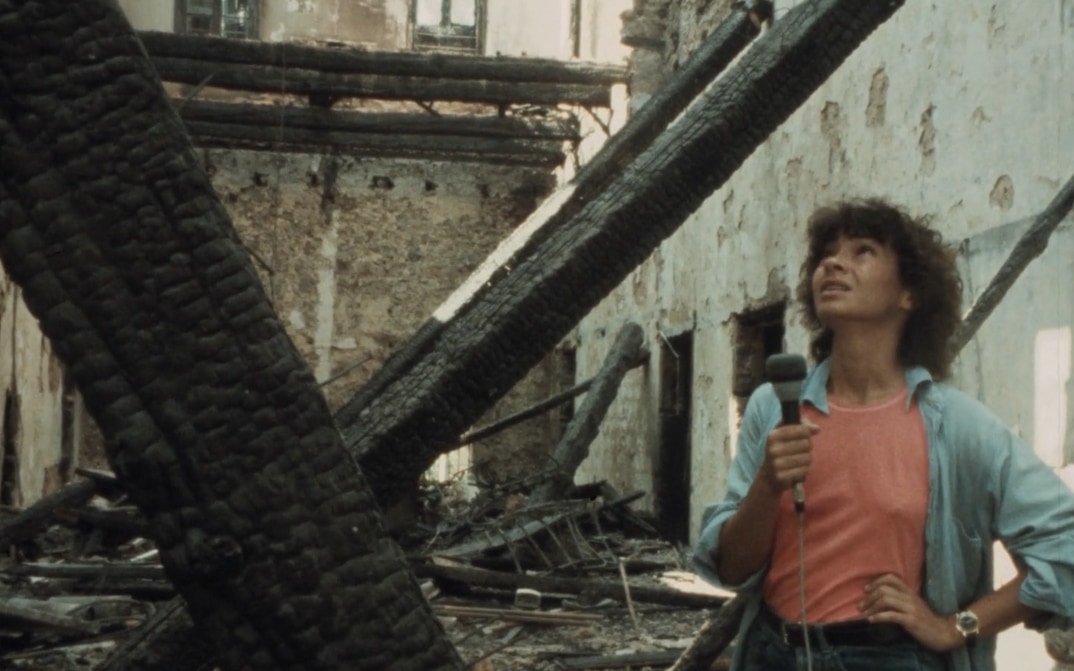
Jocelyne Saab stands in the wreckage with a microphone in her hand. Behind her, plaster has fallen away, doors open onto broken rooms, and the house no longer provides the privacy a house should. The posture belongs to a television reporter. The place was her family's Beirut home, where roughly 150 years of family life had accumulated before fire destroyed it. In Beirut, My City (1982), the familiar tool of public explanation has been carried into an irreducibly personal loss.[2][3]
That mismatch is the key to Saab's cinema. She never discarded the reporter's obligations: get close, identify what happened, preserve evidence, listen to people whom power would prefer to summarize. But she came to distrust the news image's claim to completion. A report explains an event and then yields to the next event. A life inside a war does not. Across documentaries, fiction, photography, cultural work, and an attempted national film archive, Saab kept reopening images that television would have treated as finished.
Her achievement was not to make war look poetic. It was to make form answer to an experience that a standard report could not hold. A ruined street could be evidence, a remembered neighborhood, a surreal stage, and somebody's route to work at the same time. Saab's films allow those meanings to remain in conflict. By slowing the image, separating commentary from illustration, admitting her own position, and later placing old movies inside new ones, she made Beirut outlive its assignment as news.
The reporter learned what the report leaves behind
Born in Beirut in 1948, Saab studied political economy and entered images indirectly, through newspapers, radio, and television. The official chronology maintained by the Jocelyne Saab Association records that French television first sent her to Libya in 1973 as an Arabic-speaking translator. When the assigned journalist could not obtain a visa, she directed the report herself. Work in Egypt, Syria, Iraq, Libya, and Palestine followed, including coverage of the October War of 1973.[1]
This beginning matters because the later films retain journalism's physical nerve. Saab knew how to enter a volatile place, work quickly, and recognize the political structure around a scene. Lebanon in Turmoil (1975), made as the Lebanese Civil War began, tried to assemble the causes and positions of a crisis that television audiences needed explained. Yet when the conflict reached the city she knew from childhood, explanation no longer seemed sufficient. Between 1975 and 1982 she made eleven reports and documentaries in Lebanon, gradually shifting from the ordered argument of broadcast journalism toward a cinema built from duration, association, and doubt.[1][5]
The decisive turn is Beirut, Never Again (1976). Saab filmed the damaged center at dawn, when the guns were quiet enough for long tracking shots. Instead of making combat the privileged spectacle, she watched what violence had left in the street: furniture, typewriters, mannequins, facades opened like stage sets, and children converting an adult catastrophe into work and play. Shells and explosions sometimes arrive from beyond the frame, but ordinary gestures keep occupying the foreground.[2][4][5]
These images do not pretend the war is unknowable. They change the scale at which knowledge is sought. A conventional report might use a broken chair to illustrate destruction; Saab lets discarded objects retain the absent bodies and habits around which they once had meaning. Children hauling water or moving through looted rooms are neither decorative symbols of innocence nor miniature political experts. Their improvisations show how war reallocates labor, space, and childhood before any commentator can turn those changes into a thesis.[4][5]
Commentary stopped telling the image what to mean
Saab's most important collaborator on Beirut, Never Again was the poet and artist Etel Adnan, who wrote its commentary. The choice altered the usual contract between words and pictures. Television voice-over normally names what the image proves and directs attention toward an agreed fact. Adnan's language remembers what is missing, draws associations across time, and sometimes refuses to coincide neatly with what is visible. Claudia Polledri's study of the film locates its break from reportage in precisely this reworking of commentary and montage: text and image cease to certify each other and begin producing several possible relations.[5]
That loosened relation is not an escape from evidence. It is an ethical limit placed on evidence's authority. The ruins are real, but they cannot disclose by themselves how a street was inhabited, who profited from its division, or what its disappearance does to memory. Poetry creates enough distance to think without making the suffering remote. Montage makes a present object answer an archival view, a child's gesture answer an adult institution, silence answer the noise outside the frame.
Saab extended the method in Letter from Beirut (1978). Its address to friends abroad makes distance part of the film rather than a neutral condition of its distribution. She crosses the country, speaking with students, refugees, artists, prisoners, and peacekeeping troops; images of destruction sit beside outings, horse racing, and old Hollywood posters still advertising fantasy on damaged streets.[2][4] The tonal instability is the point. Daily life does not wait for history to settle into a consistent genre.
The letter form also makes clear who is speaking. Saab moves between insider and exile, eyewitness and returning spectator. She does not offer that divided position as superior access. She exposes it as one of the forces shaping the film. The result is more accountable than an impersonal voice claiming a view from nowhere: every image has been taken from somewhere, carried elsewhere, and addressed to someone.
When her own house entered the frame, objectivity became a subject
By Beirut, My City, the separation between reporter and scene has collapsed visibly. The opening still used for this article shows Saab holding the microphone in her ruined home. Arsenal's record of the restored film identifies the house as the place of her childhood and describes the work as an inquiry into fact, fiction, identity, and loss made with the playwright and director Roger Assaf.[3] The image is not powerful because a supposedly objective journalist has finally confessed emotion. It is powerful because the film makes objectivity itself available for inspection.
Saab keeps the apparatus in view. The microphone promises testimony, yet no concise dispatch can inventory generations of family memory. The damaged rooms are evidence, yet their meaning depends on a history the camera cannot retrieve from the rubble. Rather than resolve that failure, the film builds with it. Assaf's text, Saab's presence, reused material, and new footage turn the act of looking into part of what must be judged.[2][3][4]
The film is severe about the seductions of witness. It revisits people and places recorded earlier, including a friend who has since been killed and a racecourse subsequently destroyed. Before-and-after images can make change undeniable, but they can also flatter the viewer with the feeling of having possessed another person's catastrophe. Beirut, My City repeatedly asks what an image suppresses, who has interpreted it, and whether horror is becoming spectacle.[4]
This skepticism never becomes an excuse to stop filming. Saab's answer to an insufficient image is another relation: past beside present, the visible beside the remembered, a writer's voice beside a shot that it does not merely caption. The work of witness moves from collecting proof to testing how proof changes when it is edited, narrated, repeated, and received.
Fiction did not mean leaving the real city
After years of documentary work, Saab's first fiction feature, Ghazl al-Banat—shown at Cannes in 1985 as The Razor's Edge and later re-edited as A Suspended Life—might look like a retreat from immediate history. It is better understood as the next consequence of her documentary doubts. Shot in a Beirut still marked by war, the film follows a teenage girl whose emotional and imaginative life cannot be reduced to the evidence of damaged streets. The cast combines French actors with non-professional Lebanese performers, while the city's real, war-damaged spaces remain inside the fiction.[1][7][8]
Fiction gives desire the same historical weight as destruction. A news camera can show that a building has been gutted. It struggles to show how a young person born into war borrows fantasies from Egyptian romantic movies, invents a future, or experiences a ruined palace as more than a ruin. Saab does not rebuild the city into a seamless set. She lets real spaces carry invented encounters, so that imagination registers as one of the ways people inhabit material damage.
The film's versions make this question tangible. The 1985 Cannes cut was shortened for its 1988 French release; surviving prints differed, and the recent restoration returned to the longer original using a 35 mm preservation element.[7] Here restoration is not a cosmetic polish applied to an uncontested object. It recovers an earlier arrangement of fiction, documentary trace, and wartime space—the form Saab felt had been compromised when distribution demanded another shape.
Eventually, directing meant rescuing other people's images
In the early 1990s Saab expanded the same practice from making films to preserving cinema. She researched more than 250 films that had represented Beirut and Lebanon, trying to rebuild a Lebanese film archive interrupted by war. Around fifty works were presented in the 1993 program Beirut, One Thousand and One Images. The research then became material for Once Upon a Time in Beirut (1994), in which two young women search old movies for a city they know largely through inherited stories.[6][8]
The project refuses a single authentic image of Beirut. Newsreels, melodramas, foreign productions, local films, documentary fragments, and Saab's own footage have all made versions of the city. In Once Upon a Time in Beirut, those representations do not line up into a clean chronology. They become encounters. The two protagonists move through a cinematic memory whose glamour, distortion, fantasy, and evidence are inseparable.[6]
This is where the full logic of Saab's career comes into focus. The discarded object in Beirut, Never Again carried the trace of a missing household. The repeated shot in Beirut, My City acquired a new meaning after a person died or a place vanished. The archive project treats whole films in the same way: not as sealed records, but as surviving objects whose meanings depend on who can find, screen, and answer them.
Preservation therefore belongs inside her idea of direction. Saab was not merely protecting her own authorship for a future canon. She was recovering the contradictory images through which a public might argue with the stories already told about its city. The archive she envisioned did not fully materialize as a national institution, but the cataloguing, restorations, screenings, and Once Upon a Time in Beirut made parts of that missing institution function in practice.[1][8]
Beirut was the center of a wider field of attention
Saab's cinema was never confined to one city. She filmed Palestinian women and fighters, the Western Sahara, post-revolutionary Iran, communities in Egypt, a doctor in Vietnam, and Syrian refugees in Lebanon. She moved among documentary, fiction, photography, and multi-screen installation, repeatedly centering people whom geopolitical coverage tends to render as crowds, types, or consequences.[2][8]
Yet Beirut remained the place where all her forms pressed against one another. It was home and subject, location and archive, a city experienced directly and a city already overproduced by other people's images. Because she knew it intimately, she could not accept either of the easy pictures often imposed on it: cosmopolitan playground or permanent war zone. Her Beirut contains shattered facades and movie posters, armed streets and horse races, family history and foreign broadcasts, political analysis and private grief.[4]
Saab died in 2019, leaving work that now depends on the very acts of recovery she had practiced for others. The Jocelyne Saab Association's restorations and renewed screenings have brought the Beirut trilogy and the original version of The Razor's Edge back into circulation.[1][3][7][8] Their return does more than repair an omission in film history. It restores a method for looking at images that arrive labeled urgent.
Urgency tells us to look now. Saab also asks what happens after looking: who keeps the image, what the edit made invisible, whose memory can revise its meaning, and whether the people inside it are permitted a life beyond the event. That is how she made Beirut outlive the news. She did not rescue the city from history. She built forms in which history could not finish speaking for it.
Sources
- Jocelyne Saab Association, “Biography” — official account of Saab's entry into reporting, film career, casts, archive project, and final years.
- Nicole Brenez, “Jocelyne Saab: history's witness.” Sight and Sound, British Film Institute, updated January 24, 2019 — overview of Saab's political and artistic practice and the Beirut trilogy.
- Arsenal – Institute for Film and Video Art, “Beirut, My City” — film record, restoration note, synopsis, and the official still used for this article.
- Linda Mokdad, “‘You Have to Treat an Image Like it Never Existed’: Jocelyne Saab's Beirut Trilogy.” Mizna, July 27, 2021 — close analysis of the trilogy's essay form, recurring images, and critique of spectatorship.
- Claudia Polledri, “Jocelyne Saab, du reportage au cinéma ‘de poésie’: ‘Beyrouth, jamais plus.’” Observatoire de l'imaginaire contemporain, 2022 — study of Saab's shift from broadcast reportage through commentary, montage, sound, and poetic distance.
- Jocelyne Saab Association, “Once Upon a Time Beirut” — official film page with synopsis, credits, and archival premise.
- Jocelyne Saab Association, “Ghazl el-Banat at Cinema Jolly” — production and version history for The Razor's Edge / A Suspended Life and provenance of the restored original cut.
- Jocelyne Saab Association, “Biography & Chronology” — official career timeline covering Saab's reporting, documentaries, fiction, archive research, later work, and preservation program.