For many non-Japanese viewers, jidaigeki (period drama) still gets flattened into one phrase: “samurai movies.” That shorthand hides what made the form so influential. Jidaigeki is not a costume skin over modern action; it is a way of organizing moral conflict through space, hierarchy, and consequence. The best films in the form do not ask only “who wins the duel?” They ask: who controls information, who reads the room correctly, and who pays for violence after the scene ends.
The global turning point is usually traced through Akira Kurosawa’s run from Rashomon (1950) to Seven Samurai (1954) and Yojimbo (1961), but the bigger story is genre-level. Kurosawa did not invent jidaigeki. He changed its operating tempo and visual syntax so thoroughly that later action cinema—Japanese and non-Japanese—could reuse the grammar.[1][2][3][4]
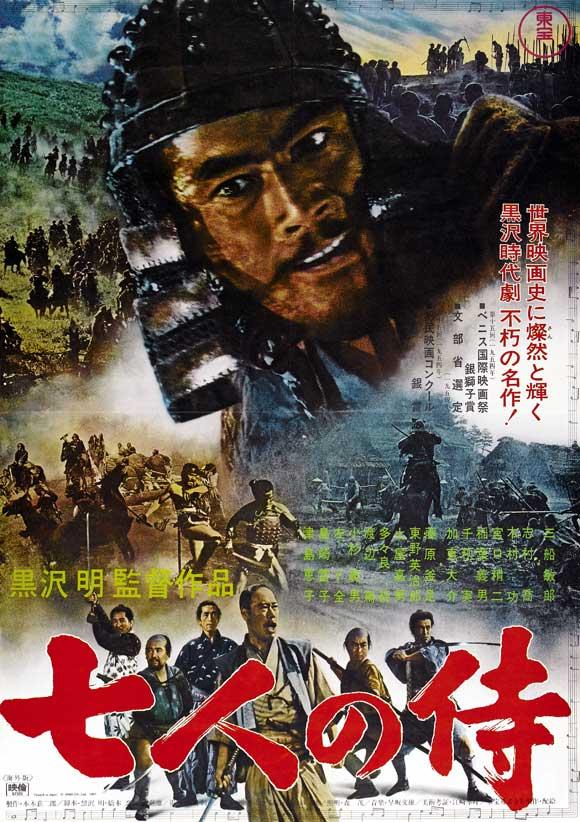
Image context: the cover uses a 1954 Seven Samurai release poster as historical genre context; the craft claims below are grounded in cited film-history and criticism sources, not in poster design itself.
1) What jidaigeki already was before the global breakthrough
Historically, jidaigeki covers stories set in earlier Japanese eras (especially Edo-period settings), often involving class order, legal authority, and social obligation.[1] Within it, chanbara emphasizes sword combat and kinetic confrontation. Even before Kurosawa, the form already had major stars, studio ecosystems, and audience familiarity inside Japan.
What changed after 1950 was not simply export volume. It was interpretability. International audiences who did not share local class codes could still read Kurosawa’s scene logic because the films translated social tension into legible physical systems: rain, mud, distance, doorways, formation lines, and field position. The action became readable across cultural boundaries without becoming culturally generic.
2) Kurosawa’s intervention: action as weather + geometry + aftermath
Kurosawa’s most durable contribution to genre language is often mistaken for “spectacle.” In practice, it is structural.
Three patterns matter most:
- Weather as a narrative force — rain, wind, dust, and heat are not background realism; they alter decision speed and visibility.
- Group blocking as strategy — especially in Seven Samurai, bodies move as tactical units, not as isolated hero poses.[3]
- Aftermath emphasis — violence is rarely treated as a clean endpoint; physical and social consequences continue into the next beat.
This is why the films feel modern even when the settings are historical. They do not present combat as pure skill display. They stage conflict as information management under friction.
3) Why Seven Samurai became a reusable template
Released in 1954, Seven Samurai is more than a “great film” in canon terms; it is a transferable action blueprint.[3][8] The premise is simple—village defense against bandits—but the execution introduces patterns that later industries copied repeatedly:
- team assembly with differentiated competencies,
- defense planning through terrain,
- cyclical attack waves that test formation discipline,
- emotional payoff tied to collective survival rather than lone-hero invincibility.
The key point is not that later films “borrowed” from it. The point is that Seven Samurai demonstrated that ensemble action could stay clear at scale without collapsing into chaos. You can trace this DNA through war films, heist structures, and modern franchise team-ups that rely on role clarity and staggered tactical beats.
4) The transnational handoff: from samurai lanes to western and beyond
Two adaptation lines explain the genre migration most clearly.
- Seven Samurai (1954) to The Magnificent Seven (1960): core structure preserved, setting translated.[3][5]
- Yojimbo (1961) to A Fistful of Dollars (1964): the manipulative drifter logic re-encoded in spaghetti western form.[4][6]
These are often discussed as copyright or remake history, but the deeper craft story is about portability. Kurosawa’s films packaged moral conflict into robust scene mechanics that survived language change, geography change, and star-system change.
A related branch is The Hidden Fortress (1958), frequently cited in relation to Star Wars narrative perspective choices and adventure pacing.[7] Whether or not one overstates one-to-one influence, the directional fact is clear: jidaigeki-era structural decisions moved into global blockbuster grammar.
5) What later action cinema kept—and what it quietly dropped
Modern action franchises kept several Kurosawa-era strengths:
- clearer objective ladders per sequence,
- tactical geography that viewers can parse quickly,
- escalation through changing constraints rather than random volume.
But many productions dropped one crucial element: consequence density. In classic jidaigeki and Kurosawa-adjacent works, physical conflict usually rewrites social reality in visible ways. In weaker modern imitators, action resets to status quo by the next scene.
That difference is why older films can still feel heavier than bigger contemporary productions. Weight comes less from body count than from causal continuity.
6) Why this movement context matters in 2026
In 2026, audiences are saturated with action images but still respond to clarity and stakes. That is exactly where jidaigeki’s best lessons remain practical:
- choreograph for orientation, not just speed,
- let environment change tactical options,
- treat victory as costly rather than frictionless.
Kurosawa’s canon position in international polling is part of this story, not separate from it.[8] These films keep traveling because they encode reusable craft principles, not because they are museum objects. In movement terms, jidaigeki became globally durable when it proved that historical cinema could also be a forward-compatible action design system.
If you watch Rashomon (1950), Seven Samurai (1954), and Yojimbo (1961) in sequence, you can see the handoff happen in real time: from local period genre to transnational action grammar.[2][3][4]
Sources
- Wikipedia — Jidaigeki
- Wikipedia — Rashomon
- Wikipedia — Seven Samurai
- Wikipedia — Yojimbo
- Wikipedia — The Magnificent Seven (1960 film)
- Wikipedia — A Fistful of Dollars
- Wikipedia — The Hidden Fortress
- BFI Sight and Sound — The Greatest Films of All Time (2022 poll)
- Wikimedia Commons file used (poster)