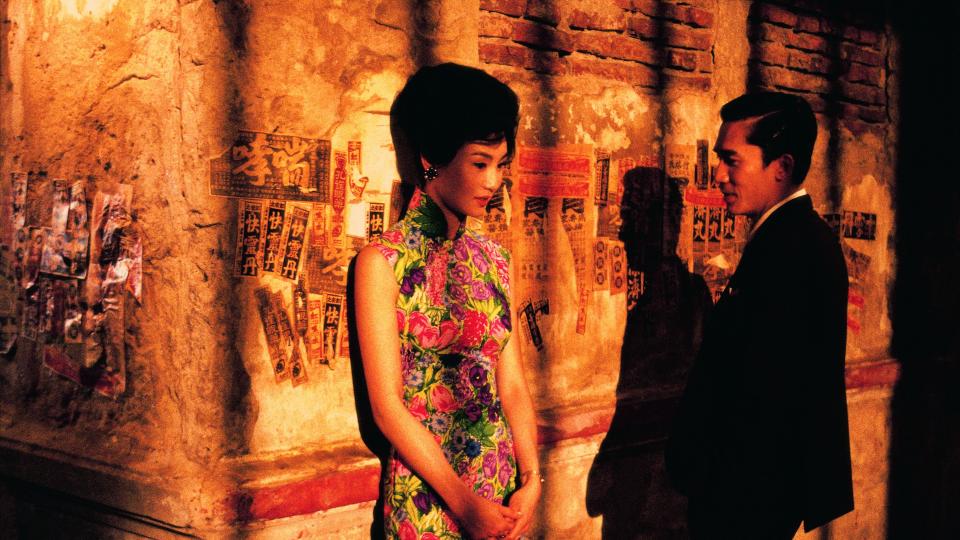
Wong Kar-wai’s In the Mood for Love (2000) is often praised as a “beautiful film,” which is true but incomplete. Its real force comes from structure: how space and time are arranged so that emotion arrives late, in fragments, and often after the practical chance to act has passed.
Set in 1962 Hong Kong, the film follows Chow Mo-wan (Tony Leung) and Su Li-zhen (Maggie Cheung), neighbors who discover their spouses are having an affair.[1][2][3] That premise could have produced a melodrama of confrontation. Instead, Wong builds a drama of intervals: hallways, stair landings, noodle-shop trips, doorway pauses, and rehearsed conversations that are only partly “real.”
Spoiler note: this essay discusses late-film scenes and ending details.
Image context: the cover still shows Chow and Su against the corridor wall, an image that captures the film’s key formal idea—desire staged in narrow transitional spaces rather than private rooms.
1) Corridors as moral architecture
Most romance films grant lovers private zones where speech can become direct. In the Mood for Love does the opposite. It repeatedly places Chow and Su in shared, semi-public passageways: the stairwell, the alley to the noodle stand, the hallway outside rented rooms. These are not neutral locations. They are social pressure chambers.
A corridor is built for movement, not dwelling. By making it the film’s recurring emotional stage, Wong imposes a rule: intimacy must stay provisional. Even when the two characters are physically close, architecture reminds them that they are passing through borrowed time.
This is why the repeated slow-motion walk sequences carry such weight. They are not decorative music-video inserts. They dramatize recurrence without progression. The same gestures repeat, but the ethical boundary does not move. Every return to the corridor accumulates feeling while denying release.
In close-reading terms, the corridor functions like a sentence with no full stop: clause after clause, suspended before completion.
2) Repetition, not plot twists, creates emotional escalation
The film is only 98 minutes,[1][2][3] yet it feels expansive because Wong stretches tiny behavioral units across time. A thermos is carried down a hall. A meal is bought. A line is spoken, then replayed later in altered context. Instead of major plot turns, the movie relies on micro-variation.
That design mirrors the characters’ moral strategy. Chow and Su keep saying, in different forms, that they will not become like their unfaithful spouses. The film therefore cannot escalate through obvious consummation. It escalates through pressure on restraint.
Three formal mechanisms do this work:
- Rhythmic returns — recurring walks and repeated framings create expectation, then frustrate it.
- Elliptical cuts — key decisions are often skipped or displaced; we infer change from aftermath rather than witness event.
- Performance under role-play — when the pair “rehearse” how the affair may have begun, acting and confession overlap, but never fully merge.
The result is a rare emotional geometry: the film gets more intense by refusing to change state quickly.
3) Costume and framing turn time into visible pressure
Maggie Cheung’s succession of cheongsams is frequently discussed for beauty, but in this film costume also behaves like a temporal marker. Pattern and color shifts register the passage of days and moods without explanatory dialogue. We do not get “three months later” title cards; we get textile and rhythm.
Likewise, framing repeatedly places characters behind doorframes, reflected in mirrors, or partially occluded by walls. This visual strategy does two things at once:
- It literalizes social surveillance in a crowded residential environment.
- It externalizes self-surveillance: they are watched by neighbors, and by their own codes.
Because of this, even stillness feels eventful. When Chow smokes alone in a rented room, or when Su pauses before knocking, the frame already contains the conflict: desire has arrived, but legitimacy has not.
4) Soundtrack as memory loop, not emotional instruction
Critical summaries often mention the film’s “aching” score and recurring musical motifs.[2][4] In close reading, the key point is not simply that the music is melancholic. It is that recurrence in sound matches recurrence in blocking.
Music here does not tell the audience what to feel next; it tells us that the characters are living inside a loop. The same melodic return can accompany slightly different emotional temperatures: caution, tenderness, regret, resignation. This keeps scenes from collapsing into one-note sentimentality.
In other words, soundtrack and spatial design are synchronized systems. The corridor repeats, the melody repeats, the chance repeats—and each repetition arrives more burdened than the last.
5) The ending and the ethics of unsaid things
By the final movement, the film has shifted from social constraint to historical distance. Chow’s whisper-at-the-wall gesture (set against Angkor Wat) is often read as pure romantic melancholy. It is that, but it is also the logical conclusion of the film’s form.
If the whole movie is built on displaced speech—things practiced, deferred, rerouted, or swallowed—then the ending must place confession where no dialogue can answer it. The secret goes into stone, not into conversation.
That ending can feel devastating because it denies both melodramatic punishment and melodramatic reward. No scandal climax, no triumphant union, no clean closure. The film preserves its governing ethic to the final shot: desire exists, but timing and world structure may never permit its ordinary fulfillment.
Why this close reading still matters in 2026
Two decades on, In the Mood for Love remains influential partly because it offers filmmakers a durable lesson: intensity does not require louder plot. It can be built through controlled repetition, spatial restriction, and moral tempo.
That lesson helps explain why the film remains highly ranked in major critic canons, including the 2022 Sight and Sound critics’ poll (ranked #5) and BBC Culture’s 21st-century critics poll (ranked #2).[5][6] Canon status is not only about prestige; it reflects a reusable craft model.
Wong’s film shows what cinema can do when it treats timing as fate. Love is not framed as a revelation scene. It is framed as an accumulated delay.
Sources
- Festival de Cannes — In the Mood for Love (2000 film entry)
- Janus Films — In the Mood for Love (film page/details)
- Britannica — In the Mood for Love (film entry)
- Criterion Channel — In the Mood for Love (edition page)
- BFI Sight and Sound — The Greatest Films of All Time (2022 poll)
- BBC Culture — The 21st Century’s 100 greatest films
- Wikipedia — In the Mood for Love (production/release baseline)
Editor’s Pick Review
This piece wins on editorial craft because it performs true close reading instead of plot recap: every major claim is anchored to repeatable formal evidence (corridor blocking, rhythmic returns, elliptical cuts, costume-as-time marker, and soundtrack recurrence), and the argument stays coherent from opening premise to the Angkor-wall ending logic. It also balances readability with specificity, so both film readers and general audiences can follow the causal chain without losing nuance. The Chinese translation quality is publication-grade and materially strengthens the pick score: phrasing is natural and fluid, retained technical/craft terms are introduced in-context with clear Chinese wording, key terms stay consistent across sections, and the prose avoids heavy translationese or analyst-jargon density while preserving analytical precision. In the current non-picked active pool, this is one of the clearest examples of form analysis that remains both rigorous and readable in EN+ZH.