Spoilers follow, including the ending.
A biscuit left on a table is a small invitation. In The Quiet Girl (2022), Seán's gesture toward Cáit matters because he has been difficult for her to read: reserved, easily mistaken for another adult she should avoid. The biscuit makes his attention tangible. She can accept it without having to find the right words.[2]
Colm Bairéad's film, set in rural Ireland in 1981, sends a neglected child to spend the summer with relatives. Eibhlín and Seán offer a household whose calm conceals a painful history.[1] What makes the summer convincing is its accumulation of ordinary acts. Kindness becomes something Cáit can begin to expect. The film gives that expectation a rhythm, then changes the rhythm when she has to leave.
Someone has time for her
Eibhlín's welcome involves work: bathing Cáit, brushing her hair, putting her to bed. When the child wets the bed, Eibhlín attributes the dampness to the mattress. She deals with the practical problem while sparing Cáit the humiliation of an accusation.[3]
That tact is a form of attention. Eibhlín has noticed enough to understand what should remain unsaid. The bath and the hairbrush also give care a duration: somebody is willing to spend time on this child's comfort. Carrie Crowley's performance makes hospitality feel like a series of tasks she wants to complete, each offering another chance for Cáit to relax.
The film has prepared us to register this difference. Bairéad told interviewer Paul Risker that he constructed an opening act beyond the starting point of Claire Keegan's Foster, the story he adapted, developing hints about the girl's earlier life into scenes.[6] That addition gives the summer a before-and-after structure. By the time Cáit reaches this house, being attended to is itself an event.
The frame waits at her height
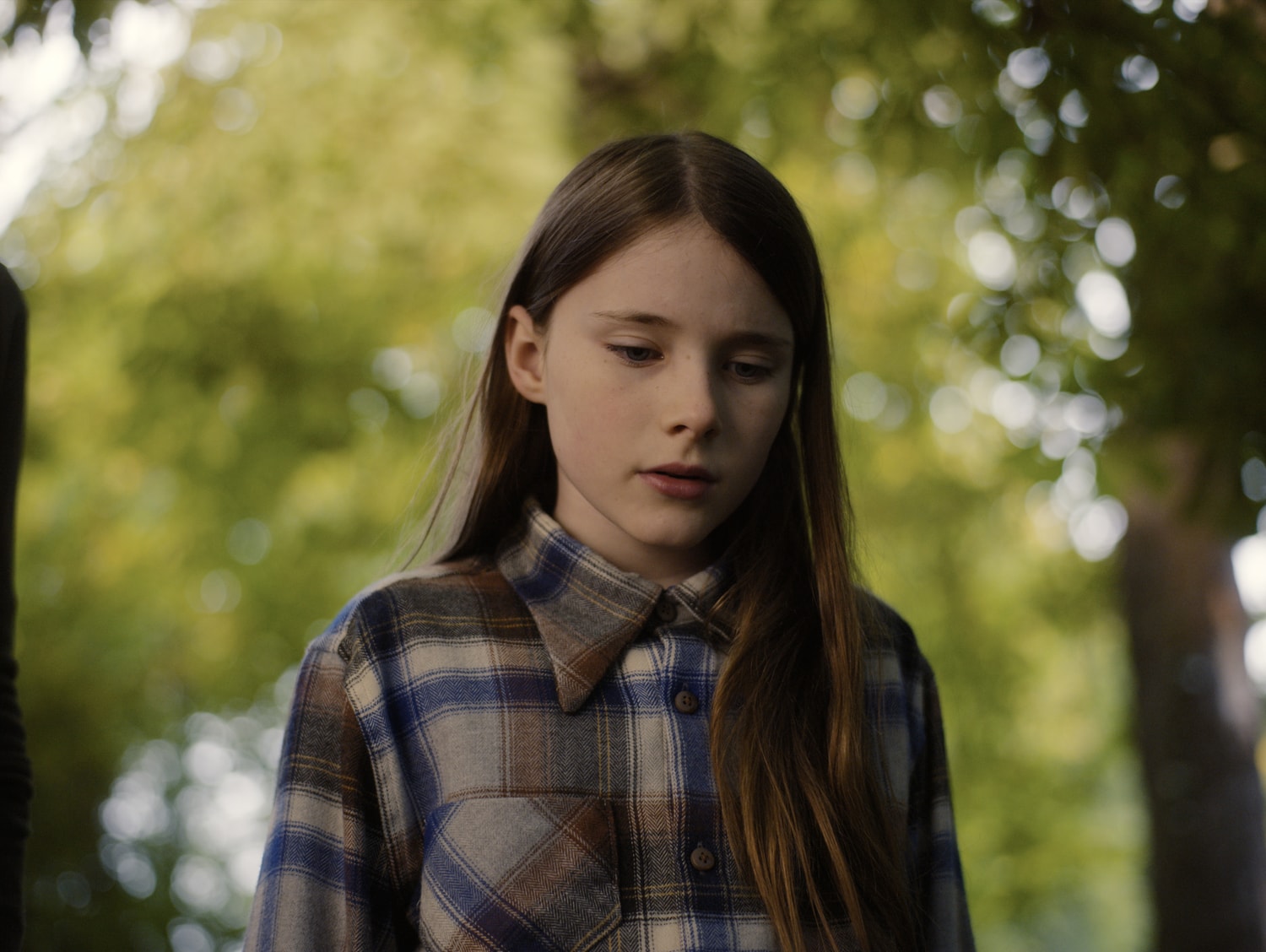
Kate McCullough's cinematography makes the girl central without making her surroundings fully intelligible. In her account for British Cinematographer, McCullough describes testing the narrow, approximately 1.37:1 frame, bringing the camera to Cáit's height, and leaving a world beyond its edges that the child cannot yet understand. She also wanted the image to retain a sense of the surrounding place rather than dissolve everything into dreamy blur.[4]
Those choices give looking two simultaneous jobs. We attend to Catherine Clinch's face, but we also search the space around her for clues. A child can occupy the centre of an image and still lack the knowledge that would make her secure. The frame gives Cáit importance before the story gives her confidence.
Clinch does not have to announce each step of that change. The film's patience allows a glance to remain a glance: an attempt to understand someone whose intentions may be unfamiliar. Our attention begins to resemble what Eibhlín offers. We have to allow the child time.
A run with someone waiting
Seán's growing affection acquires its own repeated action. He times Cáit as she runs to the postbox along the lane. The errand becomes a game, and her pleasure becomes visible in her face as she runs.[2]
The timing matters less than the person doing it. Someone is interested in her return. Her speed can give him pleasure; his attention can give her pleasure. The repetition makes a relationship out of a route that could otherwise be merely useful.
Read alongside the biscuit, the run shows Seán finding gestures that Cáit can answer. A gift can be taken; a challenge can be attempted. Neither demands that she explain herself first. The two actions give her different ways to participate in affection, at the table and in motion.
Quiet can mean more than one thing
The house cannot remain an uncomplicated refuge. A neighbour's intrusive questioning exposes the couple's hidden grief, and Cáit has to revise her understanding of the adults caring for her. Later, Seán tells her she need not always speak.[5]
The difference between intrusive speech and considerate silence is crucial. The neighbour supplies information while making the child vulnerable. Seán offers permission to withhold a response. Knowing more about a household does not automatically mean treating its inhabitants better.
Katie McCabe's Sight and Sound review locates the film's movement in this changing meaning of quiet: what begins in fear can become a choice.[5] The title therefore describes something unstable. Cáit's silence cannot be read as a fixed personality trait. Its meaning depends on who is listening, what they expect, and whether she feels safe enough to speak.
The final distance
At the end, Cáit runs after the couple's departing car and embraces Seán at the gate. Her biological father approaches as she says “Daddy.”[3] A movement associated with encouragement now becomes urgent. This time she chooses the run herself, because the person she wants to reach is leaving.
The word hangs between two paternal claims. It can be heard as an address to the man holding her and, with her father approaching, as an alarm. That is a reading of the scene's arrangement, not a promise about which household will claim her afterward.
Bairéad explicitly leaves that future open. In his Film in Revolt interview, he distinguishes the certainty that the summer has changed Cáit from the unanswered question of how her life will proceed.[7] The embrace gives emotional recognition a physical form without settling her circumstances.
The earlier runs have taught us what this final distance contains. Cáit knows the experience of moving toward someone who is pleased to see her arrive. She can now reach for that person. The film ends before we know how long she will be allowed to hold on.
Sources
- ASC Distribution, “The Quiet Girl” — official film page, production year, synopsis, and distributor-supplied film still.
- Joyce Glasser, “A quiet film that packs a big emotional punch,” Mature Times, May 12, 2022 — the biscuit, timed postbox runs, and the returning movement motif.
- Markie Robson-Scott, “The Quiet Girl review — finding a home away from home,” The Arts Desk, May 12, 2022 — domestic care, the damp mattress, and the final embrace.
- Kate McCullough, “The Quiet Girl,” British Cinematographer, Focus on Lenses — the cinematographer's account of framing, camera height, and visual restraint.
- Katie McCabe, “The Quiet Girl: silence turns tender for a young Irish family outcast,” Sight and Sound, May 13, 2022 — the neighbour, Seán's counsel, and the changing meaning of silence.
- Paul Risker, “Summer's child,” Eye for Film, May 18, 2022 — interview with Colm Bairéad about adaptation, the added opening act, and narrative restraint.
- Madison Stephens, “Interview with Colm Bairéad,” Film in Revolt, September 1, 2022 — the director on care and the deliberately unresolved future beyond the ending.