Spoiler note: this essay discusses major plot turns in In a Lonely Place, including the murder investigation, Dix Steele's violent outbursts, and the ending.
Nicholas Ray's In a Lonely Place (1950) is often introduced as noir with an unusual love story inside it.[1][2][3] That is true, but it still undersells how the movie actually works. The murder mystery matters, the Hollywood setting matters, Humphrey Bogart's unstable charisma matters, yet the film's deepest technical move is simpler and nastier. Ray keeps taking situations that should belong to romance or privacy and making them feel like deposition material. A glance across a courtyard, a dinner-table anecdote, a late-night drive, a telephone call after midnight: each one is asked to carry feeling and evidence at the same time.[1][2][4]
That doubleness is why the picture remains so hard to shake.[2][3][4][5] Criterion's essay calls it a heartbreaking tragedy rather than a clever Hollywood satire, and the distinction is exact because tragedy here does not arrive through one giant revelation.[2] It arrives through accumulation. Bogart's Dix Steele does not need to be the killer in order to poison the love story. He only needs to become a man whose talent, wit, and tenderness are no longer separable from the threat of sudden force. Ray and cinematographer Burnett Guffey make that threat legible by staging romance inside watched spaces.[1][2][3]
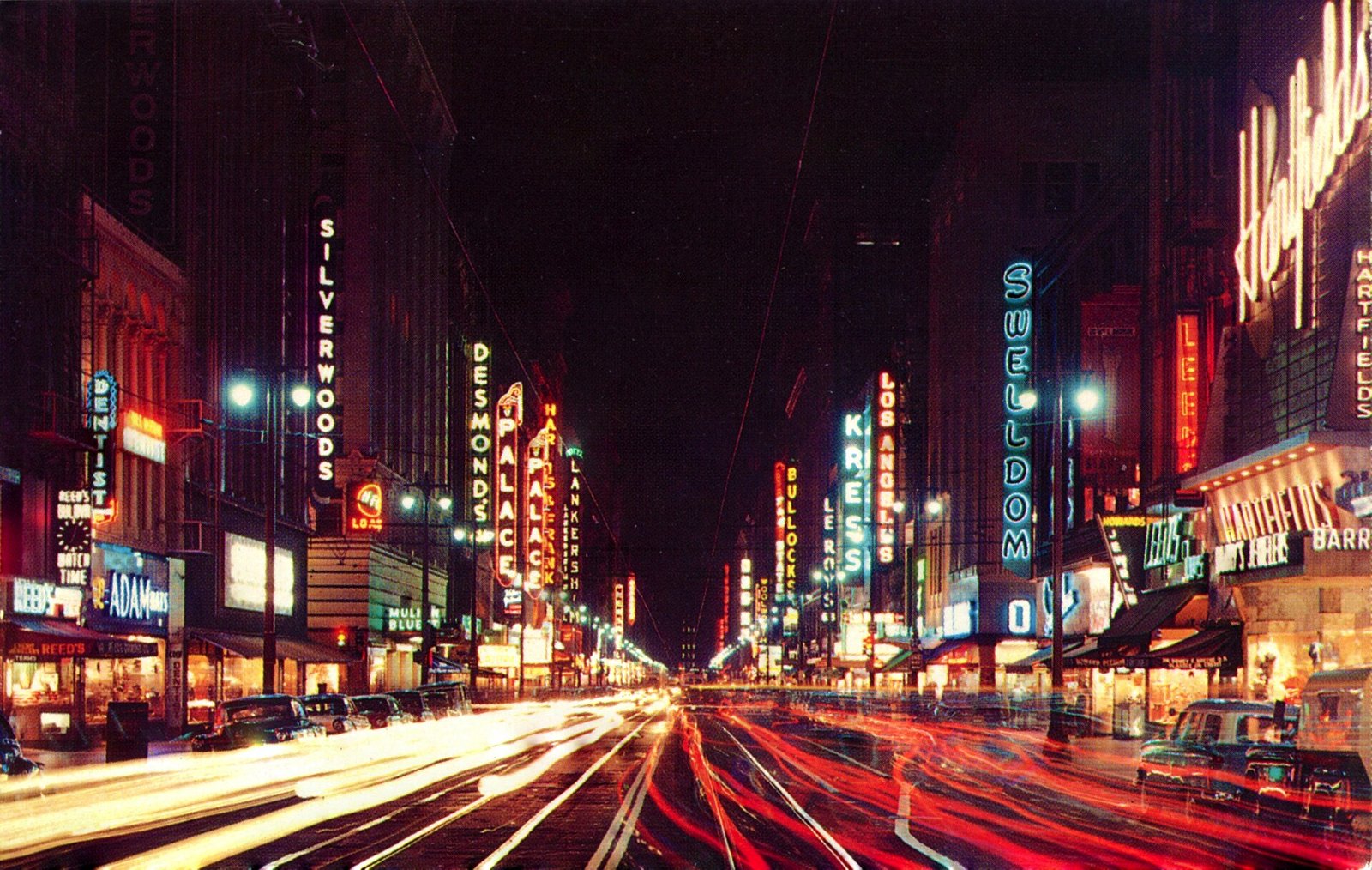
Image context: the lead image shows Broadway in Los Angeles at night in the 1950s, the same city-and-era pressure chamber that gives In a Lonely Place its watched courtyards, studio labor, and late calls.[6] It avoids turning the essay into a screenshot gallery and instead keeps the reader inside the real urban atmosphere that noir made so unstable.
The first witness lives across the courtyard
One of the film's boldest structural decisions is that Laurel Gray enters the story as both possible lover and eyewitness.[2][3][4] When Mildred Atkinson leaves Dix's apartment after summarizing the trashy novel he has been assigned to adapt, Laurel is the neighbor who sees her go.[3][4] That detail sounds procedural, but Ray uses it for emotional architecture. Before the couple can become fully legible to one another as man and woman, they are already connected through police logic. Laurel's beauty matters. So does her line of sight.
Ray builds the apartment complex accordingly.[2][3] Windows, balconies, and courtyard angles keep everyday life half-public. A person can lean, watch, infer, and misread without ever fully entering the other room. This is where In a Lonely Place separates itself from a more straightforward detective picture. The investigation is not confined to police headquarters. It lives inside domestic space. The apartment should be where Dix can joke, write, seduce, and rest. Instead it becomes a place where every threshold carries evidentiary weight. Someone saw who came in. Someone saw who left. Someone knows whether the light was on.
That watched quality also sharpens Gloria Grahame's performance.[2][3][5] Laurel is not merely the classic noir woman who may or may not be trustworthy. She is a woman learning that the role of witness can never be cleanly set aside once desire begins. MoMA's program note quotes Francois Truffaut describing the film to Hitchcock through its conflict between good and evil, but Ray's more unsettling achievement is that the conflict first appears in ordinary social attention.[5] Laurel sees Dix at the very moment the police need a witness. The romance therefore begins already contaminated by proof.
Dix keeps turning imagination into rehearsal
The movie's most frightening passages are the ones in which Dix's gifts start looking indistinguishable from menace.[2][3][4] He is a screenwriter; he can narrate, improvise, embellish, and direct other people's attention. Criterion's essay isolates the key scene perfectly: like a director walking actors through a setup, Dix talks Brub Nicolai and Sylvia through his imagined version of Mildred's murder, describing how the killer might have crushed the girl's throat while driving.[2] Nothing visible has happened in that room. Yet the scene lands with the force of an exposure. Dix's imagination is so exact that it ceases to feel like neutral intelligence.
This is the point where the film stops being only a whodunit and becomes a study of how performance bleeds into conduct.[2][4] Dix's cleverness makes him magnetic; it also keeps handing the police, and Laurel, fresh reasons to doubt him. TCM's note on the picture describes it as a Ray story about idealistic romance being destroyed by a harsher world of distrust and treachery, and that summary is useful because distrust here is not imposed from outside alone.[4] Dix helps generate it. He keeps staging himself in ways that make fear reasonable.
The beach-road incident completes the movement from rehearsal to action.[3][4] By then Laurel has already started to understand that Dix's anger is not a decorative masculine edge but a governing weather system. When he drives recklessly, attacks another driver, and moves toward a level of violence Laurel can barely interrupt, the film does something devastating. It confirms that the police may be wrong about the murder and right about the danger. Ray does not flatten Dix into a monster; that would make the movie easier. He shows instead how charm and terror can occupy the same body without warning long enough for love to survive.
The final phone call solves the case and destroys the couple
The greatness of In a Lonely Place lies in the cruelty of its timing.[2][3][4] Many noirs are built so that the final reveal clears the innocent, punishes the guilty, and restores moral perspective. Ray keeps the clearing of the murder charge, but he empties it of comfort. By the time the phone call comes with the news that Dix is no longer the murderer the police suspected, Laurel has already learned to experience him as a person she may have to escape.[2][4] The legal question and the emotional question separate, and once they separate the movie has nowhere consoling to go.
This is why the ending still feels so modern.[2][3][4] The late call does not expose a misunderstanding that lovers can laugh off. It reveals that misunderstanding was never the core problem. BFI is right to stress Ray's precision and Guffey's eloquent camerawork, because the film's final damage depends on that precision.[3] Every earlier watched space, every flash of temper, every piece of staged intelligence has been preparing for a moment in which innocence before the law no longer matters to the person standing in the room. Dix may not have killed Mildred. Laurel still has reason to fear what life with him would mean.
That is the hard truth packed into the title. The lonely place is not just Hollywood, or Dix's apartment, or the police system closing in around a suspect.[1][2][4] It is the emotional location reached when love has acquired enough knowledge to survive only by withdrawing. Ray takes a noir premise and keeps shifting its center of gravity away from the corpse and toward the couple. The murder matters because it teaches Laurel how to look. Once she has learned that lesson, the exonerating phone call can no longer return the world to its earlier shape.
Sources
- The Criterion Collection, "In a Lonely Place (1950)" film page.
- Imogen Sara Smith, "In a Lonely Place: An Epitaph for Love," The Criterion Collection.
- BFI, "In a Lonely Place (1950)" film page.
- Turner Classic Movies, "In a Lonely Place."
- MoMA, "In a Lonely Place. 1950. Directed by Nicholas Ray."
- Wikimedia Commons, "Broadway signs at night looking south from 5th Street, Los Angeles, 1950s" - source for the article image.